
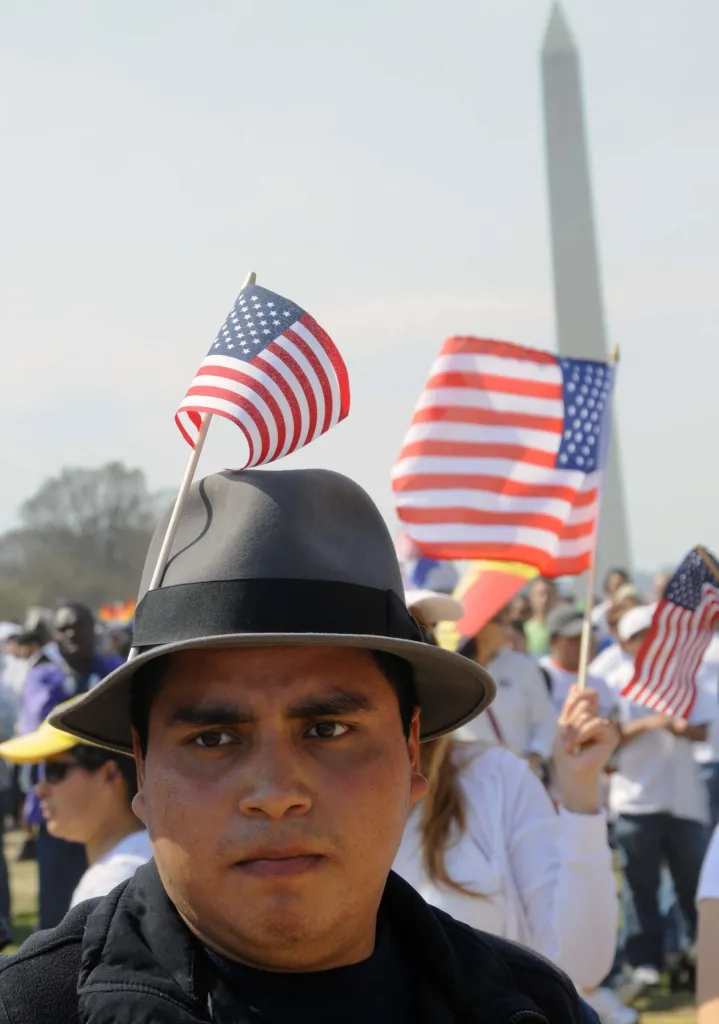
Photo caption. Mass mobilization for immigrant rights in Washington DC. May 2010, foto: Bill Hackwell.
Since taking office in 2024, the current administration has implemented a series of policies that restrict and persecute immigration. More than 622,000 undocumented immigrants have been swept up and deported from the US since Donald Trump returned to the White House on January 20.
Among the measures implemented are the cancellation of the CBP One app for asylum seekers; the end of humanitarian programs (CHNV); the deployment of military troops in cities and at the border; the expansion of detention centers; and the use of the Alien Enemies Act for deportations without a hearing.
A step with a major negative impact on the intensification of his anti-immigrant policy was the implementation of Proclamation 10949, an expansion of travel restrictions that establishes selective demographic exclusion and wiped out the principle of family reunification with a stroke of the pen.
Added to all these draconian measures are the operations launched by the US government in several cities, whose stated objective is the detention and deportation of immigrants with “criminal records,” aimed at the mass apprehension of migrants from Central and South America.
This is nothing new; endemic racism, inherent in the culture of that nation, has reaped its harvest of hatred throughout most of its history. Thus, during the 18th and 19th centuries, the Naturalization Act of 1790 was enacted, establishing citizenship only for “free white persons”; and in 1882, the Chinese Exclusion Act was proclaimed, the first legislation prohibiting immigration based on nationality/race.
The Immigration Act of 1924 (Johnson-Reed Act) established a quota system based on national origin to favor the entry of Europeans from the north and west; and in 1930, they implemented the “Mexican Repatriation,” which allowed for mass deportations that included U.S. citizens.
In the 21st century, the criminalization of immigrants and asylum seekers, the use of narratives of “invasion” and threats to U.S. security have resulted in numerous human rights violations in centers where victims of raids and arbitrary detentions are held.
The coexistence of the “nation of immigrants” discourse with exclusionary policies may sometimes seem contradictory, but if we analyze the structural and historical factors, we may be able to “understand.”
Since its inception, U.S. citizenship has been legally linked to race, and the category of “white” has been used as a tool to grant privileges and include or exclude groups according to economic and political convenience, for example, Native Americans.
Currently this is fueled by the non stop racist diatribe emanating from the White House that defies the reality of the integration of immigrant groups, who have not just been accepted but have become important productive communities into cities. The all-out attack byTrump on the Somali community in Minneapolis and the Haitian community in Springfield Ohio are just two of the most glaring examples.
The rhetoric that describes immigrants as a threat to the “blood” or culture of the country repeats this historical pattern. It is a narrative that diverts attention from structural causes such as the concentration of wealth and corporate policies laden with privileges.