
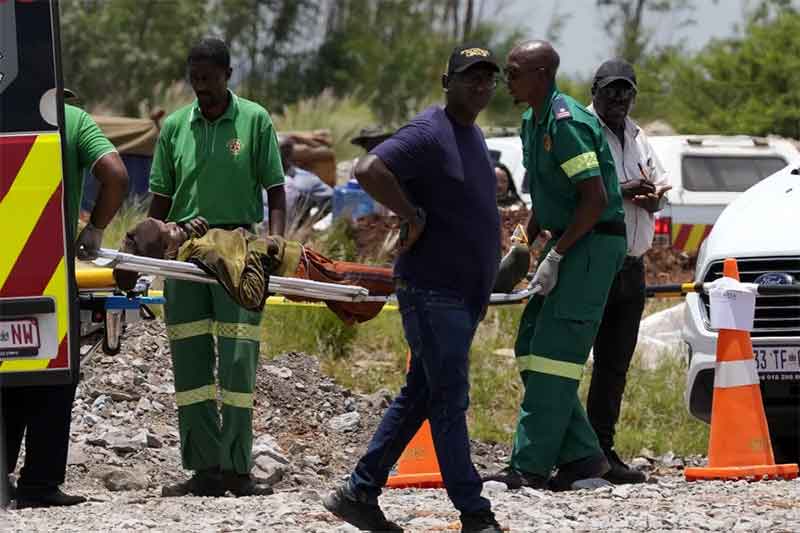
Photo caption. A miner is transported on a stretcher by rescue workers after he was rescued from below ground in an abandoned gold mine in Stilfontein, South Africa. Themba Hadebe/AP
JOHANNESBURG – This week, policymakers and industry executives gathered in Cape Town for the annual African Mining Indaba. They will follow a familiar script: governments will court investors, companies will promise jobs and growth, and champagne will flow as speakers tout Africa as indispensable to the global energy transition.
As always, the emphasis will be on new projects, fresh capital, and untapped opportunities, with no mention of how these ventures tend to end. But in mining, endings matter more than beginnings, because they reveal where power truly lies.
As the clean-energy transition gathers pace, the question of how mining projects end has taken on new urgency. The global race for critical minerals is often framed as a technical challenge: How quickly can fossil fuels be replaced without destabilizing supply chains? But the more fundamental issue is who bears the costs of extraction.
For transnational mining corporations, exit has become the most decisive and least regulated phase of value capture. By selling assets, restructuring operations, and relocating headquarters, they are able to shed social, environmental, and fiscal liabilities with impunity.
South Africa offers a striking example. Anglo American, founded in 1917, has long been the country’s dominant mining company, shaping labor systems, settlement patterns, and infrastructure for more than a century. Yet as the company has streamlined its global portfolio in recent years, its domestic footprint has shrunk rapidly. Between 2021 and 2024, its South African workforce fell by more than 20%, from roughly 41,000 to 32,000. Over the same period, its tax and royalty payments plummeted 81%, from approximately R41 billion ($2.5 billion) to R7.8 billion.
It may be tempting to explain these figures as a reflection of market cycles or the unavoidable costs of transition, but they point to a deeper structural problem: capital is mobile, but accountability is not.
When mining companies exit a country, the costs do not disappear; they are transferred to local communities. Mining towns lose their tax base, municipalities struggle to maintain essential infrastructure, and environmental damage goes unaddressed. In the South African province of Mpumalanga, ravaged by decades of extraction, hundreds of mines sit abandoned or inadequately rehabilitated. Between 2011 and 2016, authorities issued only six mine closure certificates, the formal confirmation that rehabilitation has been completed. Meanwhile, acid mine drainage continues to contaminate water systems.
The human costs are equally stark. In Kriel, a mining town in Mpumalanga, more than 200 residents were forcibly evicted in 2025 after a mine changed hands and employment-linked housing was abruptly terminated. What had been presented as a path to work and stability ended in homelessness, legal uncertainty, and social rupture.
Kriel is not an outlier. Across South Africa, mining companies have generated tens of billions of dollars in profits while delivering only negligible benefits to host communities. Astonishingly, a large share of the funds earmarked for local development has never been delivered or cannot be accounted for.
Defenders of the current system often claim that tougher regulation would drive investors away, and that African governments, facing high unemployment and rising debt, cannot afford to scare off foreign capital. This argument deserves to be taken seriously, but it relies on a false premise.
South Africa’s problem is not that entry conditions for multinational companies are extremely onerous. On the contrary, mining law does not require companies to obtain the consent of affected communities, merely “consult” them, and enforcement of social and environmental rules remains weak. Canada, by contrast, imposes stricter requirements for mine closures and routinely conducts public-interest reviews of major corporate restructurings, yet continues to attract international investors.
The problem is not regulation, but a global governance gap. While multinational corporations can move profits, assets, and legal domiciles across national borders with ease, the enforcement of environmental, social, and human-rights protections remains confined within them.
This asymmetry is obvious at the African Mining Indaba. Governments, many of them under fiscal pressure, compete to attract foreign investment, while mining companies retain the ultimate leverage: the option to leave. The imbalance is the result of a system that overwhelmingly favors shareholder interests and treats corporate exit as a business decision, rather than a public concern.
Alarmingly, the same logic is now being extended to the clean-energy transition. With demand for platinum, lithium, copper, and cobalt expected to surge over the coming decades, Africa is poised to become a major supplier of the minerals required for decarbonization.
National reforms are necessary but insufficient. Domestic law alone cannot resolve a problem rooted in transnational power imbalances. This is why the long-stalled negotiations toward a binding international treaty on business and human rights are so consequential.
Without reliable accountability mechanisms, the clean-energy transition will be neither just nor sustainable. Instead, it will leave behind a trail of abandoned mines, hollowed-out municipalities, contaminated water sources, and displaced families.
The African Mining Indaba prides itself on shaping the continent’s resource future. But that claim rings hollow if the conversation stops at celebratory announcements of new beginnings and avoids what happens after projects wind down. When they do, someone always pays. The question is whether the costs will continue to fall on those with nowhere else to go.