
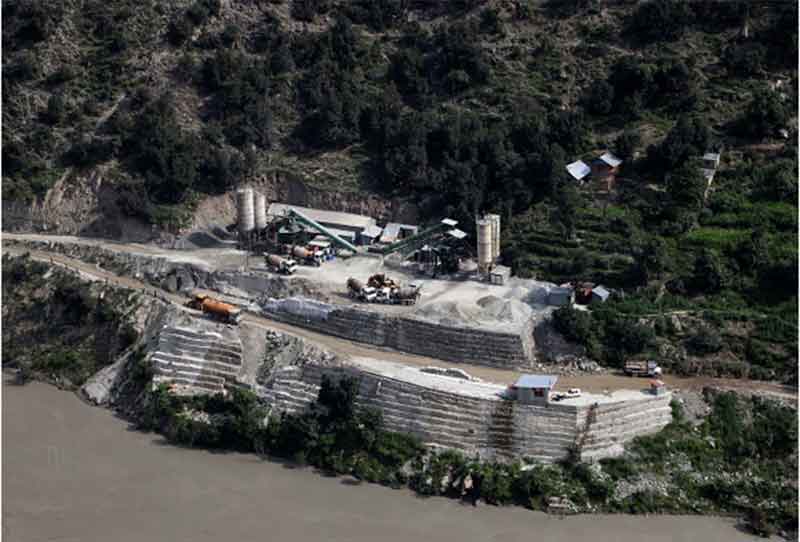
A recent report in Foreign Policy has cast renewed international attention on the accelerating pace of hydropower construction along the Chenab River, portraying a landscape where concrete expansion is outpacing ecological caution and social safeguards. What is officially framed as a clean energy transition is, on the ground, unfolding as a sweeping territorial transformation reshaping fragile mountain ecosystem, displacing communities, and embedding river governance within the charged arena of regional geopolitics.
In the Chenab valley, blasting for tunnels and dam foundations has reportedly cracked homes, destabilized slopes, and filled once-quiet villages with dust and uncertainty. Springs that sustained subsistence farming systems for generations are said to be weakening, with some local estimates suggesting declines in flow of nearly 30%. In a mountainous watershed already stressed by erratic monsoons and glacial retreat, such hydrological shifts carry consequences far beyond individual hamlets. Springs are not merely water sources; they anchor local agriculture, recharge groundwater, and sustain micro-ecosystems that underpin rural life. When they falter, entire socio-ecological systems wobble.
Seven hydropower projects are currently advancing along the river corridor, with thousands of residents reportedly affected by land acquisition, forest clearance, and altered access to natural resources. While many of the schemes are described as “run-of-the-river,” their cumulative footprint is proving anything but minimal. Clustered infrastructure—diversion tunnels, access roads, substations, and transmission lines—has fragmented forests and submerged farmland. The result is a patchwork of ecological disruption that extends beyond any single project’s blueprint. Run-of-the-river in name does not always translate into low-impact in practice when multiplied across a confined valley.
The strategic implications of this upstream engineering cannot be divorced from the legal framework governing the basin. The Indus Waters Treaty was designed to provide predictability and structured cooperation between India and Pakistan over shared rivers. Its durability has long been cited as a rare example of sustained water diplomacy in a conflict-prone region. Yet as storage-capable infrastructure expands—most notably through projects such as the Baglihar Dam questions arise over how flow timing and seasonal release patterns might influence downstream stability.
Technically, the treaty permits certain forms of hydropower development. Politically, however, infrastructure that enables greater control over river timing introduces a new layer of sensitivity. In a climate-stressed Himalayan basin, even modest alterations in storage or release schedules can cascade into amplified drought exposure or flood risk downstream. Sediment flows may shift, aquatic biodiversity may decline, and agricultural calendars dependent on predictable water rhythms may falter. When upstream control acquires strategic overtones, basin trust becomes fragile.
This convergence of infrastructure and statecraft is perhaps the most consequential dimension of the Chenab’s transformation. Hydropower corridors are not merely engineering projects; they are governed spaces where energy generation, territorial authority, and security considerations increasingly intersect. Control over flow timing can translate into leverage, whether intended or perceived. In a region where political relations are often strained, perception alone can heighten insecurity.
The social dimension is equally profound. Displacement from dam construction is not simply spatial relocation; it is structural disruption. Families dependent on forest-based livelihoods or smallholder agriculture find themselves transitioning into precarious wage economies. Traditional knowledge systems tied to river cycles erode. Young people migrate toward urban centers in search of work, fracturing community cohesion. The valley’s transformation thus reverberates through demographic patterns, labor markets, and cultural continuity.
Proponents of hydropower emphasize its renewable credentials in an era of global decarbonization. Indeed, transitioning away from fossil fuels is imperative. Yet climate resilience cannot be achieved by overlooking localized ecological fragility. In earthquake-prone Himalayan terrain, mega-infrastructure raises additional safety concerns. Reservoir-induced seismicity, slope destabilization, and the risks associated with extreme rainfall events in a warming atmosphere must be factored into long-term planning. Green energy that disregards cumulative ecological thresholds risks becoming environmentally paradoxical.
The Chenab case underscores a broader truth about transboundary rivers: they are lifelines, not instruments of leverage. Millions depend on the Indus basin system for irrigation, drinking water, and livelihoods. Stability in such basin’s rests on transparency, data sharing, and strict adherence to treaty obligations. When development decisions appear unilateral or opaque, they can erode confidence even if technically compliant.
Ultimately, the debate unfolding along the Chenab is not a binary contest between development and stagnation. It is a question of balance between energy needs and ecological integrity, between sovereign rights and shared responsibilities, between engineering ambition and long-term resilience. The international spotlight, amplified by reporting in outlets such as Foreign Policy, highlights that infrastructure choices in sensitive basins reverberate far beyond construction sites.
In an era defined by climate uncertainty and intensifying resource pressures, predictable and cooperative water governance is indispensable. Hydropower, when carefully calibrated, can contribute to sustainable growth. But when clustered without adequate ecological assessment or diplomatic reassurance, it risks deepening mistrust and destabilizing already fragile socio-ecological systems. The Chenab’s future, therefore, will not be determined solely by turbines and spillways, but by whether regional actors prioritize transparency, environmental stewardship, and the shared security of the basin’s millions.