
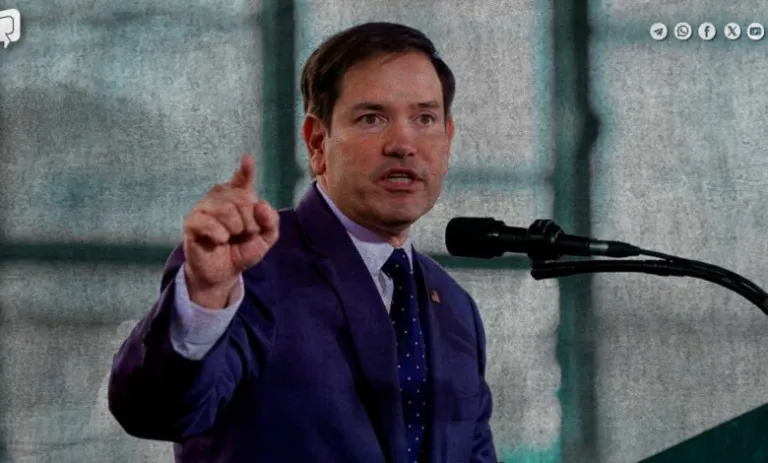
The US official asserts that “Cuba needs to change” and that Cubans require “economic freedom.” However, his narrative omits key facts about the social achievements of the Revolution and Washington’s responsibility for the current difficulties.
Recently, US Secretary of State Marco Rubio issued a statement that deserves in-depth analysis:
“Cuba needs to change, and it doesn’t have to change all at once. One of the demands of the United States is economic change in Cuba. Cubans need economic freedom.”
Sounds nice, right? But behind those words lies a history that Rubio prefers to ignore. Let’s ask the uncomfortable questions: What kind of economic changes is he referring to exactly? And what would happen to the island’s social achievements if those changes were implemented?
Free, quality education: also on the list of “changes”?
Rubio fails to mention that his own parents left Cuba in 1956, fleeing the difficult situation the country was going through under the capitalist system that some in Miami long for so much.
Let’s talk about the facts: Cubans who emigrate today have between 9 and 12 years of schooling, many with technical or university degrees. Why? Because education in Cuba is free from preschool through university.
UNESCO ranks Cuba among the top 16 countries in the world for its educational development index. It is the Latin American and Caribbean nation that allocates the highest percentage of its budget to education. Is this educational model among the changes Marco Rubio dreams of?
Public health: business vs. rights
Before 1959, health care in Cuba was big business. Just like in the United States today. But the Revolution changed the rules:
- Universal and free coverage throughout the island, including mountainous areas.
- Vaccination program that prevents 15 diseases.
- Eradicated diseases: malaria, polio, diphtheria, measles, rubella…
- Controlled HIV and free medication for patients.
During the COVID-19 pandemic, Cuba developed three vaccine candidates thanks to scientists trained under socialism. While private pharmaceutical companies were doing business, the island was saving lives.
If the socialist system were to change, healthcare would once again become private. Community clinics would disappear. Millions of Cubans would lose free access to doctors and hospitals.
Would Rubio leave these health achievements intact?
The Cuba that Rubio does not know (or prefers not to remember)
The Secretary of State should read the results of a survey conducted in 1957 by young Catholics on the standard of living of Cuban agricultural workers. The data is chilling:
- Widespread tuberculosis and typhoid fever.
- Intestinal infections and amoebic dysentery.
- Necator americanus: a parasite acquired by walking barefoot on the ground. The cause? Poverty prevented people from buying shoes.
All of this was eliminated by the Revolution. But today, the U.S. economic war—intensified by 244 sanctions imposed by Trump in 2019—is creating shortages that would not exist without the blockade.
Economic freedom or recolonization?
Marco Rubio talks about “economic freedom,” but his track record shows otherwise. He has pressured countries that hire Cuban doctors to cut off that vital income to the island. He has threatened tourism companies, international banks, hotels, and even Cuban rum brands.
Is that caring about human rights?
In 1960, Lester Mallory, deputy secretary of state, wrote a chilling memo:
“The only foreseeable means of alienating internal support for the Revolution is through disenchantment based on economic hardship. Any means should be used to weaken the economic life of Cuba; to deny it money and supplies, to cause hunger, desperation, and the overthrow of the government.”
That strategy is still in place. The hardships of the Cuban people are not the fault of socialism, but of eight laws that make up the economic war, 244 sanctions imposed by Trump, and the inclusion of Cuba on the list of state sponsors of terrorism.
The master plan according to the CIA
Rubio is applying to the letter the strategy that Allen Dulles, director of the CIA in the 1950s, designed against the USSR:
“By sowing chaos without being noticed, we will replace their values with false ones… Our main focus will be on youth. We will corrupt, demoralize, and pervert them. We must ensure that those who are attacked welcome us with open arms.”
Today, that same recipe is being applied in Cuba through social media: creating the opinion matrix that the difficulties are the fault of the socialist system, hiding the blockade and sanctions.
The truth, according to Martí
Cuban socialism is not without its mistakes. It is changing to make its economy more viable. But it faces a relentless siege designed precisely to prevent those changes and blame it for the problems.
Cubans know the truth. And that is why, as José Martí said:
“The homeland is sacred, and those who love it selflessly and tirelessly owe it the whole truth.”