
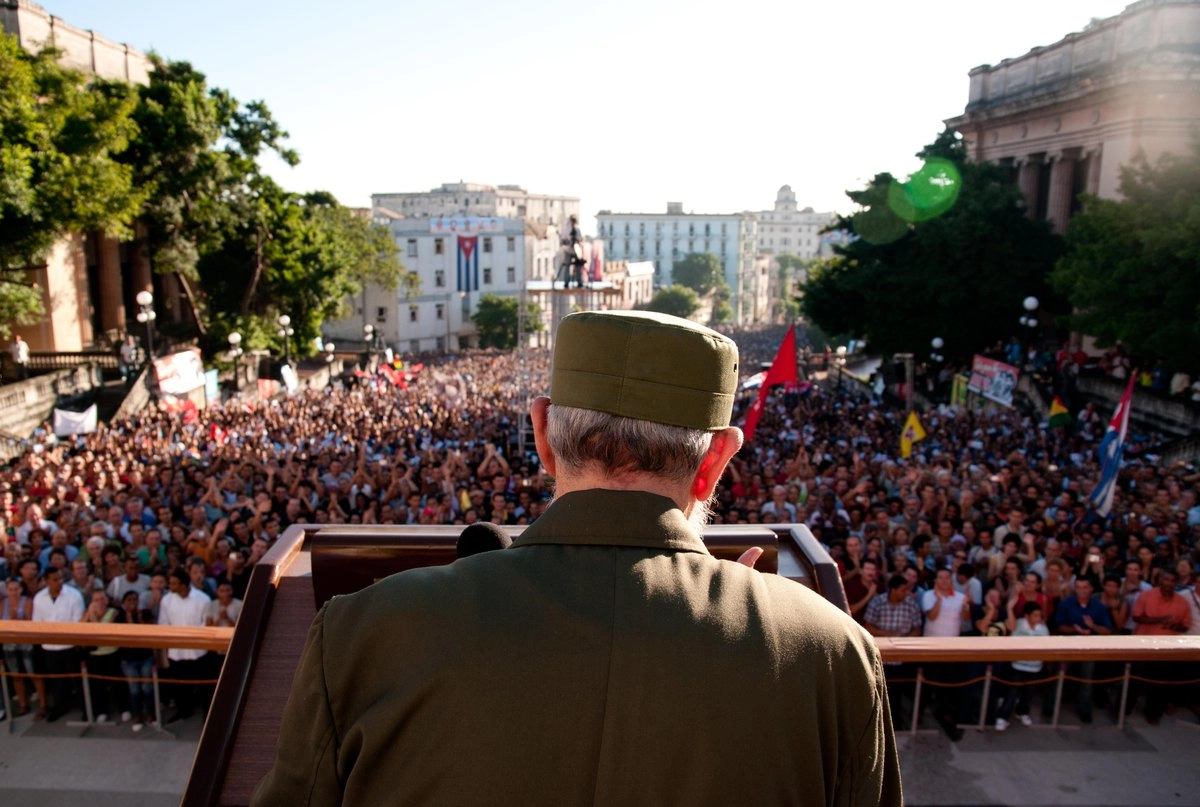
Photo caption. Cuban Revolution leader Fidel Castro delivering a speech to students at the University of Havana in 2015. Photo: Roberto Chile/Cubadebate
During the invasion of Cuba at Playa Girón, the attackers’ air force had around 30 aircraft, including B-26 bombers and C-46 and C-54 transport planes used to drop paratroopers and provide logistical support for the landing. On the Cuban side, in April 1961, the revolutionary air force could barely muster eight operational aircraft: a few Sea Fury fighters, a couple of T-33 jets, and a handful of B-26s recovered after the fall of Fulgencio Batista’s dictatorship. The disparity was enormous, and yet in less than 72 hours, those eight aircraft proved decisive in breaking through enemy defenses and striking a blow to the invasion’s logistics.
“The CIA believed, as always, the reports of its rogue local spies, who are paid to say what they want to hear, and, as always, confused geography with a military map that was alien to the people and history,” Eduardo Galeano would write about those days in April 1961.
It is worth remembering this story because its political significance remains relevant today. The mercenaries, backed by the CIA, would land with clear material superiority. Their plan was to destroy the Cuban air force on the ground, secure control of the airspace, and protect the beachhead until a provisional government could be established that would request direct intervention by the United States. But the plan failed at a crucial point.
A few surviving aircraft and Fidel Castro’s brilliant political and military leadership, backed by the mobilization of the Cuban people, were enough to alter the course of the offensive. The lesson of Girón is not that Cuba had more aircraft or more resources: it is exactly the opposite. A state under attack managed to identify the vulnerable point of the enemy’s operation and strike it quickly.
Eight aircraft were enough to thwart the plan designed in Washington because they turned the adversary’s apparent military advantage into a strategic vulnerability. Sixty-five years later, the context is different, but the underlying logic has not disappeared.
In recent weeks, Donald Trump has once again placed Cuba at the center of his rhetoric, insinuating that the island will eventually “fall” and suggesting the possibility of an agreement or even some form of “control” over the country. His words are part of a policy of coercion that combines economic sanctions, information warfare, and political threats at a particularly difficult time for the Cuban economy.
It would be naive to interpret this discourse as the immediate prelude to a military invasion in the style of 1961. The contemporary scenario is more complex. Today, the forms of pressure mainly involve strangling Cuban society and expecting that internal attrition will eventually lead to political capitulation. We are not dealing with simple external pressure, but with a logic of punishment that relies on social suffering as a tool to force surrender.
However, the history of Girón helps us understand why this goal is not so simple either. The Cuban question has never been exclusively a military problem, but above all a political one. Even in 1961, when the United States had overwhelming material superiority, the operation failed because it did not manage to break the Cuban state’s capacity for resistance or provoke the internal fracture it had hoped for.
The invasion did not encounter the popular uprising that the CIA and its local agents had imagined, and once logistics and air cover were lost, Washington’s strategy collapsed. Everything indicates that Trump’s pressure will continue and may intensify. But historical experience suggests that the decisive issue is not the material strength of the adversary, but a country’s ability to prevent that strength from translating into political dominance. Girón showed that even an operation prepared for months and backed by the greatest power on the planet could fail if it encountered organized resistance and political leadership capable of sustaining it.
Today’s threats operate in a different arena, but they face the same fundamental dilemma: it is one thing to exert pressure and quite another to transform that pressure into real control over a country that has repeatedly demonstrated its ability to resist. Girón taught that even the most obvious disproportion can be reversed when the aggressor’s political objective becomes unviable. And that lesson, more than six decades later, continues to weigh heavily on any calculation that seeks to decide Cuba’s fate from outside.