
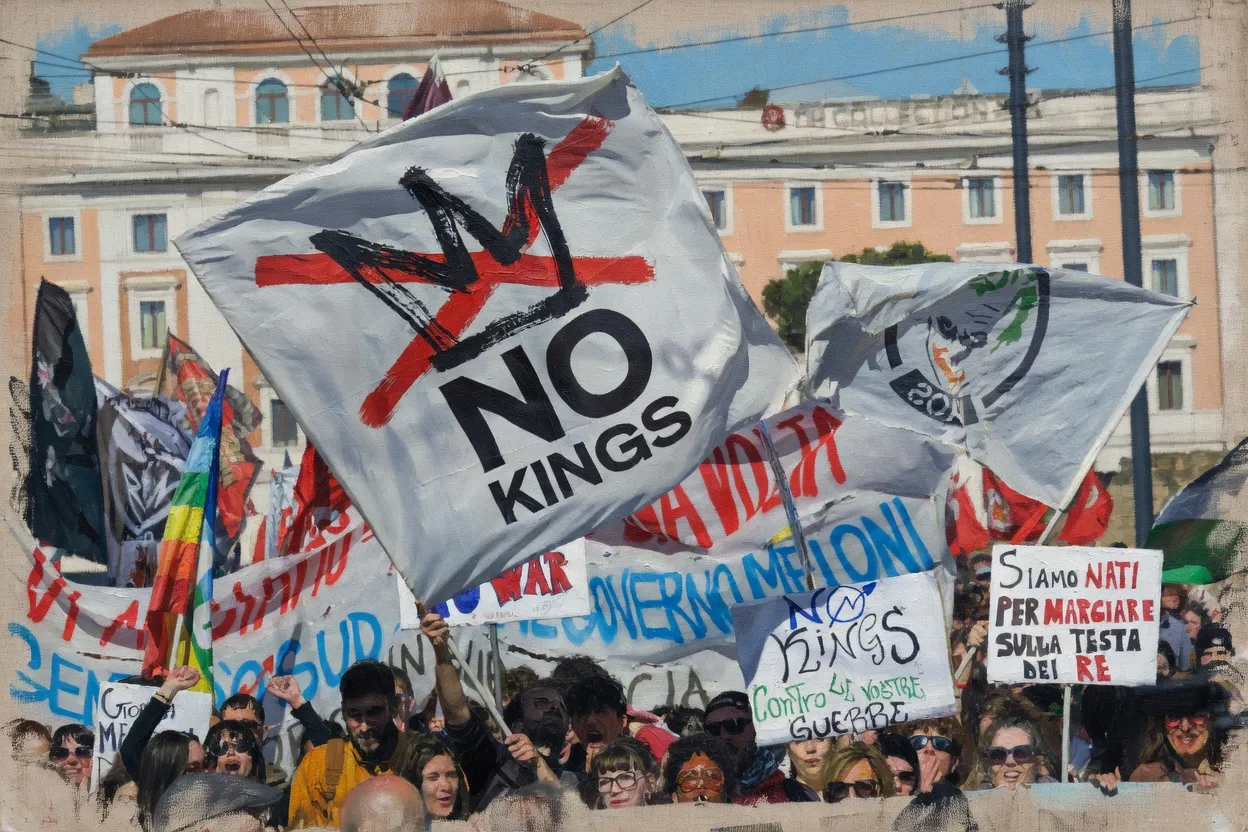
You’ve seen the posts. Maybe you’ve written one yourself.
“This is just a pressure valve for suburban liberals. They’ll march, feel righteous, go home, and change nothing. We need sustained civil disobedience, strikes, and direct action — not pep rallies.”
“Where are the demands? ‘No Kings’ isn’t a platform. It’s a bumper sticker for people who want to feel like they’re resisting without actually challenging anything.”
“These protests are a Dem party psyop to get us to vote blue and nothing more.”
These critiques come from people who consider themselves more radical than the average protester. They carry a tone of world-weary sophistication. The implication being that those who show up are naive, and those who stay home see the bigger picture.
Here’s the problem: this attitude is strategically illiterate. It mistakes cynicism for analysis. And it guarantees the one outcome its proponents claim to fear most: a movement that never escalates beyond what it already is.
An organizer looks at a mass protest and sees something completely different.
Where the cynic sees a feel-good spectacle, the organizer sees thousands of people ready to get involved — a chance to connect them with local groups, deepen their engagement, and build the relationships that every form of deeper resistance depends on.
I get the weariness. You’ve seen massive turnout before and then watched the thing everyone was protesting happen anyway. But the conclusion people draw from it — that mass protests don’t work — confuses one stage of a process for the whole strategy.
Protests rarely achieve their maximalist demands on their own. But they do things nothing else can: they shift public discourse (Occupy didn’t break up the banks, but the language of the “99%” permanently changed how Americans talk about inequality), they energize waves of downstream organizing (the Women’s March fed directly into the candidate recruitment and voter mobilization that flipped the House in 2018), they build relationships between people and groups who might never have connected otherwise, and they make visible the scale of opposition in a way that no online petition or social media post ever will.
The valid critique is that a march disconnected from sustained organizing, clear demands, and escalation strategies can dissipate without leaving much behind. But that’s an argument for doing the harder work of connecting protest energy to lasting structures — not for staying home.
Jonathan Matthew Smucker, a lifelong organizer and author of Hegemony How-To: A Roadmap for Radicals, draws a useful distinction between mobilizing and organizing. Mobilizing gets people into the streets. Organizing plugs those people into ongoing structures — local groups, campaigns, direct action networks — that build sustained power over time. The two are not in tension. Mobilizing creates the conditions organizing depends on. You can’t recruit people into deeper resistance if they never show up in the first place.
The radical’s job at a mass protest isn’t to stand on the sidelines and sneer. It’s to be there with clipboards, with flyers for local organizations, with QR codes for upcoming actions, with conversations that move the newly-activated toward more committed forms of engagement.
You recruit. You bring sign-up sheets for your local group — whether that’s DSA, your tenants’ union, a mutual aid network, or an independent organizing project. You hand out flyers with specific calls to action: a city council meeting next Tuesday, a canvassing drive this weekend, a training for civil disobedience next month. You talk to people who are fired up and give them somewhere to direct that energy.
You build relationships across groups. Protests bring together dozens of organizations that might otherwise never share a room. Labor unions march alongside climate groups. Immigrant rights organizations find common cause with anti-war activists. An organizer uses that proximity to connect — to meet people from other organizations, find out what they’re working on, offer support, and look for common cause. These lateral connections across issue silos are how coalitions form.
You push the demands further. If you think the protest’s messaging isn’t radical enough, that’s an argument for showing up with bolder demands, not for staying home. Bring your own signs. Hand out your own literature. Rally people around the demands you think are missing. A mass protest is an open forum. The more often people see people promoting more radical demands, the more it normalizes them, and that exposure only happens if folks like yourself are in the crowd making the case.
You normalize dissent. When we see millions of people flooding the streets in Hong Kong, or South Korea, or Iran — do we dismiss those protests as “pep rallies”? Do we sneer at them for not immediately toppling their governments? Of course not. We recognize them as signs of a society in motion, as evidence of courage and collective will, as the essential precondition for political transformation. It’s strange how quickly that recognition evaporates when it’s our own country’s streets filling up. Large-scale participation signals to elites, to the media, and to fence-sitters that the political landscape is shifting.
You escalate from a position of strength. Civil disobedience, strikes, occupations, and other forms of escalation are most effective when they emerge from a mass base. A hundred people blocking a highway is easily dismissed and arrested. A hundred thousand people whose support network includes the hundred who are willing to get arrested — that creates a political crisis. The broad base provides the legitimacy and the material support (bail funds, legal observers, public pressure) that make escalation sustainable rather than suicidal.
Major social transformations didn’t happen because a small cadre of militants targeted capital while everyone else stayed home. They happened because mass participation created the conditions in which more militant tactics could succeed.
The U.S. civil rights movement illustrates this at every stage. The lunch counter sit-ins escalated into a national crisis because they spread to dozens of cities and involved thousands of participants, the vast majority of whom engaged in what the cynic would dismiss as “mere” nonviolent protest. The March on Washington — the ultimate “pep rally” by the cynic’s logic — was a crucial inflection point that built political pressure for the Civil Rights Act. The Freedom Rides worked because they combined direct action with a mass base of support that made it politically impossible for the federal government to look away.
A movement that shrinks to a militant core loses its legitimacy with the broader public, its ability to sustain pressure over time, and its leverage over the institutions it’s trying to change. A hundred radicals willing to get arrested have far more power when they are backed by a million people who showed up peacefully than when they stand alone. The mass base is the soil in which escalation can actually take root.
One of the more sophisticated-sounding critiques is that protests function as a “pressure valve” — that they release anger that might otherwise fuel more radical action, allowing people to go home feeling like they’ve done their part.
There’s a grain of truth here, but only if organizers fail to do their job.
A protest that ends with no next steps, no local groups to join, no escalation pathway — that can become a dead end. But that’s an argument for better organizing at protests, not for boycotting them.
The No Kings movement has been learning this lesson in real time. After the first event in June 2025, Austin organizer Salvador Espinoza noted the feeling that organizers “could have done more to push rallygoers toward the next step of getting more deeply involved.” So they adapted. Subsequent No Kings events have been structured to connect participants to local organizations, offer volunteer sign-ups, and provide on-ramps to sustained engagement. Indivisible chapters report surges in volunteers after every major action.
The pressure valve theory assumes that protest releases energy. But anyone who’s been in a crowd of thousands knows the opposite is true. People leave a mass action more fired up than when they arrived, not less. The question is whether organizers give them somewhere to take that energy on Monday morning.
Another common dismissal: mass protests organized by groups like Indivisible or MoveOn are essentially a Democratic Party operation, and the whole thing exists to channel dissent into voting blue and nothing more.
Let’s be honest about what’s true. The main national organizers of movements like No Kings are progressive organizations with institutional ties to the Democratic Party ecosystem. That’s not a secret. But the coalitions marching under these banners are broader than the cynics assume — labor unions, immigrant rights organizations, anti-war groups, religious communities, and hundreds of local organizations with no party loyalty. This is a broad and sometimes contradictory coalition, which is exactly what a mass movement looks like.
But the concern that this energy gets captured and funneled exclusively toward “vote blue” without building independent power structures?
That’s a real and historically grounded concern, and the answer to that risk is to show up and make sure the energy doesn’t get captured — to be the people in the crowd handing out literature for DSA, for tenant unions, for strike funds, for anti-war groups, for organizations that will keep pushing regardless of who’s in office. If radicals cede this space because they think it’s too liberal, they guarantee the outcome they’re worried about.
Many groups are already modeling this. Left Voice, for example, is calling on socialists to show up at No Kings in force — while campaigning for demands that go far beyond the official platform: abolish ICE, full rights for all immigrants, end the war on Iran. They’re not boycotting because the event isn’t radical enough. They’re using the largest mobilization available to advance a more radical agenda. That’s the “yes, and” approach in practice.
And here’s the harder question: if No Kings isn’t radical enough, where is the radical alternative? Where is the mass organization with national visibility building toward something bolder? Nobody is stopping us from building something more radical. But other people showed up and did the work to turn out millions. Scoffing at what they built while offering no alternative is just inaction with an alibi. At the very least, show up, use the momentum they created, and recruit for the deeper work you say needs to happen.
Michael Albert put this contradiction plainly: if you say the movement needs more than mobilization — it needs civil disobedience, strikes, and concrete demands — but your response to that analysis is to stay home and disparage those who do show up, you have chosen to do less in the name of wanting more. You have not advanced the cause of deeper resistance. You have subtracted yourself from it.
Whether you stay home because you don’t care or because you consider yourself too radical for a march, the effect is the same: one fewer body in the streets, one fewer potential connection to a local group, one fewer person who might have been the link between a newcomer and their first direct action.
As Albert writes: “Just ask yourself, if Saturday is bigger than last time, isn’t that positive? If Saturday is smaller than last time, isn’t that negative?” If your framework can’t give a clear answer to those questions, your framework has a problem.
An organizer looks to meet people where they’re at and build from where we are. Their aim is to make the most of any mass gathering, whatever shortcomings they may have.
As Michael Albert writes:
“To retain and grow numbers, to keep shifting the overall public leftward, and to add to that leftward shift components that are compatibly more militant and more disobedient while maintaining on-going growth is a road to Trump’s collapse, to war’s decline, to saving the planet and then on from there.
The radical’s task, the revolutionary’s task, is not to disparage millions turning out but to support millions turning out. It is to function in ways compatible with millions. It is to function in ways that broaden the strength, diversity, and focus of millions without driving their numbers down.
No Kings is historically good at mobilizing. Radicals and revolutionaries need to be historically good at compatibly organizing.”
That’s the organizer’s mindset. It always has been.