
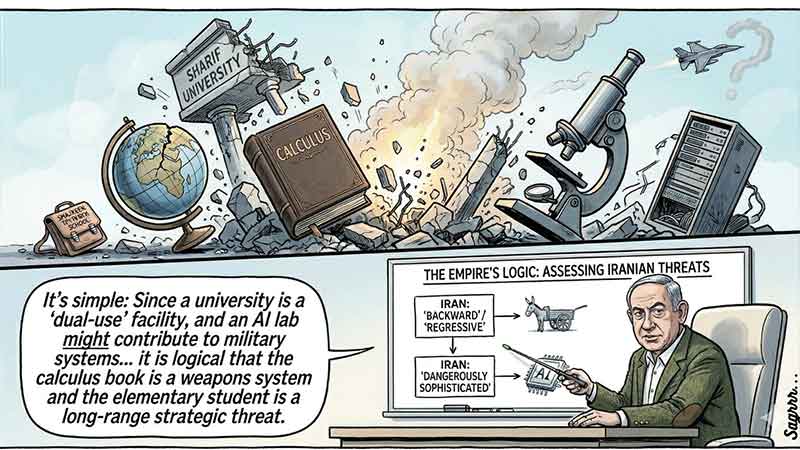
On 6th April US and Israeli fighter jets sliced through the sky above Tehran, not to strike missile silos or military convoys, but a university campus with laboratories, lecture halls, a mosque, and an AI research centre. Sharif University of Technology, often called the “MIT of Iran,” was reduced to rubble in the attack.
This strike, alongside the reported systematic degradation of over 30 other Iranian universities, 763 schools nationwide and the prior levelling of educational institutions in Gaza, reveals a diabolical shift in the strategy of the “Enlightened West.” It is no longer enough to contain a rival militarily or economically; the new front is the total erasure of their capacity to read, write, think, innovate, and compete.
The justification, when offered, tends to follow a familiar script and the logic borders on the psychotic. A university is not merely a university; it is a “dual-use” facility. A physics department might someday produce a weapons designer. An AI lab might contribute to military systems. A chemistry lab might become something darker. Therefore so the argument goes the institution itself becomes a legitimate target.
If the mere potential for an Iranian student to use mathematics for a weapon justifies their elimination, then the logic of the empire demands the slaughter of every Iranian child with a high IQ.
Perhaps that is exactly what we are witnessing. When a school is bombed and over 170 girl students are killed at the very start of a conflict, it isn’t a “mistake.” It is a demographic and intellectual culling. It is the realization that a girl who learns calculus in Tehran today is a woman who disrupts the technological hegemony of the West tomorrow.
This is a perverse form of reasoning. It treats knowledge not as a universal human endeavour, but as a latent threat when possessed by the “wrong” people. It is not the existence of knowledge that is dangerous, but its distribution.
There is a second, deeper contradiction at play, that borders on the grotesque. On the one hand, Iran is frequently described in Western discourse as “backward,” “regressive,” governed by a clerical establishment hostile to modernity. On the other hand, its universities are treated as sites of dangerous sophistication – places where cutting-edge research in engineering, artificial intelligence, and science could pose a threat.
If the Iranian leadership were truly the Luddites the Western media portrays them to be, they would be no threat. One does not bomb a country because its leaders are “backward”; one bombs a country because its students are too forward-thinking.
The reality is that Iran has, for decades, invested heavily in higher education. Its universities produce engineers, scientists, and researchers at scale. Female literacy rates are remarkably high – indeed, by some measures, near-universal. Women constitute a significant proportion of university students in many disciplines.
This does not neatly fit the caricature.
And so the contradiction must be managed. Iran must be portrayed as backward enough to justify Western intervention, yet advanced enough to justify fear. Its people must be depicted as oppressed, yet its intellectuals as dangerous. Its society must be both pitied and policed.
The result is a narrative that collapses under its own weight.
None of this is new. The fear of knowledge in the hands of the “other” is as old as empire itself. The Roman Empire tightly controlled the spread of certain forms of learning among its provinces. Colonial regimes across Asia and Africa established education systems designed not to empower, but to produce clerks – useful, but not threatening. The British in India famously debated how much education was “too much” for the colonized population. Knowledge was to be rationed.
Perhaps the most infamous example is that of Nazi Germany. The book burnings of the 1930s were not random acts of vandalism; they were deliberate attempts to purify intellectual life, to eliminate ideas deemed dangerous. Universities were purged. Scholars were exiled. Entire disciplines were reshaped to serve ideology.
The target was not just books, but the very possibility of independent thought.
There is a grim continuity here. When power feels secure, it celebrates knowledge. When it feels threatened, it begins to police it.
What distinguishes the present moment is the nature of knowledge itself. We are no longer speaking only of philosophy or literature, but of technologies that have immediate, tangible power: artificial intelligence, nuclear physics, biotechnology.
These fields blur the line between civilian and military applications. A breakthrough in machine learning can improve healthcare or enhance surveillance systems. A nuclear physicist can work on energy or weapons. The ambiguity is real.
But ambiguity does not justify obliteration. If anything, it demands more nuanced engagement, not less. International cooperation, scientific exchange, and regulatory frameworks have historically been the tools used to manage such risks. The global nuclear order, flawed as it is, emerged not from bombing universities, but from treaties, inspections, and diplomacy.
To abandon these mechanisms in favour of force is to replace complexity with bluntness and to pretend that destruction can substitute for understanding.
The targeting of universities in Iran is not without precedent. In Gaza, educational institutions have repeatedly been damaged in cycles of conflict. Schools, universities, libraries and other spaces of learning have been caught in the crossfire. Two decades ago the invasion of Iraq similarly resulted in the destruction of its educational infrastructure and even the looting of its museums by US soldiers.
The pattern is instructive. When a society is already marginalized, its institutions of knowledge become even more vulnerable. And when those institutions are weakened, the society’s ability to recover, to innovate, to participate in global discourse is correspondingly diminished.
It is a form of long-term incapacitation. One does not need to invoke conspiracy to see the effect: a population deprived not just of infrastructure, but of intellectual infrastructure.
At the heart of this lies a deeper anxiety one that is rarely articulated openly.
What if the “Third World” were to become not merely politically assertive, but intellectually competitive? What if countries long relegated to the periphery began to produce world-class research, technologies, and cultural output? What if they ceased to be markets and became rivals?
This is not a hypothetical scenario; it is already happening. Countries across Asia, Africa, and Latin America are investing in education, research, and innovation. The global distribution of knowledge is shifting.
For those accustomed to dominance, this shift can feel destabilizing.
And so the temptation arises not necessarily as a conscious conspiracy, but as a structural impulse to slow it down. To frame knowledge as dangerous when it emerges from the “wrong” places.
What makes all this particularly jarring is the moral language often employed. Actions taken in the name of “security” are framed as necessary, even regrettable. Civilian casualties are described as unintended. The destruction of infrastructure is presented as collateral damage.
But when the infrastructure in question is a university, the language begins to ring hollow.
A university is not a weapons depot. It is a place where ideas are formed, debated, contested. It is where a society thinks about itself and its future. To target it – whether directly or through reckless indifference – is to strike at the possibility of thought itself. And to do so while claiming to defend civilization is an inversion so complete it borders on satire.
If the presence of scientific expertise in a country is grounds for suspicion, then the only “safe” world is one in which such expertise is monopolized. If the potential for misuse justifies pre-emptive destruction, then every school becomes a potential target.
It is a logic that, taken seriously, leads to absurdity and, more dangerously, to atrocity.
Perhaps the most unsettling possibility is this: that the fear is not of weapons or “terror”. The US and Israeli elites are fighting a war on parity. A world in which knowledge is widely distributed is a world in which power is less concentrated. It is a world in which narratives can be challenged, technologies developed independently, and cultural influence diversified.
For those at the centre of existing hierarchies, this can feel like loss. And so the temptation is to frame that loss as danger. It arises from fear of a world in which knowledge is no longer the preserve of a few. It tells us that the battle is not only over territory or ideology, but over who gets to think, to innovate, to imagine.
And that, perhaps, is the most dangerous battlefield of all. As the cruel slaughter of little girls at the Shajareh Tayyebeh School in Minab clearly demonstrated to the entire world.