
It is eight in the morning. Maina Devi stands at a bus stop on the sidewalk beside a large warehouse in Noida’s Phase 2 industrial belt. Her left thumb was wrapped in a fresh bandage. The day before, a wire terminal had punctured through the flesh while she worked at Gurudas Amardas International Private Limited. It is a firm that makes wire harnesses for automobiles and shielded cables for data systems. The pain is severe. But she is waiting for the company bus regardless.
A reporter asked her why she isn’t resting. She answers. She has three children to support. If she missed a single day of work, she would lose 530 rupees. That is the hard arithmetic of her life- brutal, and non-negotiable.
Maina Devi is a migrant from Muradabad. It is 160 kilometres from Noida1, which lies in Gautam Buddha Nagar District of UP, bordering Delhi. Before this job, she worked for two years in garment factories across the road in the Noida hosiery complex. Those factories, she says, paid even less- nine thousand rupees a month. “For two years I stood at the table cutting threads in twelve-hour shifts,” she recalls, “and the company did not increase our wages by even one rupee.” When she worked overtime – three to four hours nearly every day, she says – she was paid twenty-five rupees per hour, in open violation of the law that mandates a minimum of twice the regular wage for overtime. Nobody complained. Because nobody could afford to lose their job, around her, her younger co-workers nod.
Lower wages; twelve-hour work is the norm in Noida factories.
The Factory Republic: The Capital and Labour in Noida
What did happen in Noida’s industrial zone in April 2026? We must first understand what Noida actually is. It is not the glass-tower city of IT parks and expressways that appears on the glossy real estate brochures. But it is the other Noida. The Noida of sheds and sirens, of migrant dormitories stacked six to a dungeon-like room, of factory gates that open at eight and close at nine at night- a rhythmic subjugation that makes the 181-year-old observations of Friedrich Engels on the English working class feel less like history and more like a contemporary report.
Noida- an acronym for the New Okhla Industrial Development Authority- is among the largest planned industrial townships in Asia. Its Special Economic Zone (NSEZ) alone accounted for over 11,000 crore rupees in exports in 2025. Across the broader industrial zone, there are more than ten thousand industrial and service units. They are small-scale establishments employing fewer than a hundred workers each, subcontracted from the factories of Indian and global monopoly corporations, such as TCS, HCL, Microsoft, Samsung, Xiaomi, and a constellation of multinational clothing brands whose labels adorn garments sold on the high streets of Europe and the US. The Noida readymade garment cluster alone, with roughly three thousand export-oriented units, generates between 18-20,000 crore rupees in annual exports. When Covid-19 froze the city in 2020, the Noida Apparel Export Centre wrote to the UP government in desperation, noting that their units needed two lakh workers to resume normal operations. Remember those heart-wrenching pictures? The workers and their families, who had fled on foot across highways and along railway tracks, were trying to get home to the hinterlands of Bihar and Uttar Pradesh during the COVID pandemic period.
There are approximately 20,000 industrial units in Noida and Greater Noida employing about 17 lakh workers.2
The production landscape of Noida spans mobile phones, electronic components, auto parts, IT services, medicines, and, importantly, readymade garments. These are the sinew of India’s manufacturing exports, sewn together by human hands under fluorescent lights, in temperatures that climb above the forties between April and June. Work is outsourced layer by layer, from global brand to Indian conglomerate to sub-contractor to labour contractor, each layer extracting a margin, each layer placing another layer of insulation between the brand and the worker. By the time a production order reaches the shop floor, the workers who fulfil it have no direct employment relationship with the company whose product they make. They are hired on a temporary contract, through a private placement agency, which pockets a percentage of their paltry wages as a service fee.
Naomi Klein demonstrated in her book No Logo, the great corporations of our era have strategically exited production altogether – Nike does not make shoes, Apple does not make phones, Louis Vuitton does not stitch its garments. What they manufacture is the brand, the logo. The commodity is made elsewhere, by someone else, through a chain of contracts so long that legal responsibility dissolves before it reaches the worker. Marx described alienation as the worker’s estrangement from the product of her labour. What Klein documents – and what the Noida factory floor makes viscerally concrete – is a further mutation: the capitalist’s own deliberate self-alienation from production, a designed amnesia about where the thing comes from and whose hands made it.
In organised manufacturing across India, the share of contract workers rose from 38 per cent to 42 per cent between 2019–20 and 2023–242. In Central Public Sector Enterprises, excluding banking and insurance, it rose from 34 per cent to nearly 50 per cent between 2019 and 2025.3 In Noida’s industrial belt, this contractualisation has been total. Nearly all workers in the garment and electronics units are hired on short-term contracts. There is no permanent employment. No union recognition. No collective bargaining. No grievance mechanism. The Minimum Wages Advisory Board in Uttar Pradesh, the body that should have been calling for wage revisions, had been inactive for fourteen years. The Indian Labour Conference, the institutionalised tripartite dialogue between government, employers, and workers, has not met since 2015.
Even among regular wage and salaried workers in non-agricultural sectors, informality remains widespread. In 2025, about 58.2% of workers had no written job contract, while 51.7% were not eligible for any social security benefits. In addition, 47.3% were not eligible for paid leave. This means that a significant section of workers employed in formal establishments is, in practice, informally employed.4
It is as if the capital were a different republic with its own constitution and laws.
Women Workers
In the garment sector, women constitute nearly 60 per cent of the total workforce, according to 2025–26 industry estimates.5 Particular vulnerabilities compound their situation. Supervisors use the threat of dismissal to extract sexual compliance- a systemic issue highlighted by the April 2026 industrial unrest, where workers demanded safer harassment-reporting protocols. Toilet breaks are rationed and timed, a hallmark of the high-pressure production lines. Pregnant workers are often ‘quietly edged out’ to avoid maternity benefit liabilities. Women migrant workers, far from their family networks in Bihar and eastern UP, live in cramped single-gender hostels or shared rented rooms- where a single room costs between five thousand and seven thousand rupees a month in Noida’s industrial zones. This rent consumes forty to sixty per cent of an unskilled worker’s monthly wage, which, before the April 2026 strikes, was officially stagnant at ₹11,313. The rent does not leave room for illness, children’s school fees, or the bus fare home. For Maina Devi, standing from eight in the morning until nine at night- with toilet breaks as the only respite and an injured thumb that cannot be rested because rent is due- is simply the condition of being a woman worker in Noida.” A worker said: “Only our lives are cheap. And everything else is expensive”.
The migrant character of the workforce is phenomenal. Workers come primarily from Bihar and the eastern districts of Uttar Pradesh, regions where agriculture has collapsed into smallholding misery and where industrial jobs do not exist. In the city, they are isolated and have no roots. The contractor knows this. The factory owner knows this. The state knows this.
Rising Prices
The wages they earned before April 2026 ranged between Rs 9000 and 11,013 per month for unskilled work – wages that had not been revised in any meaningful sense since 2012. The Minimum Wages Act mandates revision at least every five years. Uttar Pradesh had flouted this obligation for more than a decade. Meanwhile, the Consumer Price Index for Industrial Workers (CPI-IW) had risen nearly twenty-five per cent between 2021 and 2026 alone. The gap between nominal wages and real purchasing power was not a policy failure- it was an intended policy. The state’s silence was conscious and benefited the factory owners. So, the owners could keep labour costs artificially suppressed while the rest of the economy, including the price of a thali swallowed too many times.
Labour Codes- Legalising the Illegal Practices on the Ground
And then, in November 2025, the Union government notified the four Labour Codes – the Code on Wages, the Industrial Relations Code, the Occupational Safety, Health and Working Conditions Code, and the Code on Social Security – consolidating twenty-nine existing labour laws into four, in a sweeping restructuring of India’s labour regulatory framework, facilitating the Capital “for an easy way of doing business”. Central trade unions were unanimous in their condemnation, calling the codes a “genocidal attack on the lives and livelihoods of workers”. They accused the government of “imposing virtual slavery.” Their objections were substantive. The new codes allowed for “spread over” working hours of up to twelve hours a day, effectively legalising the twelve-hour shifts that Maina Devi had been working illegally for years. The threshold for factory recognition of unions was raised, making collective bargaining harder. The definition of “worker” was narrowed, excluding more categories of contract labour from statutory protection. On the promise that the codes would rationalise wages from April 1, 2026 – a promise that was then quietly left unfulfilled as the Iran war disrupted oil supplies and the cost of everything from cooking gas to cooked food surged – the workers’ patience ran out. The Central government fully operationalised the Labour Codes from 9 May 2026, with the notification of the rules. Rules of Code failed to come out with fixing of minimum wages, saying: ‘.. a special order shall separately specify criteria..’.
The Spark from Manesar (Haryana)
It did not begin with any trade union’s strike call. There was no leader. No stage. No microphone. It began with a single act of collective refusal that caught fire because the conditions for the strike had been building for years.
The spark came from across the state border. In the industrial hub of Manesar, Haryana, home to Maruti Suzuki and hundreds of auto-component and garment-export units, workers had been protesting through late March and early April 2026. The protests spread from factory to factory like a wildfire. It spread from Honda to Munjal Showa to Satyam Auto to Roop Polymers by early April. Garment companies like Richa Global and Modelama saw workers walk out. By April 9, the Haryana government had to come down. It announced a 35 per cent increase in the minimum wage for unskilled workers, from roughly Rs. 12,000 to over Rs. 16,000 per month, effective from April 1. It was the first revision in nearly eleven years. Who would then deny that it is the people who create history and change things?
The news reached Noida. Workers who assembled auto components and stitched garments in Noida discovered that their counterparts doing identical work twenty kilometres away in Haryana would now earn a third more. The injustice was too stark. The simple arithmetic that workers who laboured twelve-hour shifts could perfectly understand.
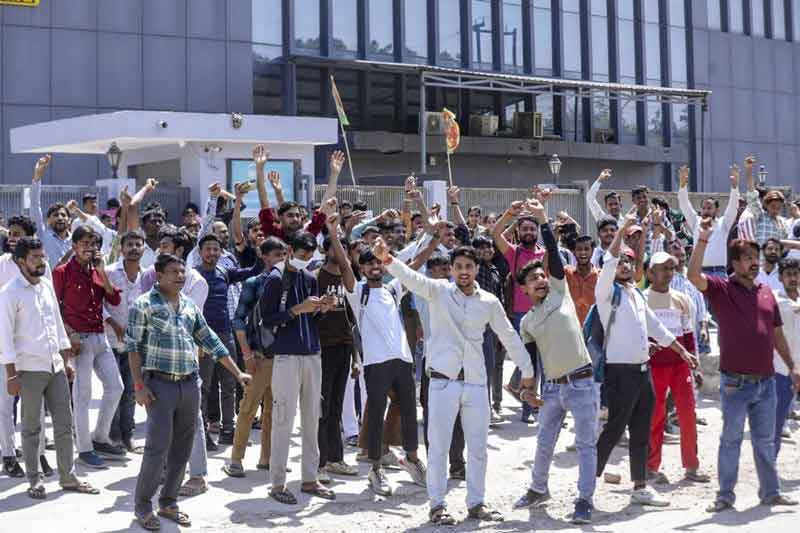
On April 9, 2026, workers gathered near the NSEZ Metro Station in Noida’s Phase 2 industrial area. Hundreds came out. They sat down. They raised slogans. They demanded the same wage revision that Haryana had conceded. They were peaceful. The police watched.
What are workers’ demands?
The primary demands include a minimum wage of ₹20,000 to 26,000 per month for unskilled workers to match the rising cost of living, and direct company hiring to prevent contractors from skimming wages. Workers are also demanding strict implementation of double pay for every hour worked beyond the standard shift, immediate clearance of pending bonuses from the previous financial year, and retrospective payment of wage arrears. They have called for a significant increase in the House Rent Allowance, citing skyrocketing rents in Noida’s sectors and villages. They also insist that any work beyond eight hours be voluntary and compensated as overtime, and that employees be guaranteed paid weekly holidays. Additionally, they seek the establishment of functional Internal Complaints Committees to address workplace harassment and verbal abuse by managers, as well as the withdrawal of FIRs and unconditional release of those arrested during the April 13 protests.
Over the next three days, the protests spread from factory to factory. Workers at Richa Global, which operates five garment factories in Noida (and three more in Manesar, where the earlier wage hike had already been won), walked out demanding parity. Workers at Motherson Sumi Wiring, the automobile components giant, joined. Domestic workers, gig workers, even the invisible army of home-based piece-rate workers who stitch elastic bands and cut threads in their single rooms in Sector 63 – all of them began to move out from the factories. While the strike began in the second week of April 2026 with factory workers in industrial phases, it saw a significant spread to many categories of workers, as domestic workers- maids, cooks, and cleaning staff- launched their own protests starting from 14–15 April 2026.It was an unprecedented general strike, so to speak, in Noida.
The Battlefield
And then the morning of April 13 arrived.
The factory owners had not been responding. The state government was too adamant. The workers had been sitting peacefully at factory gates and road intersections for four days, and the only answer they had received was more police officers. On April 13, the crowds were larger, the anger wafting in the air, the desperation flowing more acutely. In the industrial sectors of Phase 2 and Sector 60, the situation escalated.
The Week wrote that the violence escalated in Phase 2 after a lathi struck a female employee during a police action, which enraged the crowd. Then the use of tear gas and lathi-charges to disperse large crowds in the Hosiery Complex area transformed a protest into a street battle.
Vehicles were set on fire. Stones were hurled. Police motorcycles were attacked. The police responded with lathi charges and tear gas shells. By nightfall, the images had gone countrywide: flames rising from police vehicles, workers running through smoke, the satellite city thirty kilometres from Parliament as if in a state of insurrection. Castigating the police’s accusation that violence was the “well-orchestrated syndicate activity”, the trade unions said that the violence was a spontaneous outburst of “simmering anger” from workers who have seen their real wages decline due to inflation. At the same time, their working hours increased to 12-hour shifts.
Behind the fire and fury, the unscrupulous exploitation and the horrible conditions in the factories and the unlivable conditions in the jhuggi-jhopdis were undeniable facts.
Unless we hear the voices from within the agitation, we cannot get the real picture of those conditions.
Vinay Mahoti is thirty years old, from Bihar, and a worker at a hosiery company in Noida. He describes how he first protested inside his manufacturing unit, and then joined the throngs from other companies who had taken to the streets. His demands were elemental: “Duty hours should be fixed, overtime hours should be paid.” Just imagine. He was not asking the moon. He was demanding that the law be applied.
A young woman worker at a garment factory said, her voice recorded and shared widely: “They tell us there are no funds for wages, but the owner just bought a second house in Greater Noida. We can see who is poor and who is not.” Another worker, who had migrated from Gorakhpur, said: “We are not criminals. We pay our rent, we send money home, we buy food. And they haven’t changed our wages in ten years. Ten years! What were we supposed to do?”
According to multiple estimates, nearly 50,000 workers have come out onto the streets in Noida by April 13. This was not a riot. This was not a conspiracy. This was decades of accumulated anger against the exploitation of their sweat and blood. This was a reminder of the agitation of 1997, when more than a lakh workers in Noida protested and went on strike, attracting countrywide attention.
Response in Repression
The Yogi Adityanath government’s first response was not a wage committee. Or talks with the agitating workers. Nor the involvement of the Labour Commissioner. It was an FIR. Shreya Ghosh of the Centre for Struggling Trade Unions said in an interview to G Sampath of The Hindu: Why do labour disputes get treated as ‘law and order’ issue?6
Within hours of the events of April 13, Noida Police Commissioner Laxmi Singh announced the registration of seven First Information Reports and the arrest of more than three hundred individuals. By April 14, the count had risen to over 300. Over three hundred and fifty people were, according to police, “rounded up,” with more than two hundred formally arrested, including those accused of “arson in a methodical and pre-planned manner.” Chief Minister Yogi Adityanath described the events as a “conspiracy” aimed at derailing the state’s development.
And then came the political vocabulary that the Bharatiya Janata Party has deployed with such practised fluency in the post-2014 years: “Pakistan hand.” “Urban Naxals.” “Anti-national forces.” Uttar Pradesh police sources announced to the media that the violence was “no spontaneous protest but a meticulously orchestrated conspiracy.” According to the police, phones seized from the arrested accused revealed WhatsApp groups circulated by “external” organisations with “incendiary and provocative” messages. Two contact numbers, traced by the police to Bigul Mazdoor Dasta, a workers’ organisation, the police said. Some trade union leaders were put under house arrest.
The subsequent arrests tell the real story of what was happening.
On April 13 itself – before the violence had even fully erupted – Rupesh Roy, an auto-rickshaw driver associated with Mazdoor Bigul, the workers’ newspaper, was taken into custody. According to his colleagues, Roy was at the protest site as a reporter, covering the workers’ movement for the journal. His family later filed a formal complaint with senior UP Police officials, alleging torture in custody, fabrication of evidence, and that the police had taken him to a location within NSEZ where bottles of kerosene and torches had already been “pre-positioned” – a chilling allegation of evidence-planting that could not be independently verified but could not be dismissed.
On April 18, twenty-four-year-old Himanshu Thakur – a young man preparing for his PhD, who had cleared the National Eligibility Test – was taken into custody. His sister Neha says neither a warrant was shown nor were grounds for arrest stated.
On the same day, Satyam Verma – a senior journalist, formerly with the United News of India (UNI), and the son of renowned retired historian Professor Lal Bahadur Verma at Allahabad- was, according to the Countercurrents report, “abducted by Noida police for two days and then imprisoned.” Verma was neither a factory worker nor a union organiser. He was a journalist, a man of letters, a public intellectual. The message his arrest was meant to send was not lost on anyone: even bearing witness to this movement would be treated as participation in a conspiracy.
And then there was Aditya Anand. The police named him as the “prime mastermind” of the Noida violence. He was arrested on April 19 – not in Noida, but at the Tiruchirappalli Railway Station in Tamil Nadu, by the UP Special Task Force acting on a lookout notice. The image of the state deploying squads to a railway junction in the deep south to arrest a labour activist from Bihar, for attending workers’ protests in Noida, speaks volumes about the geography of state power and its fragility.
Also arrested was Akriti, a NET-qualified young woman. The police accused her of being a criminal conspirator.
The arrested are not the factory owners who violated the minimum wage law for fourteen years. They are not the contractors who paid twenty-five rupees an hour for overtime, even though the law mandates double the regular wage. They are the people who helped workers understand their rights, who circulated their newspaper, who organised door-to-door campaigns explaining what workers in Haryana had won.
Central Trade Unions Call for a Nationwide Demand Day on May 12th!
Mazdoor Adhikar Sangharsh Abhiyan (MASA), the coordination of fourteen workers’ organisations and unions, issued statements demanding the immediate release of all arrested. The Samyukta Kisan Morcha, continuing its tradition of workers-and-farmers solidarity, expressed support for the Noida workers and condemned the repression. Central trade unions – CITU, AICCTU, AITUC, HMS, INTUC, and others – jointly called for a nationwide “Demands Day” on May 12, 2026, describing the events as a “state-backed corporate offensive” against democratic labour rights. They demanded the rollback of the Labour Codes, a statutory minimum wage of twenty-six thousand rupees per month, an eight-hour workday, and the abolition of contract labour in permanent jobs. More than a thousand workers, they estimated, had been arrested across the recent wave of labour unrest. They demanded the immediate withdrawal of all cases.
The ruling party-affiliated BMS Union did not support the workers’ agitation. It opposed the imposition of a uniform minimum wage on the industrial working class. It said: “The recent unrest in Manesar Noida was a matter of serious concern. Disagreeing with the other central trade unions about a uniform wage structure, and the idea of a uniform wage structure across the country is neither practical nor economically sustainable.” It condemned the workers’ “violence”.
The UP government, under this combined pressure, moved – grudgingly and partially. On April 17 and 18, 2026, the state notified revised minimum wages. Unskilled workers would now receive between twelve thousand three hundred and fifty-six and thirteen thousand six hundred and ninety rupees per month, up from eleven thousand three hundred and thirteen. Skilled workers would receive between fifteen thousand two hundred and twenty-four and sixteen thousand eight hundred and sixty-eight rupees. A high-powered committee under the Infrastructure and Industrial Development Commissioner was constituted to develop a “permanent wage revision framework.”
The workers received the news with cautious satisfaction. “Our wages were stolen, and we forced a correction,” said one woman worker in Noida’s industrial complex. But union leaders and labour analysts pointed out that even the revised wages lagged far behind Haryana’s levels and were nowhere near the 26,000 rupees the trade unions had demanded as a living wage. The Minimum Wages Advisory Board in UP had been inactive for fourteen years. What guarantee was there that the next revision would not take another fourteen?
Meanwhile, as of early May 2026, scores of workers and activists remained in custody. Many – including workers who are women and in some cases minors – faced serious criminal charges under provisions that carry heavy sentences. Opposition leaders, human rights organisations, and lawyers reported being prevented from meeting those detained. The cases registered against labour organisers like Aditya Anand and Rupesh Roy remain active, with the UP Special Task Force pursuing what the state has framed as a conspiracy case.
Lessons
The Noida uprising of April 2026 will be remembered as a watershed – not because it won a complete victory, but because it was irreducible. Fifty thousand people coming out of factories in a city that is the showcase of UP’s industrial development, spontaneously and without central union direction, cannot be dismissed as a “planned conspiracy.” It was lit by 14 years of minimum-wage stagnation. It was lit by twelve-hour shifts made legal by the Labour Code. It was lit by twenty-five rupees per hour of illegal overtime. It was lit by a woman standing at a factory gate with a punctured thumb, doing the math.
In the era of the Labour Codes, amid the backlash of capital against the working class, with the state’s help, the working class is fighting back. As people fought against CAA and NRC, as the farmers did against the farmers’ laws, the working class is fighting the effects of the Labour Codes regime. Samsung workers in Sri Perambadur fought against low wages, unpaid overtime, and the company’s refusal to recognise the union two years ago. Workers at Baruani, Panipat, and Hazira struggled against the parasitic contractor system and for better working conditions in February. Workers at Patratu Vidyut Utpadan Nigam Limited (PVUNL) plant- a joint venture between NTPC and the Jharkhand government- held protests against unpaid wages and long hours in February and March. The workers struggled at Raikheda, at the Adani Raikheda Power Plant in Raipur, against contract labour rights, safety concerns, and unfulfilled land-for-job promises.
A spectre of workers’ struggles is haunting the capitalist class. Suchvaliant expressions of direct class confrontation are bound to increase in the coming days, especially the burden and ramifications of the US- Israel war on Iran, and the resultant price rise all over for the common masses.
The Noida ‘uprising’ remains etched in the memories of the working class for long, long years. Workers will learn the hard lessons of unity, the strength in the organisation, the collusion of state and capital, and the irreconcilable contradiction between capital and labour. All the workers’ actions are rehearsals for the final acts of liberation, Lenin said.
There is Maina Devi, standing at the bus stop with a bandaged thumb, still going to work, still doing the math. She has won something – a small, inadequate, but real increase in her monthly wage. She has won it not through any institutional process but through the collective courage of fifty thousand people who took to the streets and refused to be invisible. She will go on standing for twelve hours a day, handling forty to fifty pieces an hour, rushing back from the toilet so that production targets do not pile up. The fight she and her co-workers lit is not over – it is only beginning.
The fire in Noida will not be easily extinguished as long as the exploitation of workers like Maina Devi continues. Working-class people all over India certainly take inspiration from Noida, Manesar, and the refinery workers’ struggles at Barauni, Panipat, and Hazira.
I owe to The Migration Story (Anumeha Yadav, April 22, 2026); The Wire (Shruti Sharma, May 2026); Countercurrents, April 2026; The Federal, April 21, 2026; Groundxero, November–December 2025, for writing this piece.
1 Okhla was a village in Delhi city bordering UP and Faridabad of Haryana. Around Okhla and Industrial Estate was planned in 1958. The UP counterpart, as an extension of the Okhla industrial belt, began in 1976. Okhla Industrial Estate (Delhi), Noida (UP) and Faridabad (Haryana) form a vast contiguous belt of industrial activity where 10 lakh workers labour in various kinds of factories.
2 The Hindu, How the War on Iran set off worker protests around Delhi, April 18, 2026.`
3 Weaving Futures: A Study on Women’s Employment in India’s Textile Sector”, VNGSU Journal of Research and Innovation
4 The Annual Survey of Industries (ASI) 2023–24 report, released in August 2025, confirmed that contract workers now account for 42% of India’s organised manufacturing workforce – the highest level recorded in at least 27 years. This represents a steady rise from the approximately 38% observed during the 2019–20 period.
5 The Hindu, Why Noida’s factory unrest is about more than just wages, 20 April 2026
6 Economic Times, April 19, 2026