
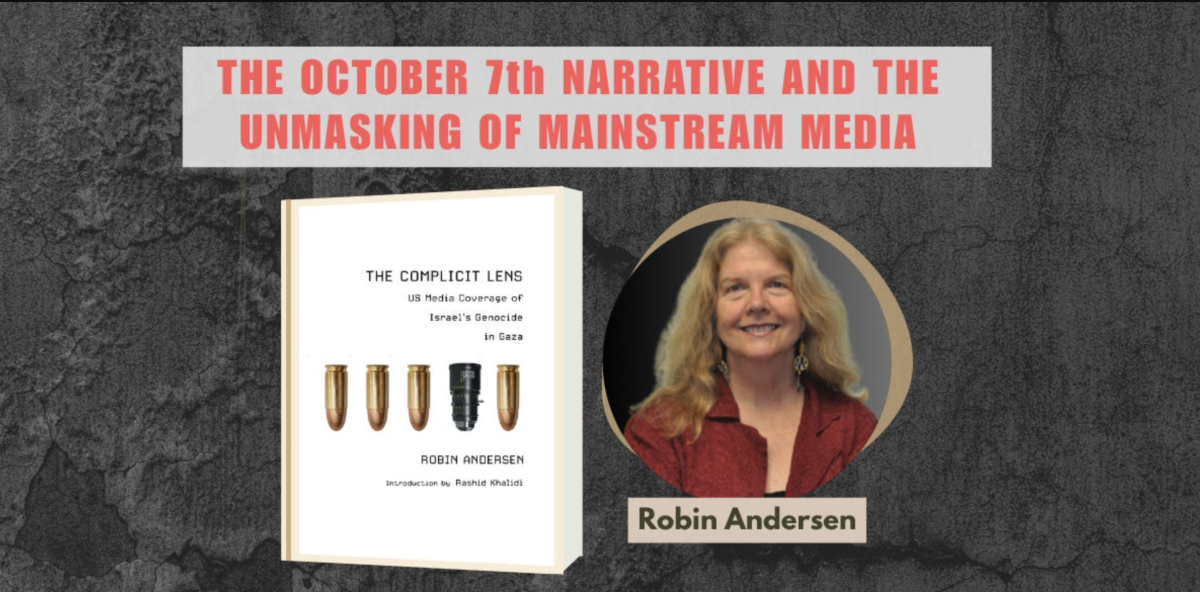
Robin Andersen’s The Complicit Lens is a tour de force: not only does she focus on US legacy/mainstream/capitalist media coverage of Israel’s genocide of the Palestinians, but she examines their coverage in light of what was then-happening in Gaza between October 7, 2023 and late 2025, which she documents carefully with 942 footnotes, most linked by URLs. Andersen, a Professor Emerita of Media Studies at Fordham University, builds a very solid case through making claims and supporting them with strong evidence.
Near the end of the book, she quoted a statement made by Dr. Feroze Sidhwa, a volunteer physician in Gaza, to the UN Security Council. He broke down while presenting it.
“I did not see a single combatant during my five weeks in Gaza. My patients were six-year-olds with shrapnel through their hearts and bullets in their brains, pregnant women with their pelvises obliterated and their fetuses cut in two while still in the womb.” He operated without sterility, electricity, or anesthetics on “crowded and filthy floors.” He said as a physician he bore “witness to the deliberate destruction of health care, the targeting of my colleagues, and the erasure of a people.” He cited numbers; eighty-three of American medics in Gaza reported seeing children shot in the head or chest. The destruction of health care was not a system failure, rather, he pointed out, it had been “systematically dismantled through violations of international law.”
Then, importantly, Andersen wrote, “No establishment media covered Dr. Sidhwa’s compassionate testimony or printed his words disputing Hamas was embedded in hospitals. This reporting was left to Middle East Eye, Al Jazeera, UN Media, and human rights organizations.”
This exchange nicely illuminates her argument, with two exceptions. Here, we see testimony by a doctor who had risked his life to volunteer his skills to help Palestinians in Gaza, a testimony to bring the light of his experiences to the world, a failure of the mainstream media to cover it, while the alternative media—with considerably more limited resources and a much smaller range of projection—admirably reports. The only thing missing, as shown extensively in Andersen’s book, is the State of Israel’s lying response, and US government acceptance—and often projection—of the correctness of the lying.
This is a book for the strong, not for people feeling personally vulnerable. Starting with her title, Andersen does not pull her punches: she unflinchingly addresses the genocide of Palestinians by the Israelis and their US supporters—both in the US government and the Zionist lobby in this country, including but much larger than just AIPAC (American Israel Political Affairs Committee)—and shows how the “legacy” or “mainstream” media has contributed to this process.
Andersen does this through a very systematic presentation that starts with the cover of her book. She shows four bullets along with another image; that of a camera. Kudos to the cover designer, Antara Ghosh: this really conveys the message of the book, genocide aided by mainstream media. Not a subtle approach! But appropriate for this book.
She asked Professor Rashid Khaldi of Columbia University to introduce the book. Khalidi, one of the most prominent of English-speaking Palestinian scholars in the world—I highly recommend his book, The Hundred Years’ War on Palestine: A History of Settler Colonialism and Resistance, 1917-2017—writes:
“She shows how most of the mainstream US media, instead of informing the American public about the easily discernible reality of Israel’s intentional mass slaughter, starvation, and attempted ethnic cleansing of the 2.3 million people of the Gaza Strip, has justified and covered up this reality, effectively acting as a shill for the Israeli and US governments. Andersen meticulously explains this shameful page in the history of Western journalism, holding accountable the most prestigious name in US journalism, The New York Times, for its central role in glossing over, excusing, and prettifying genocide, war crimes, and crimes against humanity.”
How does Andersen do this?
No one, outside of the perpetrators and victims of war, can tell us what it’s like. We outsiders are dependent in most cases on the media. And the media mediates what we see; in other words, reporters and editors of news outlets, located between events and readers, interpret from their personal backgrounds and experienced observations what we learn about events and therefore shape our understanding of events. So, we are dependent on what each of them decides what is important to say or not to say. We are dependent on the representations they present.
But there is a larger aspect as well that is almost never talked about: the top-level people in each news media outlet defines their own organizational interests in determining and presenting the news, and so besides the interactions between reporters and their editors in shaping the news, how each outlet defines its own interests is crucial to understand; and news that questions/threatens their self-defined interests is treated differently than news that does not. Understanding this reality—that every news outlet has these self-defined interests, whether it is the New York Times, CNN, or Democracy Now!, and is affected by this—is important, although each will define their self-interest differently; hence the differences we see between Fox News and MSNOW; as can be seen by the way they cover other issues such as climate change and the Epstein files.
What Andersen is doing in my opinion, although she didn’t explicitly say this, is destroying the mainstream media-projected myth that journalism’s role is to dispassionately (and neutrally) report the news when it violates the news outlet’s self-defined interests. By critically examining new media reporting from Gaza and operating therefrom, she obliterates the myth that the news media is neutral in the face of self-interest. It is an important understanding from which we each need to learn.
She does this by first discussing journalistic principles—describing how the media outlets claim to practice journalism—and comparing them to how the mainstream media actually has covered events in Gaza.
First of all, for most mainstream media, the war began with Hamas’ military attack on Israel on October 7, 2023. (The reality, as Khalidi shows in his book, goes back over 100 years.) Hamas, as the claim goes, assaulted Israel on that day and killed somewhere around 1,200 Israelis, men, women, and children. But it was more complicated than that. According to Andersen:
“Tuval Escapa, a member of the security team for Kibbutz Be’eri, told Haaretz [a prominent Israeli newspaper] that on October 7 commanders also called in air strikes and ‘began shelling houses with their occupants inside, in order to eliminate the terrorists along with the hostages.’ That Israel killed its own citizens has been well documented. Additionally, it has been well confirmed that the Israel Defense Forces (IDF) implemented the Hannibal Directive, a long-held principle that directs the Israeli military to kill everyone, even Israelis, in order to keep them from being taken hostage. Haaretz confirmed its widespread application on October 7 through obtaining documents and taking testimony from soldiers, mid-level and senior IDF officers.
“Why were these stories ignored, hushed, and silenced in US legacy media? The other simplistic story of October 7—that 1,200 people were killed by Hamas—was repeated across media, as if the IDF’s response that also killed Israelis never happened. If Israel had killed some of its own civilians, the rudimentary narrative structure would have lost a good deal of its persuasive value.”
In addition to not publishing established information as above, there were also stories generated that falsely vilified Hamas. [This, as does Andersen, does not excuse war crimes of Hamas, but it does put them into perspective, something the mainstream media almost never does.] Early on, a story emerged that Hamas had beheaded 40 babies. This story was shown to be fabricated fairly quickly, but already the damage had been done: eventually the story reached President Joe Biden, who told reporters in November that Hamas had killed 40 babies and suggested he had seen pictures; according to the Israeli National Insurance Institute, only one baby had been killed in the attacks. Again, nothing in US legacy media until late November.
There is so much detail in Andersen’s book that I could take many more pages more to discuss. Let me give another three examples: the overall coverage by The New York Times, and the Israeli assaults on hospital and on journalists.
In the chapter on the Times, Andersen initially focuses on more “structural” aspects of its Israeli reality. It’s bureau office, in Jerusalem, is on the second floor of a house that belonged to a Palestinian family who fled in 1948 because of the Nakba, or “catastrophe.” However, and perhaps much more importantly, they fired one of their Palestinian reporters, yet allowed three of their Jewish reporters—Ethan Bronner, Isabel Kershner, and David Brooks—to continue to write on the Middle East while their children were serving in the Israel Defense Force (IDF), or while Kershner’s husband was working to promote the Israeli military! And, on top of that, they didn’t inform their readers that was the case. And there were other similar cases.
Kershner’s case was probably the most egregious: her husband worked to promote the Israeli military as a senior research associate at the Institute for National Security Studies whose job, at least in part, was to “shape a positive image of Israel in the media.” Again, the Times didn’t think that was worthy of telling her readers.
So, the deep personal integration of New York Times reporters in Israeli society—David Brooks, whose son joined the IDF, referred to himself a couple of time in public as “an Israeli parent”—certainly affected its news coverage. That the Times or others didn’t reveal these close connections was a strong violation of the journalistic ethics they so often like to crow about.
Where we see the impact of this close personal integration of Times reporters—and they are not unique in the legacy media, just most prominent—is in coverage of events after October 7. We turn to the Israeli destruction of the Palestinian health system and the Israeli killing of journalists.
The attack on the health care system, in and of itself, is a war crime. By June 20, 2024, according to the World Health Organization, “Israel had attacked 464 health care facilities, killed 727 health care workers, injured another 933, and damaged or destroyed 113 ambulances since October 7. According to Reuters, among the doctors killed, fifty-five were specialists.” By September 2024, over 1,000 healthcare workers had been killed, “and by November 2024, one thousand doctors and nurses had been killed….”
Andersen gives multiple examples of these attacks and accounts thereof, which the legacy media usually ignored. Two humanitarian doctors—trauma surgeon Feroze Sidhwa and orthopedic surgeon Mark Perlmutter—reached one of the remaining hospitals in southern Gaza in late March 2024. It turns out that in the month after October 7, “the Israeli Air Force had dropped ‘so much American ordinance on Gaza that it exceeded the explosive force of two of the atomic bombs that destroyed Hiroshima [and Nagasaki]. Nearly 14,000 children had been killed in Gaza in six months of relentless attacks, more than were killed in all of the war zones in the entire world in the past four years combined.”
After giving multiple, detailed examples of the attacks on the Palestinian health care system, Andersen concludes:
“The magnitude of the crimes against humanity that the destruction of Gaza’s health care system represents are monstrous, but news stories relentlessly repeated Israeli propaganda, minimized the nature of the attacks, and confused the violations of international law. Considering all of the evidence ignored and misrepresentations of clear genocide, US legacy media misled their viewers and readers knowingly. … US media seemed never to encounter a piece of Israeli propaganda it did not repeat. Yet volumes of documentation were available for sourcing, including information and analysis making the case that Israel’s intentions were to destroy Gaza’s healthcare system and crush its civilian infrastructure.”
Yet not only were the Israelis determined to destroy Gaza’s health care system, but they also wanted to destroy those who would write about and record this destruction: journalists.
“Leading up to October 7, the IDF had detained, harassed, beaten, and even killed journalists, but after the Hamas raid, Israelis killed journalists in unprecedented numbers, with little recognition by establishment media. By July 2024, the Palestinian Journalists Syndicate, counted 152 journalists and media workers killed in Gaza, with more than one hundred journalists arrested, eighty five detained, and fifty two in prison. … the groundwork had been laid years before. Israel had killed more than fifty Palestinian journalists between 2000 and 2022, though no Israeli soldier had ever been charged with their murders. In 2021, Reporters Without Borders (RSF) documented Israeli air strikes on twenty-one Palestinian media outlets in the Gaza Strip.”
Andersen is thorough in her arguments. In this one chapter, she includes sections of multiple pages on “The Act of Bearing Witness,” “Censorship by Murder,” “The Slow Murder of Al Jazeera Cameraman Samee Abu Daqqa,” “The Genre of Testimonial,” “The Targeted Killing of Hamza al-Dahdouh,” “Deliberately Targeting Journalists to Block Information,” “Where is the Outrage?,” “The Deliberate Targeted Killings of Ismail al-Ghoul and Rami al-Rifi,” “Recognizing Palestinian Journalists’ Courage and Contributions,” and “An Assault on Memory, Truth, and Palestinian Culture.”
She concludes this chapter: “The latest reporting by Al Jazeera [August 11, 2025] records at least 278 journalists and media workers, killed in Israel’s war on Gaza since October 7, 2023. The words and pictures from alternative media and on-the-ground reporters was all the more important because those truths were rarely printed or recorded in the US establishment media.”
Like I said earlier, I could go on and on from Andersen’s book; this is very dense and detailed. And it is very well documented and claims are strongly supported. How do I evaluate it?
First of all, it documents the death and destruction by Israel on Gaza and its citizens; in my mind, it, along with its sources, conclusively establishes that Israel has been conducting a genocide against the Palestinians in Gaza. If nothing else, the chapter on the targeted destruction of the health care system is unequivocal: these are war crimes and must be adjudicated against senior members of the Israeli government and the IDF.
Now, because so much of what she reports has not been reported in the US legacy media, to make her charges stick, she had to detail what had happened in the first place. And, as said, she’s done an excellent job of this.
For me, however, this pulls her attention somewhat off of her ultimate target, the US legacy media. It is absolutely clear from her work that they have done generally a terrible job of reporting on the genocide and developments in Gaza; so much that without alternative sources, including this book and others, as well as social media, people would have no idea that a genocide had even been attempted! And I think she’s brought many alternative outlets and individuals to the fore through their reporting and by her including them in her discussion; certainly, she has shown that the legacy media no longer has a monopoly on what people can see once they seek information. (Whether or not they seek alternative sources is another issue!)
However, other than ingesting Israeli propaganda and then presenting it as fact—a major journalistic sin by any standard—I still don’t know what any particular legacy media did in covering/not covering the war on Palestine. Having recently reviewed Adam Johnson’s How to Sell a Genocide: The Media’s Complicity on the Destruction of Gaza (Pluto, 2026), I find that on this point, Johnson did a better job, while Andersen did a better job on the war itself. But honestly, I don’t think we should see them as competing sources, but rather as complimentary ones: together, they are incredible!
There still remains a couple of other major issues requiring detailed investigation that I hope is already taking place: one, we need a detailed account of US support—politically and militarily—of Israel’s genocide. There’s no doubt that both US Presidents, Joe Biden and Donald Trump and their top administration officials, supported and facilitated Israel’s war on Gaza. Detailed evidence must be amassed of their policies and operations so as to refer to the International Court of Criminal Justice for adjudication. (The US does not recognize this court, but a formal finding would be devastating to the US nonsense of its “enlightened” policies.)
Second, and one I truly do not understand: where have other journalists and their professional organizations and unions been in regard to the systematic attacks on Palestinian journalists? There seems so much they could do to get the word out and to deter future Israeli attacks on their colleagues on the ground: where have they been and where are they today?
In short, Robin Andersen has done an excellent job in demolishing the myth that US legacy media can be neutral in times of the news challenging their organizational self-interest; it certainly has not worked in Gaza, and I doubt it would in any other comparable situation. I see her book as a major contribution to understanding what Israel has done to Gaza since October 7, 2023.
And lastly, I want to congratulate her and OR Press for getting this work out so quickly: the last date I could find mentioned in the book was October 2025, and yet I got a paperback copy in my hands by early July 2026. Well done here, too!
In fact, both of these books show the importance of media, how it works, and how it affects our political efforts. It’s something we need to learn more about!