
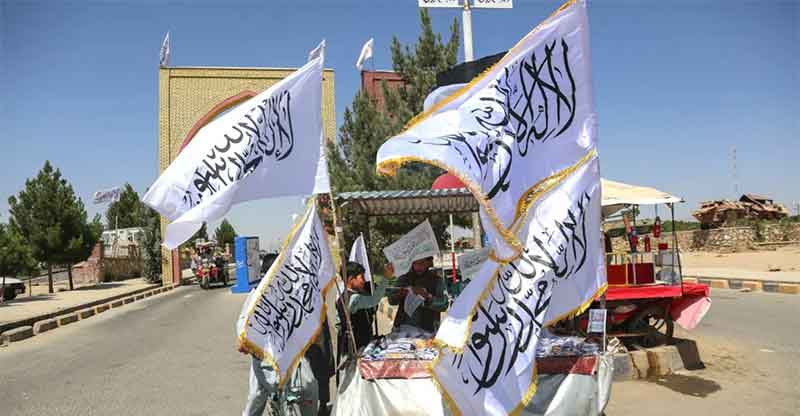
On August 15, 2021, Taliban fighters entered Kabul unopposed, sealing a lightning offensive that followed the chaotic withdrawal of US-led forces. Five years later, on August 15, 2026, white Taliban flags emblazoned with the ‘Shahada’ in black script lined the streets of the Afghan capital as the movement marked its fifth anniversary in power with large-scale ceremonies at the Loya Jirga assembly hall. The anniversary offered a moment of both celebration and reckoning—an opportunity to assess what the Taliban have consolidated, what remains fragile, and what the future may hold for a country long defined by war, occupation, and political upheaval.
Security and Governance
The most acknowledged achievement of Taliban rule is the restoration of security. After four decades of continuous conflict, Afghanistan has witnessed a significant decline in large-scale violence. The Taliban have waged sustained operations against extremist groups, particularly the Islamic State Khorasan Province (ISKP), and have repeatedly pledged that Afghan territory will not be used by terrorist groups to threaten other countries. The United Nations Assistance Mission in Afghanistan (UNAMA) has noted that the past five years of Taliban rule have brought a reduction in conflict and “tangible benefits”.
For ordinary Afghans, this has translated into a daily life that is safer than at any point since the 1970s. Travel between provinces is less perilous, kidnappings have declined, and armed checkpoints have created a sense of order. The Taliban have established checkpoints in major cities and at entry points to each province. The Afghan currency has stabilised at around 66 to 70 afghanis per US dollar, and bread prices have remained remarkably stable.
Infrastructure and Economic Development
The Taliban have invested considerable resources in infrastructure development. In May 2026 alone, the Taliban approved 15 infrastructure projects worth approximately 4.2 billion Afghanis, including road construction, power grid development, and a $150 million housing development in Balkh province. These projects are intended to signal a governing authority capable of long-term planning rather than mere coercive control.
The flagship Khush Tepa Canal project in northern Afghanistan represents the Taliban’s most ambitious infrastructure undertaking. Designed to divert water from the Amu Darya River, the canal is intended to irrigate hundreds of thousands of hectares of agricultural land. Excavation for the second phase has reached 98 percent completion, with embankment construction at 90.5 percent. The canal could transform Afghan agriculture, potentially shifting the country from food importer to exporter.
Connectivity projects have also advanced. The Wakhan Corridor road project, intended to link Afghanistan with China in the country’s northeast, has made significant progress. The Taliban have been working on this with considerable speed, recognising that reduced dependence on Pakistan is a strategic imperative. The TAPI (Turkmenistan-Afghanistan-Pakistan-India) gas pipeline project has also progressed, with 116 kilometres of pipeline laid in Afghanistan and installation expected to be completed by the end of 2026.
Despite these infrastructure efforts, Afghanistan’s economy remains deeply fragile. The country inherited a structurally weak economy heavily dependent on foreign aid when the Taliban seized power. That aid has largely evaporated. The World Bank has estimated real GDP growth at 4.8 percent, driven in part by strong domestic demand and the return of millions of Afghans. Yet this growth has not translated into better living standards. Rapid population growth of around 11 percent in 2025 has outpaced economic expansion, resulting in a 5.6 percent decline in GDP per capita. Inflation climbed to 7.6 percent by March 2026, driven by food price pressures. According to Afghanistan’s Ministry of Economy, roughly 26 percent of the working-age population is unemployed.
The Refugee Crisis and Regional Pressures
One of the most significant challenges the Taliban have faced has been the mass return of Afghan refugees from Pakistan and Iran. Since late 2023, nearly 7 million Afghans have returned to their homeland, according to the United Nations. In 2025 alone, the UN estimates that 2.9 million were returned, and during the first four months of 2026, more than 600,000. Pakistan has uprooted millions of Afghan refugees—including those born in Pakistan across several generations.
The scale of this return has placed enormous pressure on Afghanistan’s already strained resources. Jobs, housing, and public services have been stretched to breaking point. Yet despite limited resources and limited governance experience, the Taliban have absorbed these returning refugees without losing administrative control. In some cases, returnees have received official assistance, including emergency monetary funds and land to build houses. During a visit to a dried-fruit processing factory and a carpet-weaving centre supporting returning refugees in Balkh Province in July 2026, UN High Commissioner for Refugees Barham Salih acknowledged the scale of the challenge. The United Nations has launched a $529 million plan to support Afghan returnees.
International Relations: Pragmatic Engagement
Five years after returning to power, Afghanistan’s Taliban authorities have built working relationships with a slate of countries despite a lack of formal recognition. Russia remains the only nation to have officially recognised the Taliban government in July 2025.
Yet the Taliban have made quiet diplomatic inroads. China accepted the Taliban’s ambassador in January 2023, becoming the first country to do so since the Taliban’s return. Iran, Uzbekistan, India, the United Arab Emirates, Qatar, Saudi Arabia, and Turkey have all developed closer ties with Kabul, falling short of formal recognition but representing increasingly substantive engagement.
China has positioned itself as Afghanistan’s most significant external economic partner. The Taliban have promised that Afghanistan will not be used as a base for militants and, in exchange, China has offered economic support and investment for reconstruction.
Iran remains Afghanistan’s largest source of imports, and the two sides have discussed expanding economic cooperation, removing trade barriers, and increasing joint investment in agriculture. Iran, Tajikistan, and the Taliban have agreed to establish a new road transit corridor through Afghanistan.
India has also expanded engagement. Afghanistan’s foreign minister Amir Khan Muttaqi made a landmark visit to India that further cemented the relationship. India has continued humanitarian assistance, allocating Rs 150 crore for Afghanistan in its 2026-27 Budget. The Taliban have also backed India’s sovereignty over Jammu and Kashmir in a joint statement. India has not formally recognised the Taliban but upgraded its embassy engagement in 2024.
Central Asian nations have intensified cooperation, seeking trade routes through Afghanistan to access sea ports. Uzbek-Afghan trade volume reached almost $1.7 billion in 2025, with a target of $5 billion within five years. Afghanistan aims to increase trade with Central Asian countries to $10 billion within the next three or four years. Kazakhstan is helping to complete a railway connecting Iran’s Khaf to Afghanistan’s Herat, and exploring collaboration to build railways connecting Herat to Mazar-i-Sharif.
Relations with Pakistan, by contrast, have deteriorated sharply. Pakistani officials described the situation as an “open war”. Pakistan accuses the Taliban of sheltering the Tehrik-e-Taliban Pakistan (TTP), allegations the Taliban deny. A UN report has highlighted the continued cross-border terrorist threat posed by the Afghan-Taliban-backed TTP. From late 2025 to the spring of 2026, the confrontation escalated beyond frontier areas, with Pakistan carrying out intermittent airstrikes inside Afghanistan, including around Kabul killing hundreds of civilians including children. The attacks have subsided after the two sides returned to dialogue through international mediation, but the underlying tensions remain unresolved.
The United States remains a complicating factor. The Taliban have called on the Trump administration to reopen the US embassy in Kabul and invest in Afghanistan’s infrastructure and mineral wealth. Yet the Taliban have rebuffed President Trump’s public demands, including regaining control of Bagram Air Base, the return of abandoned US weapons, and the release of an American detainee. The Taliban have insisted that “the chapter of war has come to an end” and that they want “relations based on mutual respect”.
The Human Rights Issues: Women and Girls
The most intractable aspect of Taliban rule remains the systematic exclusion of women and girls from public life. The Taliban have refused to budge despite approaches from a large number of Muslim countries and bodies. There are reports that in some regions the ban is not enforced as vehemently as in others, but the official position remains unchanged.
The Exclusion of Former Government Employees
The Taliban have refused to accommodate a large number of former staff who worked under the US-propped Ashraf Ghani government. Despite announcing a general amnesty, the Taliban have systematically dismissed remaining employees from the previous administration. This exclusion of talented and experienced personnel represents a significant loss of institutional knowledge and capacity at a time when Afghanistan desperately needs skilled administrators. One former senior government official told me that the only talent in vogue is being a ‘moulvi or a madrassa background’.
Internal Governance Challenges
The Taliban’s internal governance structure remains opaque and centralised. Real power resides in Kandahar, where Supreme Leader Hibatullah Akhundzada holds ultimate authority. Localised disputes and attacks by opposition groups have been driving an increase in political violence in Badakhshan and Herat provinces, highlighting the vulnerabilities. The Taliban have faced a string of assassinations of key regional officials in the country’s northeast in recent weeks. The Taliban blame Pakistan army for these attacks as its erring military desperately seeks some leverage to monetise it for the erring generals.
Conclusion
Five years after their return, the Taliban present the image of a strong and coherent movement, adept at sharp and calculated politicking. They have delivered a degree of security and stability that Afghanistan has not known in decades. They have built roads, canals, and infrastructure projects that promise to transform the country’s economy. They have absorbed millions of returning refugees and expanded trade relations with neighbours – Iran, China, India, and the central Asian countries. They have demonstrated resilience and control over the entirety of Afghan territory—a feat no other government in the past five decades could achieve.
However, the systematic exclusion of women and girls from education, employment, and public life represents severe human rights crises. The economy remains fragile, with high unemployment, widespread poverty, and declining living standards. Relations with Pakistan have deteriorated to the point of open conflict.
Whether the Taliban can evolve into a government capable of delivering both stability and rights remains the central question shaping Afghanistan’s future.