
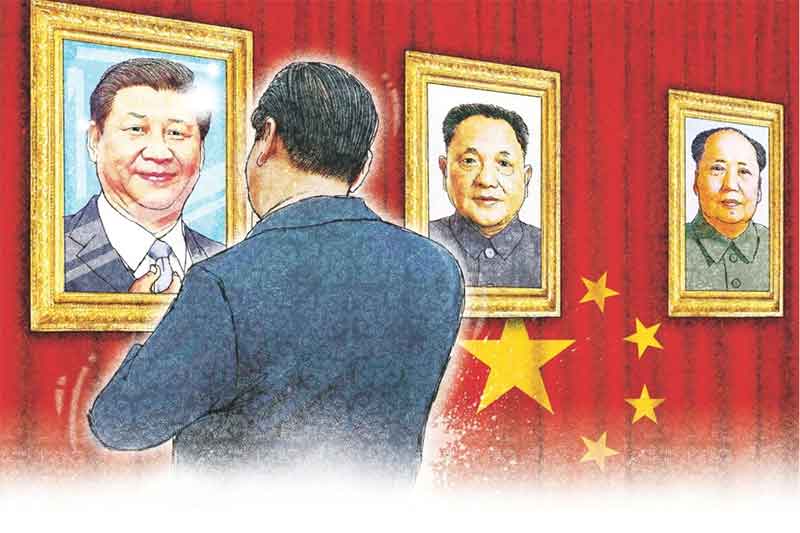
Mao Tse Tung’s death on 9 September 1976 closed an extraordinary chapter in modern China, but not the questions he left behind. He led the generation that made the Chinese Revolution, shaped a second generation charged with building the new society, and during the Cultural Revolution appealed directly to a third generation – China’s young students – to question inherited authority and preserve revolutionary purpose. The Red Book became the portable symbol of that endeavour. Although the Cultural Revolution was deeply controversial and often destructive, this tribute remembers Mao as a revolutionary thinker whose achievements, contradictions and unfinished questions continue to shape debate about China’s socialist future.
I. Introduction: Who Controls the Party?
Classical Marxism devoted enormous intellectual attention to the contradictions of capitalism. Marx analysed the conflict between labour and capital, social production and private appropriation, and the historical processes through which capitalist development created the material possibility of another social order. Lenin confronted a related but different problem: how could a revolutionary movement organise itself sufficiently to seize and retain political power? His answer was the vanguard party, a disciplined organisation capable of transforming dispersed economic struggles into political consciousness and coordinated action.
Revolutionary success, however, produces a second problem that cannot be solved by the seizure of power alone. If the Communist Party becomes the organised political expression of the working class and simultaneously acquires control over the state, who controls the Party? Nationalisation can alter legal ownership, but it does not automatically abolish inequalities of authority, expertise, administrative power, status or access to information. The revolutionary organisation can therefore become a governing bureaucracy, and the governing bureaucracy can acquire interests of its own.
This problem stands at the centre of the author’s earlier paper, Who Controls the Party? Mao’s Theory of Contradictions Under Socialism and the Problem of Socialist Transition. That paper argues that Mao’s distinctive theoretical contribution was to recognise that contradictions do not disappear after socialist revolution; they change their form. The decisive contradiction is no longer only capital versus labour. It may increasingly become Party leadership versus mass participation, expert versus worker, town versus countryside, mental versus manual labour, and administrative authority versus political accountability.
The collapse of the Soviet Union gave this question renewed historical significance. Public ownership, extensive planning, industrial power, scientific achievement and military strength proved insufficient to guarantee socialist continuity. The Soviet system disintegrated without military conquest by the capitalist West. Whatever weight one assigns to economic stagnation, nationalism, geopolitical pressure, institutional rigidity or ideological erosion, the governing elite itself became an agent of systemic transformation. The possibility that reversal might emerge from within socialist institutions rather than only from an external enemy was precisely one of Mao’s central fears.
Contemporary China presents the opposite historical puzzle. The Communist Party of China has survived while presiding over market reform, large-scale private accumulation, international integration and one of the most rapid transformations of productive capacity in modern history. Yet those achievements have generated new contradictions: inequality, corruption, property speculation, regional imbalance, social differentiation and the possibility that Party cadres and economic elites become increasingly distant from ordinary citizens.
The central argument of this article is therefore deliberately narrower than the claim that Xi Jinping is simply returning China to Maoism. Xi has not recreated the Cultural Revolution, and China has not abandoned the productive architecture created after 1978. Rather, Xi appears to be subjecting important features of the Deng Xiaoping settlement to renewed scrutiny through Marxist-Leninist categories concerned with Party authority, ideological discipline, distribution, bureaucratic degeneration, national sovereignty and the relation between productive forces and socialist legitimacy. The facts should therefore be allowed to speak before ideological labels are imposed.
II. Mao, Stalin and Contradictions under Socialism
For Mao Zedong, contradiction was universal. In On Contradiction, he rejected the proposition that contradiction belonged only to capitalist society or to moments of open class conflict. Development occurred through the interaction of opposing tendencies. It therefore followed that socialist revolution could not logically abolish contradiction itself. It could transform the principal contradiction, but new contradictions would appear within the new social order.
His distinction between antagonistic and non-antagonistic contradictions was therefore crucial. Not every disagreement under socialism was to be treated as an enemy contradiction. Contradictions among the people could, at least in principle, be handled through criticism, discussion, persuasion, participation and institutional reform. The task of socialist governance was not to imagine a contradiction-free society but to identify and manage contradictions correctly.
Mao’s relationship with Stalin is important because it prevents any simple opposition between ‘Stalinism’ and ‘Maoism’. Mao acknowledged Stalin’s role in transforming an economically backward Soviet Union into a major industrial and military power and in the defeat of fascism. At the same time, he criticised Stalin’s theoretical treatment of socialist society, arguing that Soviet practice placed too much emphasis on administrative unity and too little on the continuing movement of contradictions within socialism.
The 1956 Twentieth Congress of the Communist Party of the Soviet Union intensified Mao’s concern. Khrushchev’s denunciation of Stalin was interpreted by many as a necessary correction of authoritarian excesses. Mao did not deny Stalin’s mistakes, but he worried about a deeper problem: if a ruling communist party could repudiate its revolutionary history and progressively redefine its ideological commitments, what mechanism prevented formal socialist institutions from surviving while their substantive political direction changed?
This concern became the language of ‘revisionism’. For Mao, capitalist restoration did not necessarily require invasion, counter-revolutionary armies or the return of pre-revolutionary property owners. It might emerge through the gradual transformation of the governing stratum itself. Bureaucratisation could produce privilege; privilege could produce institutional self-interest; institutional self-interest could reshape political consciousness; and political consciousness could alter the direction of the state. The controversial proposition that ‘the bourgeoisie is in the Communist Party’ can therefore be read less as a literal sociological category than as a warning that social differentiation and restorationist interests can emerge within socialist institutions themselves.
The Great Proletarian Cultural Revolution remains one of the most controversial political episodes of the twentieth century. Any serious analysis must distinguish its historical consequences from the theoretical problem it attempted to address. The historical consequences included persecution, factional violence, educational disruption, administrative instability, the destruction of cultural objects and substantial human suffering. The Communist Party itself subsequently condemned the Cultural Revolution as a grave historical error. Those facts cannot be erased by theoretical sympathy for the problem Mao was trying to solve.
Yet historical failure does not remove the underlying problem. Mao increasingly concluded that socialist restoration could arise inside the socialist system itself. If Party officials acquired privileges and became separated from workers and peasants, normal administrative supervision might be insufficient because administrators would effectively be supervising themselves. Mao’s radical answer was mass supervision. Students, workers, peasants and ordinary Party members were encouraged to criticise officials and challenge bureaucratic privilege. The theoretical proposition was clear: the masses must retain the capacity to supervise the Party.
The Cultural Revolution therefore exposed a contradiction within the very idea of socialist accountability. Mass mobilisation could challenge bureaucratic privilege, but it could also weaken administrative capacity and generate factional disorder. The effort to democratise supervision could itself become dependent on extraordinary personal authority. Accountability and institutional stability thus entered into tension. Mao’s proposed remedy could reproduce the very concentration of power and political arbitrariness it was intended to overcome.
The movement commonly known as ‘Up to the Mountains and Down to the Countryside’ expressed another aspect of Mao’s analysis. More than ten million urban educated youths were eventually sent into rural China. The policy imposed heavy personal costs, interrupted education and careers, and was frequently coercive. But its ideological rationale was connected to Mao’s concern that education detached from productive labour could reproduce a privileged intellectual stratum. The programme therefore attempted simultaneously to narrow the divisions between town and countryside, mental and manual labour, and intellectuals and workers or peasants.
Xi Jinping’s own biography makes this history especially important. Xi was sent from Beijing to rural Shaanxi as a teenager and spent years in Liangjiahe. Official accounts later presented this period as formative, emphasising hardship, rural labour, contact with peasants and early Party responsibility. This does not prove that Xi seeks to reproduce the sent-down-youth movement. It does mean, however, that the Maoist proposition linking hardship, productive labour and political formation was lived experience for the generation from which China’s current leader emerged.
The barefoot-doctor movement reflected a related contradiction through healthcare. Modern medicine requires expertise, specialisation and institutions. Yet expertise can also become geographically concentrated and socially detached. Barefoot doctors attempted to embed elementary medical knowledge within rural communities, linking technical knowledge with local participation and service. The deeper proposition was not anti-scientific: it was that expertise should remain socially connected rather than becoming the monopoly of an urban professional elite.
III. Deng Xiaoping and the Development of Productive Forces
Deng Xiaoping fundamentally changed the method by which China sought to develop its productive forces after 1978. Market mechanisms were expanded, foreign capital was welcomed, material incentives gained greater importance, private enterprise developed, and international trade became a major engine of accumulation. Deng’s reforms did not formally abandon socialism; they redefined the relationship between planning, markets and ownership under the formula of ‘socialism with Chinese characteristics’.
The immediate historical task was to overcome poverty and technological backwardness. In stylised form, the reform-era priority can be written as maximising the growth of productive capacity. Rapid industrialisation, export expansion, infrastructure construction, urbanisation and technological upgrading transformed China’s position in the international economy. Hundreds of millions experienced substantial improvements in material living standards, and China eventually became the world’s largest manufacturing economy.
The principal problem therefore changed. In the early reform period the dominant constraint was poverty and insufficient productive capacity. By the Xi period the challenge increasingly became the management of prosperity itself. This shift is central to understanding why a leadership committed to maintaining growth could simultaneously place greater emphasis on distribution, Party discipline and ideological control.
IV. The 2008 Crisis and China’s Three-Stage Development Strategy
The global financial crisis of 2008 represented a major turning point because it exposed the vulnerability of development strategies excessively dependent on external demand and global finance. The author’s earlier paper Strategic Approach to Global Financial Crisis argued that China’s response should not be reduced to a simple switch from investment-led to consumption-led growth. Instead, it identified a three-stage investment strategy designed ultimately to generate new domestic demand.
The first stage emphasised infrastructure. Large investments in transport, energy, communications and urban public works supported employment and aggregate demand while simultaneously enlarging future productive capacity. Unlike a short-lived consumption rebate, infrastructure could alter the spatial and productive structure of the economy. In this sense the fiscal response was both counter-cyclical and developmental.
The second stage shifted attention toward rural areas and the interior. Investment outside the established coastal growth centres had a dual purpose: raising productivity and incomes in relatively underdeveloped regions while creating new markets. This differed from a model in which regional inequality is accepted indefinitely on the assumption that growth will eventually trickle down through market adjustment.
The third stage involved the development of new urban and regional centres, housing, transport and services. Urbanisation itself generated demand for housing, household equipment, education, healthcare, communications and consumer services. Investment was therefore not simply a substitute for consumption. Strategic investment could create the incomes, infrastructure and demographic transformation necessary for later consumption-led growth.
The sequence can be summarised as infrastructure -> rural/interior development -> new regional and urban growth -> consumption. The central theoretical point is that investment and consumption are not mutually exclusive growth regimes. Investment can be used to construct the social and physical conditions for consumption. This was the argument of the author’s earlier crisis paper and should remain central to interpreting China’s post-2008 development rather than being replaced by a generic claim that China simply became consumption-led after the crisis.
China’s trajectory can thus be stylised as capital scarcity -> capital accumulation -> productive abundance -> effective-demand constraint. At that point distribution ceases to be merely a moral or welfare issue. If purchasing power is highly concentrated, productive capacity can exceed mass consumption. Policies that raise the income and security of lower- and middle-income households may therefore support both redistribution and macroeconomic rebalancing.
This is the point at which the post-2008 development strategy connects directly with Xi’s Common Prosperity. The latter should not be understood only as a political slogan or egalitarian correction. It may also be part of the transition from an economy whose growth relied heavily on exports and capital formation toward one in which domestic consumption, services, innovation and household demand play a larger role.
V. Xi Jinping’s Reassessment of the Deng Legacy
Xi Jinping’s rise should neither be described simply as a return to Mao nor as an uncomplicated continuation of Deng. A more useful interpretation is that Xi is scrutinising the contradictions generated by the reform settlement through renewed Marxist-Leninist political categories. This is not equivalent to rejecting markets, international trade or technological modernisation. Xi’s China continues to depend on industrial capacity, sophisticated infrastructure, global commerce, modern corporations and market incentives. These are inseparable from the post-1978 transformation.
At the same time, Xi has placed greater emphasis on Communist Party supremacy, ideological education, anti-corruption, economic security, technological self-reliance, redistribution, social cohesion, discipline within the People’s Liberation Army and the objective of Common Prosperity. The relation can therefore be expressed more accurately as preservation of Deng’s productive achievements combined with political correction of contradictions generated by Deng-era development.
Kevin Rudd’s Oxford doctoral thesis, China’s New Marxist Nationalism: Defining Xi Jinping’s Ideological Worldview, is useful precisely because it treats Xi’s ideological claims as substantive rather than ceremonial. Rudd argues that Xi represents a significant departure from the ideological orthodoxies associated with Deng Xiaoping, Jiang Zemin and Hu Jintao. He describes Xi’s worldview as a form of ‘Marxist-Leninist nationalism’: Leninist in the reassertion of Party authority and individual leadership, Marxist in a stronger preference for Party-state intervention and greater income equality, and nationalist in the project of national rejuvenation.
Rudd should not be cited as proof that Xi is simply a follower of Mao; that would overstate his argument. His importance is that he places Xi exceptionally high in the hierarchy of post-1949 leadership and shows that ideological change under Xi is real. The present article extends that argument by asking whether the Marxist-Leninist framework identified by Rudd also contains a specifically Maoist theory of post-revolutionary contradiction and rectification.
Xi’s project can then be treated as a selective synthesis conditioned by the material inheritance of Deng. The interesting question is not whether Xi fits a pure ideological category but which elements of these traditions become politically operative under contemporary conditions. In that sense ideology and facts can speak together: stronger Party control, anti-corruption, regulation of capital, Common Prosperity, ideological education and national reunification can be analysed as observable policies before they are labelled.
Xi’s approach to the Cultural Revolution is instructive. The Party’s official historical resolution continues to judge the Cultural Revolution negatively, and Xi has not formally rehabilitated it as a political model. Yet his leadership also avoids constructing legitimacy through a wholesale repudiation of Mao. The continuity of Mao Zedong Thought within the Party’s ideological canon is emphasised, while the destructive mass disorder of the Cultural Revolution is rejected. This distinction supports the hypothesis of selective Maoist reconstruction rather than literal restoration.
The same distinction appears in institutional method. Mao’s answer to bureaucratic degeneration was, at its most radical, mass supervision of the Party. Xi’s answer is centralised Party supervision of the Party. Mao loosened institutional authority in order to attack bureaucracy; Xi strengthens institutional authority in order to discipline it. The diagnosis may overlap, but the remedy is almost the opposite.
The anti-corruption campaign is central to assessing whether Xi is revisiting Mao’s theoretical problem. Corruption can be treated at three levels. At the simplest level it misallocates resources. At a second level it widens inequality and undermines public trust. Within a Leninist ruling party, however, it can create patronage networks whose loyalties are personal, factional or financial rather than institutional. Corruption therefore threatens not only efficiency but Party authority itself.
Mao feared that privileged interests could emerge within socialist institutions. Xi’s anti-corruption campaigns address a structurally similar danger through a different mechanism. Instead of mobilising independent masses against Party committees, the centre strengthens disciplinary commissions, investigations and political education. The contrast can be stated succinctly: Mao’s answer was mass supervision; Xi’s is Party self-supervision.
Xi’s recurring scrutiny of senior military officers, procurement systems and strategic branches such as the Rocket Force is consistent with this broader project of organisational rectification. The motive in any individual case may include corruption, incompetence, factional conflict or political unreliability, and evidence should be assessed case by case. But the pattern demonstrates the importance Xi assigns to preventing semi-autonomous elite networks inside institutions vital to Party survival.
The Xi era can also be organised around three interconnected objectives already identified in the author’s earlier work: first, preserving and strengthening the leadership of the Communist Party on Marxist-Leninist principles; second, completing national reunification and safeguarding sovereignty, with Taiwan as the unresolved historical question; and third, advancing from prosperity toward Common Prosperity. These are best treated as an analytical reconstruction of Xi’s programme rather than a claim that every speech presents them as a formal numbered list.
The first objective concerns the Party itself. The lesson Xi repeatedly draws from Soviet collapse is that a communist system can disintegrate from within when ideological confidence, organisational discipline and elite cohesion erode. Party reconstruction therefore becomes a form of regime preservation but also, in its own terms, socialist self-correction.
The second objective concerns national reunification. For Beijing, Taiwan is not merely an external territorial dispute. It is connected to the unresolved outcome of the Chinese civil war and to the larger narrative of overcoming national fragmentation and foreign intervention. The People’s Republic consolidated control over the mainland in 1949, but territorial reunification remained incomplete. Xi’s language of national rejuvenation therefore links sovereignty, historical memory and Party legitimacy.
The third objective, Common Prosperity, connects distribution with legitimacy. Deng’s formula that some people and regions could become prosperous first was historically associated with accelerated accumulation. Xi confronts the subsequent question: what follows once substantial prosperity has been achieved? If inequality becomes too large, it can weaken social cohesion and the Party’s claim to represent a socialist project. Common Prosperity therefore addresses both political legitimacy and macroeconomic rebalancing.
These three objectives are mutually reinforcing. Party reconstruction provides organisational capacity; national reunification supplies a historical-national purpose; Common Prosperity addresses the social distribution of development. Together they form a conception of national rejuvenation that cannot be reduced either to economic growth or to nationalism alone.
VI. Common Prosperity, Labour Education and the Maoist Question
Common Prosperity is perhaps the clearest point at which Maoist and Dengist concerns intersect. It does not necessarily imply absolute equality, the abolition of private enterprise or a return to comprehensive command planning. Its significance lies in reintroducing distribution as a central question of socialist development after decades in which rapid growth and productive accumulation had priority.
In economic terms, Common Prosperity can also be linked to the post-2008 growth model. Lower- and middle-income households generally have higher propensities to consume than very wealthy households. Policies that increase household income security, social provision and purchasing power can therefore support domestic consumption as well as distributional objectives. In that sense Common Prosperity may help complete the earlier sequence from infrastructure and regional investment to urbanisation, consumption and broader social demand.
The renewed emphasis on labour education adds an ideological dimension. China’s Ministry of Education issued guidelines in 2020 making labour education an explicit component of primary, secondary and higher education in the ‘new era’. The guidelines emphasise enthusiasm for physical labour, frugality, hard work, innovation and dedication, and include daily labour, farming, handicrafts, industrial production and community service. Contemporary labour education remains embedded in a technologically advanced and examination-oriented education system, so it should not be equated automatically with the Cultural Revolution.
Nevertheless, the historical resonance is clear. Mao repeatedly treated the separation of mental and manual labour as a contradiction of socialist development. The danger was that education could produce a socially detached intellectual or professional stratum. Labour education reintroduces the proposition that intellectual formation should retain some relationship with productive and communal activity.
The 2026 popularity of commercial rural ‘hardship camps’ provides an unexpected social expression of the same concern. Reports describe Chinese parents paying substantial fees to send children to the countryside where they perform farm work such as digging and selling potatoes, chopping wood, peeling bark and feeding pigs. The stated aim is to teach the difficulty of labour, earning money, self-reliance and appreciation of family life.
The distinction from Mao’s sent-down-youth programme is fundamental. The camps are temporary, commercial and parent-funded; Mao-era rustication was state-organised, mass-scale, political and frequently coercive. It would therefore be misleading to describe the contemporary phenomenon as a revival of the Cultural Revolution. Yet the social symbolism is striking: prosperous families purchase a temporary experience of hardship for children whose material conditions are far removed from those of revolutionary China.
The paradox can be stated simply. Mao’s China imposed rural hardship in a society marked by scarcity and political mobilisation. Contemporary families purchase rural hardship in a society marked by urban affluence, digital dependence and social competition. The same physical experience therefore acquires a radically different political economy. A practice once associated with combating bourgeois consciousness can itself become a market commodity.
Xi’s personal sent-down-youth experience gives the phenomenon additional historical resonance, though not necessarily direct causality. The relevant question is whether contemporary emphasis on hardship, frugality and productive labour reflects a wider concern that material prosperity alone cannot reproduce the values, discipline or collective consciousness the Party considers necessary for socialist continuity. This is precisely the kind of new contradiction Mao’s framework would predict: the solution of one historical problem – poverty – produces another – the social consequences of prosperity.
VII. Conclusion: Correcting Deng through Mao?
The evidence permits at least two competing interpretations. The first is a restoration thesis: Xi is progressively reversing the Deng era by strengthening Party control, constraining private capital, reviving ideological education, elevating equality, reasserting discipline and recovering Mao-era concepts of labour and political consciousness. On this view, the direction of travel is from Deng back toward Mao.
The second is a consolidation thesis: the Deng period was a necessary stage in developing China’s productive forces, and once those productive forces reached a substantially higher level, new contradictions required different policies. On this view, Mao, Deng and Xi are successive stages rather than mutually exclusive ideological regimes. Revolution establishes sovereignty and institutional foundations; reform accelerates productive development; rectification addresses the contradictions generated by prosperity and integration.
The two interpretations need not be mutually exclusive. Xi may be correcting aspects of Deng through Mao while also seeking to complete Deng through Marxist-Leninist political economy. He retains the productive base created through reform but changes the political conditions under which markets and capital operate. He accepts technological modernisation but insists on Party supremacy. He accepts differentiated incomes but reintroduces distributional limits. He accepts global trade but simultaneously stresses strategic self-reliance.
This synthesis can be expressed as Maoist political contradiction plus Leninist organisation plus elements of Stalinist state capacity operating upon a Dengist productive base. Such a formulation is analytical rather than celebratory. It leaves open the possibility that these elements are themselves contradictory. Stronger Party centralisation may improve discipline while weakening independent feedback. Regulation of private capital may reduce rent-seeking while also reducing entrepreneurial dynamism. Common Prosperity may support demand and legitimacy while creating uncertainty if implemented unpredictably.
The most important unresolved problem is therefore the mechanism of accountability. Mao’s answer to Party degeneration was that the masses must supervise the Party. Xi’s answer appears to be that the Party must continuously supervise, discipline and reconstruct itself. The Party becomes both supervisor and object of supervision. This may avoid the anarchy of the Cultural Revolution, but it also concentrates the solution inside the institution whose degeneration is the problem being solved.
A dialectical interpretation should therefore resist both triumphalism and deterministic decline. Xi’s approach may represent a sophisticated attempt at institutional self-correction; it may also reproduce new contradictions at a higher level. The outcome depends on whether centralised supervision can generate reliable information, genuine accountability and correction without becoming merely vertical political control.
The central question confronting contemporary China is not whether Mao has returned. Mao cannot literally return. China’s productive forces, technological structure, social composition, urbanisation and international position differ fundamentally from those of the 1960s. Nor can Deng simply continue unchanged. The conditions that made reform successful have themselves been transformed by that success.
China developed enormous productive capacity, accumulated capital, urbanised at extraordinary speed and became a major manufacturing and technological power. But new contradictions emerged between wealth and inequality, expertise and social distance, markets and Party authority, international integration and strategic autonomy, bureaucratic administration and political accountability, and material prosperity and socialist legitimacy.
Xi’s Party rectification, anti-corruption campaigns, scrutiny of the PLA, national-reunification objective, Common Prosperity agenda and renewed emphasis on labour and ideological education can all be examined as responses to these contradictions. None proves that Xi is a simple follower of Mao. Taken together, however, they make it difficult to treat Marxism-Leninism and Mao’s theory of contradiction as merely ceremonial rhetoric.
Kevin Rudd’s Oxford research reinforces the importance of taking Xi’s ideology seriously. Rudd identifies a ‘Marxist-Leninist nationalism’ that has reasserted Party authority, strengthened state intervention and placed greater emphasis on income equality and national rejuvenation. The present argument adds that Xi’s programme also appears intelligible through Mao’s theory of contradictions under socialism, especially the fear that bureaucracy, privilege and ideological degeneration can emerge from within socialist institutions themselves.
The decisive difference lies in political method. Mao attempted mass supervision of the Party. Xi increasingly relies on centralised Party supervision of the Party. Mao loosened institutional authority to attack bureaucracy; Xi concentrates institutional authority to discipline it. The diagnosis may share a family resemblance while the remedy is almost its opposite.
The 2026 hardship-camp phenomenon captures the new contradiction symbolically. Affluent parents now pay for their children to experience forms of rural manual labour that earlier generations encountered through poverty or political mobilisation. The policy setting is entirely different, but the underlying question is familiar: can material prosperity by itself reproduce the social consciousness, discipline and connection to productive labour required by the political system that created that prosperity?
The evidence therefore does not justify declaring either a resurrection of the Cultural Revolution or a complete repudiation of Deng. A more defensible preliminary conclusion is that Xi Jinping is subjecting the Deng-era political economy to renewed scrutiny through a combination of Marxist analysis, Leninist Party organisation, selected lessons of Stalinist state capacity and Maoist theories of contradiction and rectification.
The historical sequence may consequently be represented less accurately as Mao -> Deng -> reversal under Xi than as Revolution -> Development -> Rectification. Whether this new stage resolves the contradictions of reform or generates new contradictions of centralisation remains open.
The question Mao posed implicitly more than half a century ago therefore remains alive: who controls the Party? Xi’s answer appears increasingly clear – the Party must continuously discipline and reconstruct itself. Whether Party self-supervision can permanently resolve the problem that Mao believed ultimately required mass supervision is one of the central unanswered questions of twenty-first-century Chinese socialism.
References
Deman, Suresh. n.d. “Strategic Approach to Global Financial Crisis.” Unpublished manuscript.
Deman, Suresh. 2026. “Who Controls the Party? Mao’s Theory of Contradictions Under Socialism and the Problem of Socialist Transition.” Manuscript.
Han, Suyin. 1969. Asia Today: Two Outlooks. Montreal and London: McGill-Queen’s University Press.
King, Ambrose Yeo-chi. 1977. “A Voluntarist Model of Organization: The Maoist Version and Its Critique.” British Journal of Sociology 28 (3): 363-374.
Lenin, Vladimir I. 1902. What Is to Be Done? Burning Questions of Our Movement. Moscow: Progress Publishers.
MacFarquhar, Roderick, and Michael Schoenhals. 2006. Mao’s Last Revolution. Cambridge, MA: Harvard University Press.
Mao, Zedong. 1937. “On Contradiction.” In Selected Works of Mao Tse-tung, Vol. I. Beijing: Foreign Languages Press.
Mao, Zedong. 1956. “On the Ten Major Relationships.” Beijing.
Mao, Zedong. 1957. “On the Correct Handling of Contradictions among the People.” In Selected Works of Mao Tse-tung, Vol. V. Beijing: Foreign Languages Press.
Meisner, Maurice. 1999. Mao’s China and After: A History of the People’s Republic. 3rd ed. New York: Free Press.
Michels, Robert. 1915. Political Parties: A Sociological Study of the Oligarchical Tendencies of Modern Democracy. New York: Hearst’s International Library.
Ministry of Education of the People’s Republic of China. 2020. “Guideline on Labor Education for Primary, Secondary and Higher Education.” July 17.
Mohanty, Manoranjan. 1977. “Mao’s Critique of Stalin’s Economic Problems of Socialism in the USSR.” Social Scientist 5 (8): 3-22.
Rudd, Kevin. 2022. “China’s New Marxist Nationalism: Defining Xi Jinping’s Ideological Worldview.” PhD thesis, University of Oxford.
Rudd, Kevin. 2024. On Xi Jinping: How Xi’s Marxist Nationalism Is Shaping China and the World. Oxford: Oxford University Press.
South China Morning Post. 2026. “Chinese ‘Hardship Camps’ See Children Chop Wood, Feed Pigs to Learn Family Appreciation.” August 20.
Stalin, Joseph. 1952. Economic Problems of Socialism in the USSR. Moscow: Foreign Languages Publishing House.
Weber, Max. 1978. Economy and Society. Edited by Guenther Roth and Claus Wittich. Berkeley: University of California Press.
Xi, Jinping. 2021. “Speech at a Ceremony Marking the Centenary of the Communist Party of China.” Beijing, July 1.
Xi, Jinping. 2022. The Governance of China. Vol. IV. Beijing: Foreign Languages Press.