
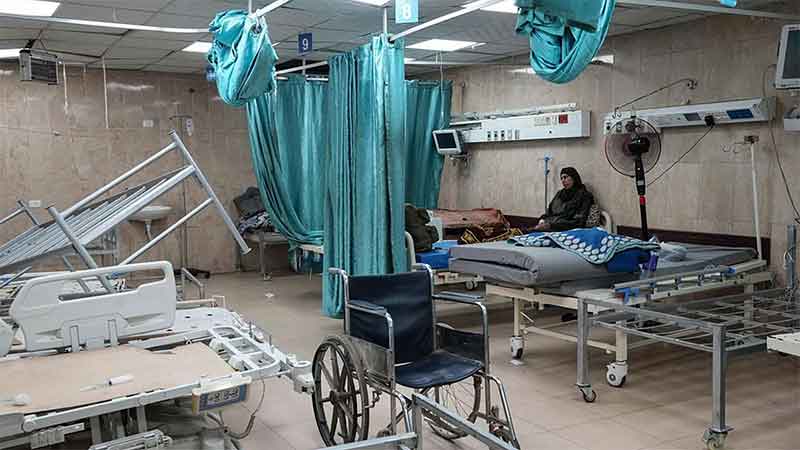
Photo caption. Israel’s threat to target hospitals in Gaza may signal a broader assault, aimed primarily at escalating killings and forced displacement. (Photo: Abdel Kareem Hana/AP)
Geneva – The escalating official and media campaign of Israeli incitement against hospitals and medical centres in the Gaza Strip is paving the way for attacks on the healthcare facilities that remain. It seeks to deprive Palestinians of any chance of survival and to continue subjecting them to living conditions that lead to their destruction.
Using unsubstantiated claims to justify such attacks, after three years of systematically destroying the healthcare system, signals an insistence on continuing the genocide by preventing the restoration of services essential to people’s survival and eliminating the capacity to save the wounded and treat patients.
Euro-Med Human Rights Monitor is following with grave concern the threats issued by the Israeli army on 6 October. In a video statement, the army claimed that “Hamas continues to exploit civilian centres and infrastructure for its terrorist purposes, especially hospitals and medical facilities”, but provided no evidence to support these allegations.
This repeats the approach the Israeli army has followed since the beginning of the genocide: pre-emptively attacking hospitals while making undocumented accusations linking them to military activity. It then uses those accusations as a pretext to bomb, raid, and disable hospitals, presenting the systematic destruction of healthcare as operations against military targets, even as the healthcare system in the Gaza Strip can no longer withstand further attacks or disruption.
Over the past two days, the Israeli army published six messages inciting against hospitals and medical centres in Gaza, including a post with a video on Wednesday. It claimed to have tracked two people allegedly affiliated with Hamas leaving Kamal Adwan Hospital in the northern Gaza Strip. According to the army, one of them transferred explosive devices from inside the hospital and planted them near the Yellow Line to target its forces.
The published footage does not provide enough evidence to substantiate the army’s account. It neither identifies the location of the person shown near the rubble or his connection to Kamal Adwan Hospital, nor shows him leaving the hospital or carrying devices out of it. The image quality also makes it impossible to verify what he is handling or to conclude definitively that he is planting an explosive device. The footage then cuts to a daytime shot of an unidentified destroyed building, without showing its location or establishing a connection to the previous clip. These spatial and temporal gaps prevent the combined footage from serving as evidence that the person left the hospital or that the alleged devices were transferred from inside it.
The Israeli army builds its accusation against the hospital on a series of conclusions unsupported by the published material: first, it interprets the person’s movement as the planting of an explosive device; then, it claims the device was transferred from inside the hospital; and finally, it uses that claim to accuse the facility of military use. Each conclusion requires evidence, and repeating allegations does not replace the lack of proof.
Even if someone were proven to have carried out a military act outside the hospital, that alone would not prove the medical facility was used beyond its humanitarian function to commit acts harmful to the enemy, nor would it automatically make the hospital a military target. Using the video to justify targeting the hospital thus relies on the army’s allegations instead of the verification required by law.
The sequence of these claims, together with the widespread accusations that medical facilities are being used for military purposes, suggests an organised effort to prepare for targeting them. This effort portrays treatment and rescue facilities as combat sites and presents attacks against them as a military necessity. Euro-Med Monitor warns that threats could disrupt these facilities even before an attack, by blocking patients and wounded people from reaching them, impeding the movement of medical teams, ambulances, and supplies, or prompting facilities to suspend some services for fear of being targeted. This could interrupt treatment, delay lifesaving interventions, raise the risk of preventable deaths, and further deprive people of care essential to their survival.
International humanitarian law provides special protection for hospitals under Article 18 of the Fourth Geneva Convention, which requires respect for and protection of civilian hospitals and prohibits attacks against them. Statements by the Israeli army or media accusations do not remove this protection: under Article 19, a hospital loses protection only if it is used, beyond its humanitarian function, to commit acts harmful to the enemy.
Protection may cease only after due warning has been given, with a reasonable time limit set where appropriate, and the warning remains unheeded while the acts continue. Treating wounded and sick members of armed forces or armed groups is not an act harmful to the enemy and does not cause a hospital to lose its protection.
Even if the conditions for losing special protection are met, an attack is not automatically permitted. It is still necessary to verify that the facility, or the relevant part of it, qualifies as a military objective, respect proportionality, and take all feasible precautions to protect patients, wounded people, and medical personnel.
Any deliberate attack on hospitals or places where the sick and wounded gather, when they are not military targets, constitutes a war crime under Article 8(2)(b)(9) of the Rome Statute of the International Criminal Court. Warnings or unsupported allegations do not make such an attack lawful or shield those responsible from accountability.
The deliberate destruction of health services and deprivation of medicine may constitute crimes against humanity when carried out as part of a widespread or systematic attack against a civilian population, with knowledge of the attack. Such acts may also constitute extermination under Article 7(b) of the Rome Statute if the conditions are deliberately imposed to destroy part of the population and result in mass killing, including by depriving people of treatment and medicine.
The continued threats to medical facilities, following three years of systematic destruction of the healthcare system and despite the knowledge that depriving the population of treatment leads to deaths, indicate the specific intent required for genocide. They target what remains of Palestinians’ means of survival and prevent the restoration of services necessary for their continued existence.
These threats, alongside the pattern of Israeli acts and statements, further indicate an intent to deliberately subject Palestinians to living conditions calculated to bring about their physical destruction, in whole or in part, which is an act of genocide under Article II(c) of the Genocide Convention.
As the occupying power, Israel is obligated under Article 56 of the Fourth Geneva Convention to ensure and maintain medical establishments and services, hospitals, and public health to the fullest extent of the means available to it. This includes protecting medical personnel’s work and securing necessary supplies, rather than undermining medical facilities’ ability to function.
Israel has deliberately targeted medical infrastructure as part of the ongoing genocide in the Gaza Strip. It has destroyed or disabled more than half of the major hospitals and medical centres, killed more than 1,700 healthcare workers over the past three years, including doctors, nurses, and other health workers, and detained more than 330 others, 81 of whom remain in detention. Several detainees have died under torture, most notably Dr Adnan Al-Bursh, one of Gaza’s most prominent orthopaedic surgeons. Detained at Al-Awda Hospital in northern Gaza, he was killed in an Israeli prison in April 2024 after four months of torture.
The United Nations and international institutions, especially the World Health Organization, UNICEF, and the International Committee of the Red Cross, must fulfil their responsibility to verify Israeli claims about hospitals and health facilities in the Gaza Strip and state their position publicly and transparently. This is particularly important because their teams and staff are regularly present in several health facilities in Gaza and have direct knowledge of how they operate and the conditions in which they work.
These institutions’ degree of field access and direct knowledge of Gaza’s healthcare system places a heightened responsibility on them to prevent the passage of unverified claims that could be used to justify targeting medical facilities and their staff, particularly in light of severe Israeli restrictions that have limited the entry of medical supplies and equipment and kept the quantities that do enter at extremely scarce levels.
Any delay in responding or waiting until attacks occur to issue statements of condemnation is highly concerning. Protecting medical facilities requires urgent preventive action by international actors and UN bodies to expose the pretext’s falsity, deny Israel any unlawful justification for attacking what remains of the healthcare infrastructure, and avert the catastrophic consequences of continued military incitement against the healthcare system and the hundreds of thousands of civilians and patients it serves.
Israel’s threat to target hospitals in Gaza may signal a broader assault, aimed primarily at escalating killings and forced displacement, both of which have continued despite the ceasefire announced in October 2025. Since the announcement, Israel has killed more than 1,470 Palestinians and injured thousands more, bringing the genocide’s toll to more than 74,200 killed and 175,000 injured. This has coincided with Israel expanding its military control to more than 65 per cent of the enclave’s total area.
More than 2.1 million Palestinians, most of them displaced, are entering their fourth year under direct attack and systematic starvation, confined to a narrow area in the west that covers no more than 35 per cent of the Gaza Strip. Despite this catastrophic reality, Israeli officials continue to openly call for maintaining the blockade and depriving the population of life’s necessities in order to ultimately remove them in an explicit entrenchment of genocide.
The international community must take urgent, concrete action to end the Israeli campaign of threats and incitement against medical facilities and prevent attacks on them. It must also apply political, diplomatic, and economic pressure to compel Israel to protect patients, the wounded, medical personnel, and ambulances, and to halt any orders or operations targeting healthcare facilities in violation of international humanitarian law.
Israel must open the crossings and remove restrictions on the entry of medicines, fuel, equipment, and spare parts needed to operate hospitals. It must also ensure humanitarian and medical personnel can enter and guarantee the safe medical evacuation of patients who need treatment abroad. Effective measures must be implemented to ensure compliance with the International Court of Justice’s binding orders, including its order of 28 March 2024 requiring urgently needed supplies, healthcare, and essential services to be provided on a large scale and without obstruction.
All states must stop supplying weapons, ammunition, equipment, and military assistance when there is a clear risk that these may be used to violate international humanitarian law. They must also impose targeted sanctions on those responsible for attacks on the healthcare system. The duty to prevent genocide requires states to use the means of influence available to them when they know, or should know, that there is a serious risk of genocide. Such action must not be conditional on a final judicial ruling.
The Office of the Prosecutor of the International Criminal Court and the Independent International Commission of Inquiry must investigate all crimes against medical facilities, including the chain of command, the orders issued, and responsibility for issuing and implementing them. States should support these investigations and cooperate fully with the International Criminal Court by executing arrest warrants in accordance with their legal obligations, halting any military or security support that contributes to attacks on the healthcare system, and invoking universal jurisdiction, where legally permitted, to prosecute those responsible.