
Karauli district of Rajasthan is predominantly agrarian, with a large proportion of small and marginal farmers dependent on rain-fed agriculture for their livelihoods. Farming in the district has been characterised by a narrow cropping pattern dominated by low-value, climate-vulnerable crops such as bajra, mustard, wheat, and gram. Erratic rainfall, frequent droughts, declining soil fertility, and limited irrigation infrastructure have further reinforced farmers’ dependence on mono- or low-diversity cropping systems.
Over the years, rising input costs, increasing climate variability, and limited market access have reduced farm profitability and heightened livelihood risks. Despite the potential for diversification into pulses, oilseeds, vegetables, and horticultural crops, adoption remains uneven due to constraints such as inadequate water availability, lack of technical knowledge, weak extension services, and poor market linkages.
Under these challenging agro-climatic and socio-economic conditions, farmers in Karauli district continue to face low productivity, high climate risk, and limited livelihood options due to mono-cropping and dependence on rain-fed agriculture. Recognising these constraints, SRIJAN initiated an innovative approach of multilayer cultivation with farmers as a pathway to promote crop diversification. This approach was designed to optimize the use of limited land and water resources, enhance soil health, and enable farmers—especially small and marginal households—to grow multiple crops simultaneously, thereby improving food security, nutritional diversity, and income resilience.
Multilayer vegetable cultivation was initially promoted among 60 farmers across three blocks—Mandrayal, Sapotra, and Karauli—with 20 farmers selected from each block. Throughout the intervention, farmers received systematic capacity-building support, including training on land preparation and crop planning, along with regular field monitoring. This initiative was implemented with financial support from Standard Chartered Bank and Axis Bank Foundation.
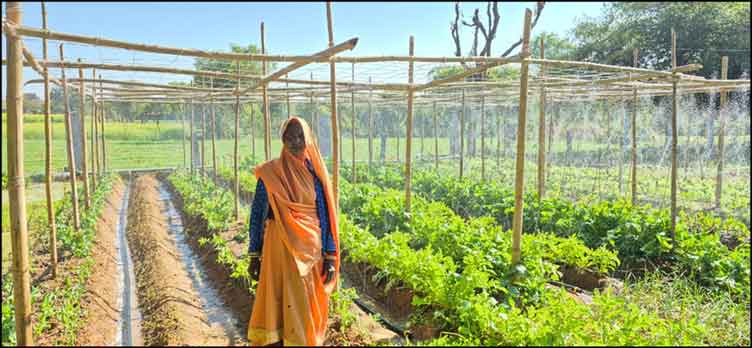
The demonstration plot was designed on an area of 36 × 36 feet, ensuring optimal utilization of limited land. The plot was developed with raised beds and clearly defined pathways, which facilitated easy movement, better crop management, and efficient intercultural operations. A trellis system of 6–7 feet height was installed to support climber crops, enabling vertical growth, improved sunlight exposure, and higher productivity per unit area. Irrigation was efficiently managed through laser pipe systems, ensuring uniform water distribution and reduced water loss.
Crops were strategically selected and arranged across layers to optimise space, sunlight, and soil health. Root vegetables such as onion beetroot, radish, and carrot improved soil structure; leafy vegetables grown at ground level included coriander, spinach, methi, and peas; while climbing and vine crops cultivated on a manchan (trellis) included tomato, bottle gourd (loki), bitter gourd, cucumber, ridge gourd (tori), along with marigold, which also helped in pest management and pollination.
To promote healthy crop growth and reduce dependency on chemical inputs, bio-inputs were provided along with vegetable seeds, including Mycorrhiza (4 kg), NPK Consortia (1 litre), Sagarika Liquid (500 ml), Trichoderma (0.5 kg), and Neem Oil (500 ml). For constructing the manchan, each farmer was supported with bamboo poles (10 feet – 54 numbers and 20 feet – 30 numbers), 25 kg of gauge wire, and 10 kg of rope, ensuring a sturdy and durable structure. Additionally, red and yellow sticky traps were supplied to manage insect pests in an eco-friendly manner, strengthening integrated pest management practices. The total cost of establishing one multilayer vegetable unit was approximately ₹19,000, of which ₹15,000 was supported by the project and ₹4,000 was contributed by the farmers, reinforcing ownership and the model’s replicability.

Jamna Mali, a 64-year-old farmer, resides in Amanpura hamlet of Khoobnagar village, a settlement predominantly inhabited by the Mali community. Her household consists of seven members—her husband, three sons, one daughter, and two daughters-in-law. The family relies on a dual-income strategy to sustain their livelihood. Jamna bai’s three sons migrate seasonally to Gujarat for approximately five months every year, where they work in the marble industry as tile fitters. The family’s long-term food security and economic stability continue to depend heavily on their 1.5-acre ancestral agricultural land in the village.
Prior to adopting new farming practices, Jamna Mali followed conventional monocropping methods using chemical inputs. While this approach provided stable but limited returns, it offered little scope for diversification or market-oriented surplus. She cultivated vegetables on about 0.5 acre of land, which generated an average annual profit of approximately ₹25,000. Rising input costs and limited resilience to climatic and market risks constrained the overall potential of her farming system.
With technical guidance and handholding support from SRIJAN, Jamna bai transitioned to Natural Farming practices and adopted a Multilayer Vegetable Farming Model. She gradually reduced her dependence on chemical fertilizers and pesticides and began preparing natural inputs such as Jeevamrut and Ghanjeevamrut using dung and urine from her three buffaloes.
This shift significantly lowered her input costs while improving soil health. Alongside this transition, she reorganized her land use by expanding wheat cultivation to 1-acre, mustard cultivation to 0.25 acre and intensifying vegetable production through spatial optimization.
On just less than 0.25 acre of land (40*40 sq ft area), Jamna bai implemented a highly diverse multilayer cropping system, cultivating more than 15 varieties of vegetables simultaneously. The plot includes root and tuber crops such as potato, radish, beetroot, carrot, onion, and garlic; green leafy vegetables like spinach, fenugreek, and coriander; cucurbits and creepers including cucumber, bottle gourd, and ridge gourd; and legumes and other crops such as chana (intercropped), pea, tomato, and okra. Jamna bai says, “Pehle to kewal alu aur pyaj hi lagate the to kabhi kabhi bohot nuksan ho jata tha rog lag jata tha, bazar se khane ka sabji laate the lekin isbar itne tareka ka sabji dek k accha lagrha he, kamai bhi hogi aur ghar ka bhi sabji ho jayegi”. This biodiverse system shows signs of enhanced productivity, improved nutrient cycling, and continuous harvests across seasons.

Livestock integration plays a crucial role in Jamna’s farming system and household nutrition. The three buffaloes not only supply raw material for natural manure preparation, closing the nutrient loop of the farm, but also contribute directly to family health providing fresh chemical free vegetables and cereals.
The impact of adopting natural and multilayer farming has been significant. From a small 0.25- acre area plot, Jamna bai anticipates an additional income of approximately ₹30,000, while substantially reducing expenditure on external inputs. More importantly, the diversified farming system—combining wheat, mustard, vegetables, and livestock—has strengthened household food and income security. In the event of fluctuations in seasonal migration income or labor demand in Gujarat, the farm now serves as a reliable safety net.
Jamna Mali’s journey clearly demonstrates that age is not a barrier to innovation. Her experience highlights how small and marginal farmers in ecologically fragile regions like the Daang can enhance resilience, reduce costs, and improve livelihoods through natural and diversified farming practices. Her case stands as a strong example of sustainable agriculture rooted in local resources, traditional knowledge, and scientific support.
Jamna Mali was not alone, there are many other farmers whose livelihoods have been enhanced through Unique approach which was newer for them but they were eager and interested which could be seen through the whole process and the way of participation that they have shown especially the women farmers.
Santra Mali from Garhi Ka Gaon village had almost lost hope of vegetable cultivation due to repeated monkey attacks on her fields. However, after learning about the multilayer cultivation approach, she decided to try once again, saying, “Ek baar aur koshish kar ke dekhte hain—agar achha hua toh theek hai.”
Within a few weeks, the results were visible. Reflecting on her experience, she shared, “Bahut achhi sabzi hui hai. Itni kam zameen mein alag-alag tarah ki sabzi ug gayi. Ab humein bahar se kuch kharidna nahi padta, roz ghar mein alag-alag sabzi banti hai. Saath hi kuch sabzi hum bahar bhi bech dete hain, jisse thodi kamai bhi ho jaati hai.” The multilayer model not only restored her confidence in farming but also improved household nutrition and provided an additional source of income despite wildlife-related challenges.

Deepak Sharma from Watda village also shares that “Laser aur pipeline se jaldi aur achhe tareeke se sichai ho jaati hai. Paani ki barbaadi bhi kam hui hai. Ab main apni baaki zameen mein bhi laser lagwaunga, taaki sichai aur aasaan ho jaaye.

After seeing the demonstration plot of Hari Singh Gurjar in Kot village, Ghanshyam Gurjar, another villager, shared his enthusiasm, saying, “Ab toh jinke paas paani hai, sabhi log aisi kheti karenge. Sab log dekh kar karne ke liye ichhuk ho gaye hain. Aisa kaam pehle kabhi kisi ne gaon mein nahi kiya tha. Sanstha ke sahyog se bahut achhi sabzi hui hai.”
The multilayer cultivation model has emerged as a centre of attraction, drawing farmers from nearby villages and surrounding areas who visit the site to observe, learn, and understand the practice. Seeing the results firsthand has motivated many to express interest in adopting the model in their own fields, highlighting its strong potential for horizontal spread and replication.
Through crop diversification using the multilayer vegetable cultivation model, families were able to earn an additional ₹25,000–30,000 from a limited area of land. This supplementary income strengthened household financial security while simultaneously improving the nutritional diversity of family diets through regular access to fresh vegetables. The model involves a low and replicable cost, making it suitable for small and marginal farmers, and allows cultivation of diverse crops throughout the year.
Reflecting growing confidence in the approach, Karan Singh Gurjar from Baguriyapura shared, “Agli baar hum ismein raat aloo bhi lagayenge,” indicating farmers’ willingness to further experiment and expand the model.