
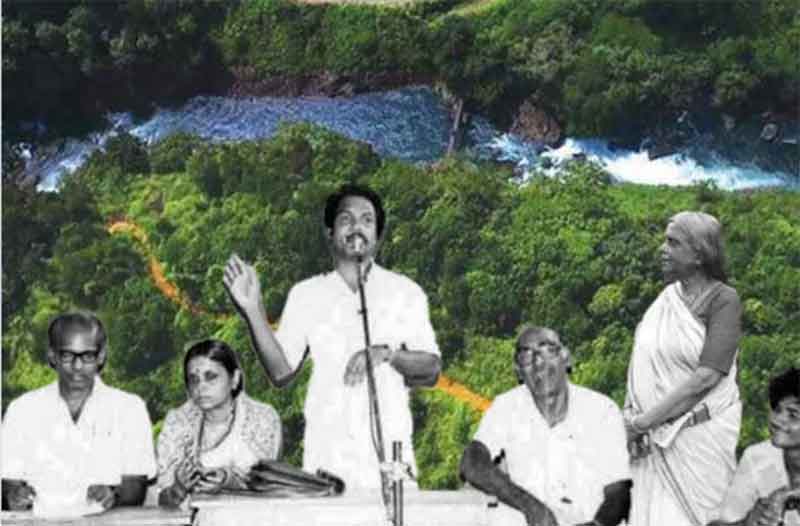
A recent visit to Mannarkkad in Kerala provided me with an opportunity to revisit one of India’s greatest environmental struggles. I had gone there to meet Comrade Basheer Master, a social and environmental activist and naturopath, whose lifelong commitment to people and nature continues to inspire many. Basheer Master runs Abhayam, a charitable trust that provides care and shelter for mentally challenged women. The warmth and generosity extended by him and his colleagues made the visit unforgettable.
As Mannarkkad lies close to the famed Silent Valley, our conversations naturally turned to the historic people’s movement that prevented the destruction of one of the world’s oldest tropical rainforests. Listening to Basheer Master recount the struggle was a reminder that environmental victories are never accidental—they are won through the determination of ordinary people armed with knowledge, conviction and collective action.
A Forest of Global Importance
Silent Valley, located in Kerala’s Palakkad district, is among the last remaining stretches of undisturbed tropical evergreen rainforest in the Western Ghats, one of the world’s biodiversity hotspots. The forest, shaped over millions of years, is home to countless endemic species found nowhere else on Earth. It is perhaps best known as a critical habitat of the endangered Lion-tailed Macaque, one of India’s rarest primates.
Flowing through this ancient forest is the pristine Kunthipuzha River, whose clear waters sustain an intricate web of life. Scientists have long regarded Silent Valley as an irreplaceable ecological treasure that plays an essential role in maintaining regional climate, water security and biodiversity.
The Hydroelectric Project
In 1970, the Kerala State Electricity Board (KSEB) proposed the Silent Valley Hydroelectric Project. The plan envisioned constructing a dam across the Kunthipuzha River to generate around 240 megawatts of electricity while also providing irrigation benefits to surrounding regions.
The proposal received approval from the Planning Commission in 1973. However, the project carried an enormous ecological cost. More than 8.3 square kilometres of untouched rainforest would have been submerged beneath the reservoir, permanently destroying an ecosystem that had evolved over millions of years. Conservationists warned that the project would fragment wildlife habitats, threaten rare species and inflict irreversible environmental damage.
The Birth of a People’s Movement
The proposal triggered one of India’s earliest and most influential environmental movements. Scientists, teachers, writers, artists, students and ordinary citizens came together in an extraordinary coalition that challenged the prevailing belief that development must inevitably come at the cost of nature.
At the forefront of the movement stood the Kerala Sastra Sahitya Parishad (KSSP), the state’s popular science movement. Rather than relying solely on emotional appeals, KSSP conducted independent scientific studies examining the ecological and economic implications of the project. Through public meetings, publications and village-level campaigns, it educated people about the importance of rainforests in sustaining water cycles, regulating climate and preserving biodiversity.
Scientists also played a decisive role. Primatologist Steven Green highlighted the grave threat the project posed to the endangered Lion-tailed Macaque. Conservationist Romulus Whitaker warned of the broader ecological consequences, while eminent agricultural scientist Dr. M. S. Swaminathan argued that Silent Valley deserved protection as a national biosphere reserve rather than exploitation for short-term gains.
Literature as Resistance
The Silent Valley movement demonstrated that science alone could not mobilise society; culture had an equally vital role.
Renowned Malayalam poet Sugathakumari emerged as one of the movement’s most inspiring voices. Her celebrated poem Marathinu Stuthi (“Ode to a Tree”) became the emotional anthem of the campaign, transforming environmental conservation into a deeply human and cultural cause. Writers, artists and intellectuals used literature, poetry and public performances to awaken ecological consciousness among people across Kerala.
At the grassroots level, organisations such as the Silent Valley Samrakshana Samithi organised meetings, signature campaigns, public discussions and legal interventions, ensuring that the issue reached every section of society.
From Local Protest to National Policy
As public opposition grew, the campaign transcended regional boundaries and became a national environmental issue.
Legal challenges temporarily halted construction. The Central Government constituted expert committees to examine the ecological implications of the project. Among them, the Prof. M. G. K. Menon Committee, established in 1982, conducted a comprehensive evaluation of the environmental and developmental aspects of the proposal.
In 1980, Prime Minister Indira Gandhi intervened, advising the Kerala Government to suspend further work until detailed environmental assessments were completed. The committee findings ultimately reinforced the conservationists’ arguments.
The result was historic.
In 1983, the Silent Valley Hydroelectric Project was officially abandoned.
The following year, in November 1984, Silent Valley was declared a National Park, and in September 1985, Prime Minister Rajiv Gandhi formally inaugurated the protected area, ensuring permanent legal protection for one of India’s greatest natural treasures.
A Defining Moment in India’s Environmental History
The Save Silent Valley Movement, spanning roughly from 1973 to 1985, remains a watershed in India’s environmental history. It established the principle that economic development cannot justify the irreversible destruction of ecologically fragile landscapes.
Equally significant was the movement’s method. It brought together scientific research, legal action, public education, literature and peaceful mass mobilisation into a powerful democratic campaign. This model inspired later environmental struggles across India, including the Narmada Bachao Andolan, the Appiko Movement and numerous campaigns to protect forests, rivers and indigenous communities.
Today, as India confronts accelerating climate change, biodiversity loss and increasing pressure on its forests, the lessons of Silent Valley remain profoundly relevant. Sustainable development demands that ecological integrity be treated not as an obstacle to progress but as its very foundation.
Silent Valley stands today not merely as a protected rainforest, but as a living monument to the power of informed citizens who refused to sacrifice an irreplaceable natural heritage for short-term gains. It reminds us that when science, culture and people’s movements come together, even the mightiest development projects can be reimagined in the interest of future generations.