
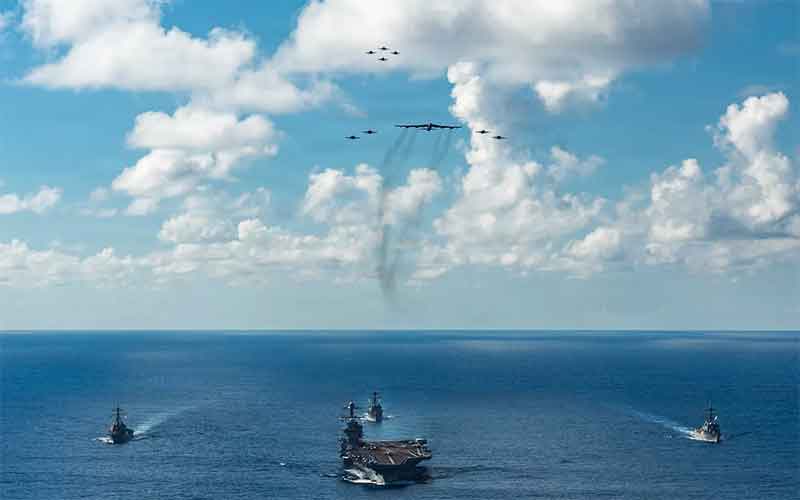
Photo caption. The U.S. Navy’s Gerald R. Ford Carrier Strike Group (Photo by Tajh Payne/US Navy via Getty Images)
The ocean is the largest economic frontier of the world. It feeds billions, generates trillions through trade, and holds the key to decarbonized energy for the future. The concept of “blue economy” — the sustainable use of ocean resources for economic growth, improved livelihoods, and ecosystem preservation — has emerged as one of the defining frameworks of twenty-first century geopolitics. And no country embodies its contradictions more sharply than the United States.
America is, by any measure, a blue economy powerhouse. The National Oceanic and Atmospheric Administration (NOAA) runs world-class fisheries management programmes. The Department of Energy is pumping billions into offshore wind. American universities lead ocean science research. Yet the same country that champions marine innovation at home consistently resists the international frameworks designed to govern the ocean it depends on. The result is a paradox that costs the world — and ultimately, America itself.
The Double Standard in Action
The most glaring example is the United Nations Convention on the Law of the Sea (UNCLOS). Widely regarded as the constitution of the oceans, UNCLOS governs everything from territorial waters to deep-sea mining rights. Nearly every maritime nation on earth has ratified it. The United States has not — and after decades of deliberation, shows no sign of changing course.
The reasoning offered by opponents in the Senate is revealing: ratification would cede sovereignty to international bodies, constrain military freedom of navigation, and expose American firms to foreign jurisdiction. It is, in essence, a calculation that the benefits of global rules apply to others more than to America. Washington wants the protections of international ocean law without the obligations that come with it.
The pattern repeats on climate. President Biden rejoined the Paris Agreement on his first day in office, signalling a recommitment to multilateral climate action. President Trump, both in his first and second terms, withdrew from it, calling the accord an unfair burden on the American economy. Whichever political logic prevails at any given moment, the underlying message to international partners remains the same: American engagement is conditional, revocable, and subject to domestic political winds.
When Geopolitics Closes the Sea
The true cost of this unilateralism crystallised on February 28, 2026. Following US and Israeli strikes on Iran, Tehran retaliated by closing the Strait of Hormuz — the narrow corridor through which nearly a fifth of the world’s oil and a significant share of global LNG passes every single day. Shipping lanes froze. Energy prices spiked. Economies from Bangladesh to South Korea felt the shockwave within days.
This was not a natural disaster or an unpredictable crisis. It was the direct consequence of a geopolitical gamble made without multilateral consultation, without a UN mandate, and outside the frameworks of international maritime law that America refuses to formally join. The blue economy — fisheries, shipping, offshore energy, tourism — does not exist in isolation from the political decisions made about the seas it depends on. When the Strait of Hormuz closes, every dimension of ocean-based commerce suffers.
For a nation that lectures the world on freedom of navigation while declining to ratify the treaty that legally enshrines it, the irony is difficult to overstate.
A Race to the Bottom of the Sea
Nowhere is this strategic self-interest more naked than in deep-sea mining. The ocean floor holds vast reserves of cobalt, nickel, manganese, and rare earth elements — critical minerals for the batteries and electronics that power the clean energy transition. China has moved aggressively to dominate the supply chains for these materials on land. The United States, eager to counter that dominance, has begun exploring deep-sea extraction in partnership with Pacific island nations like the Cook Islands.
The problem is that the scientific community is nearly unanimous: deep-sea mining at scale carries enormous ecological risk. The abyssal ecosystems targeted are among the least understood and most fragile on the planet. The International Seabed Authority, the UN body that governs these waters, has been working toward precautionary regulations. The United States, not having ratified UNCLOS, operates in a separate legal framework — one that critics argue allows it to sidestep the very rules designed to prevent irreversible environmental damage. This is not stewardship. It is strategic extraction dressed in the language of supply chain security.
Plastic, Power, and Free Riders
The United States generates more plastic waste per capita than any other developed nation. It is also one of the countries most reluctant to commit to a binding Global Plastics Treaty. At international negotiations, American delegations have consistently favoured voluntary frameworks over enforceable targets — a position that aligns with the interests of the domestic petrochemical industry but undermines the entire logic of collective action.
The consequence is what economists call free-riding. If other nations — the European Union, Japan, Canada — invest heavily in waste infrastructure and recycling technology to meet binding treaty targets, while the United States pursues a softer voluntary path, American companies may face fewer compliance costs in the short term. But the ocean does not observe national boundaries. Plastic from inadequately regulated economies ends up in the same currents, the same food chains, and ultimately on the same shores.
The Vacuum America Leaves
There is a direct connection between global governance gaps and the health of the blue economy. When a major power refuses to join a treaty, it creates a precedent. Smaller economies note the exemption. Enforcement mechanisms weaken. The standards that make sustainable ocean commerce possible — fisheries accords, pollution limits, shipping regulations — depend on near-universal buy-in.
The closure of the Strait of Hormuz in 2026 was a warning that the world cannot afford to ignore. Maritime trade is not merely an economic convenience — it is the circulatory system of the global blue economy. And that system is only as stable as the geopolitical choices made by the powers that dominate it. The United States has the scale, the technology, and the institutional capacity to lead a genuinely sustainable global blue economy. It has a research base. It has the capital. What it currently lacks is the political will to trade short-term sovereign flexibility for long-term collective stability.
The ocean cannot afford selective engagement. Neither, in the end, can the United States.