
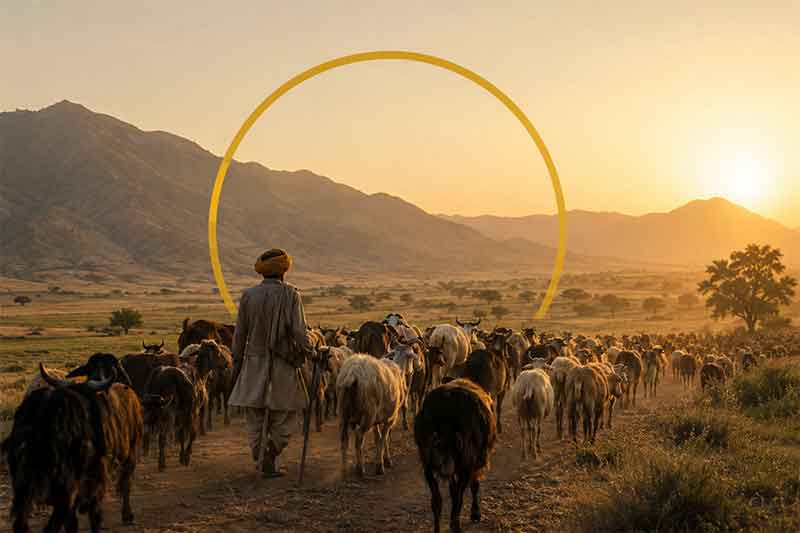
When Mongolia petitioned the United Nations to declare 2026 the International Year of Rangelands and Pastoralists, India was among the countries that formally backed the proposal. The UN General Assembly declared the IYRP on March 15, 2022, with 103 countries and 300 organisations in support.
That was the endorsement. The implementation has been a different story entirely.
The IYRP was formally launched by the FAO in December 2025. Since January 2026, civil society groups and volunteers have held awareness events across several Indian states, often without government funding. Yet not one central ministry—not Environment, not Rural Development, not Animal Husbandry—has launched a dedicated programme. The country that championed the proposal has, so far, remained absent from the year it helped create.
The people bearing the cost of that silence are India’s pastoralist communities — Gujjars and Bakarwals in Jammu and Kashmir, Rabaris and Maldharis in Gujarat and Rajasthan, Gaddis in Himachal Pradesh, Kurubas in Karnataka, and dozens of others whose livelihoods rest on seasonal migration with livestock. How many of them exist is itself a revealing question. India has conducted livestock censuses every five years since 1919, but has never counted the people doing the herding. Estimates range widely — the League for Pastoral Peoples puts the figure at around 13 million, while organisations working in the sector cite figures as high as 20 million. The 2024 Pastoral Livestock Census — the first of its kind in 105 years — may finally change that.
This invisibility did not emerge by accident. It has a colonial root. The Criminal Tribes Act of 1871 notified entire nomadic and pastoral communities as hereditary criminals, subjecting them to compulsory registration, pass systems, and forced settlement. By the time of independence in 1947, 13 million people across 127 communities were living under this legislation.
The Act was repealed in 1952, but its successor—the Habitual Offenders Act—continued to stigmatise many of the same communities. The bureaucratic suspicion of mobility that the British embedded in law never fully disappeared. Today, when a forest official blocks a traditional grazing route or a village officer refuses to register a nomadic family, the same mindset persists: people who move are seen as difficult to govern, and therefore as a problem.
The land these communities depend on is disappearing at a pace that makes that historical grievance sharply current. About half of India’s common grazing lands have been lost over the past five decades, forcing ex-pastoralists out of herding and into wage labour at construction sites — migrating now with tractors instead of animals. There is no national commons policy in India. Grasslands and scrublands managed by pastoral communities for centuries have been classified as ‘wastelands’ or ‘degraded forests’ under conservation law, making them legally available for diversion to infrastructure, plantations, and industrial use. Village commons are routinely grabbed by authorities and village elites without recourse, because herders lack the documentation, residency claims, or political access to contest it.
The Forest Rights Act 2006 was meant to address precisely this kind of dispossession. It explicitly recognises habitation and grazing rights for nomadic and pastoralist communities. In practice, pastoralists are still treated as encroachers in forest areas, their seasonal access curtailed for conservation and development projects. The structural problem is that the FRA was designed around sedentary communities. Pastoralists move between alpine pastures, arid expanses, and village commons across different seasons. They are perennial visitors to any given area, which means they cannot establish the documented residence that the FRA claims-making requires. Their traditional routes fall between jurisdictions; their rights fall between laws.
The consequences of this gap are not abstract. In Kachchh, Gujarat, four endangered Kharai camels drowned in a coastal swamp in 2024; 33 more were caught in a sea tide off Jamnagar shortly after. Both incidents were linked to the shrinking of mangrove grazing areas, blocked by the Gujarat Forest Department, the Border Security Force, and the expansion of illegal salt pans. In Rajasthan’s Neemuch district, Raika herders are now walking nearly 300 kilometres across highways and fenced farms in search of fodder. Routes that once passed through open commons have disappeared, forcing pastoralists onto longer, riskier, and more uncertain journeys.
Zoom out, and the economic stakes become clearer. The livestock sector contributes 5.5 per cent of India’s total GVA and has grown at a CAGR of nearly 13 per cent between 2014-15 and 2022-23. India is the world’s largest milk producer, accounting for nearly 25 per cent of global output — 239 million tonnes in 2023-24 alone. For small and marginal farm households, livestock contributes over 16 per cent of total income, higher than the rural average. Pastoralists maintain the hardy indigenous breeds that support much of this productivity, steward grassland ecosystems that store carbon, disperse native seeds across landscapes, and keep ecological corridors alive across fragmented habitats. The sector’s numbers appear in every government press release. The people behind those numbers rarely do.
Against this backdrop, two state-level interventions stand out — not as solutions, but as evidence that policy recognition is not impossible when there is political will. In January 2025, the Himachal Pradesh Forest Department issued a landmark notification identifying 1,637 pastoral routes and halting sites across the state, directing forest officials to avoid planting trees in these corridors under any afforestation scheme. It was the first such official mapping of pastoral routes anywhere in the country. In March 2026, Himachal followed up with a Rs 300 crore plan that includes digital IDs and formal grazing rights for shepherds. In Jammu and Kashmir, the tribal affairs department has initiated free livestock transport for Gujjars and Bakarwals during seasonal migration — a small measure, but one that acknowledges the cost of mobility rather than penalising it.
These remain isolated exceptions. For many pastoralist communities, recognition is still something to be hoped for rather than expected. That this conversation is still about visibility, legitimacy, and belonging in 2026 speaks to how far policy has lagged behind reality.
India was among the countries that championed the International Year of Rangelands and Pastoralists. To make that commitment truly meaningful, India should urgently adopt a national commons policy, legally recognise pastoral mobility as a legitimate form of land use, and ensure the full implementation of pastoral rights already existing in law. The time for symbolic gestures has passed; concrete policy action is now essential.
The year is already half over. For pastoralists, the question remains: will India take deliberate action to recognise and support their rights, or will 2026 be remembered as another missed opportunity?