
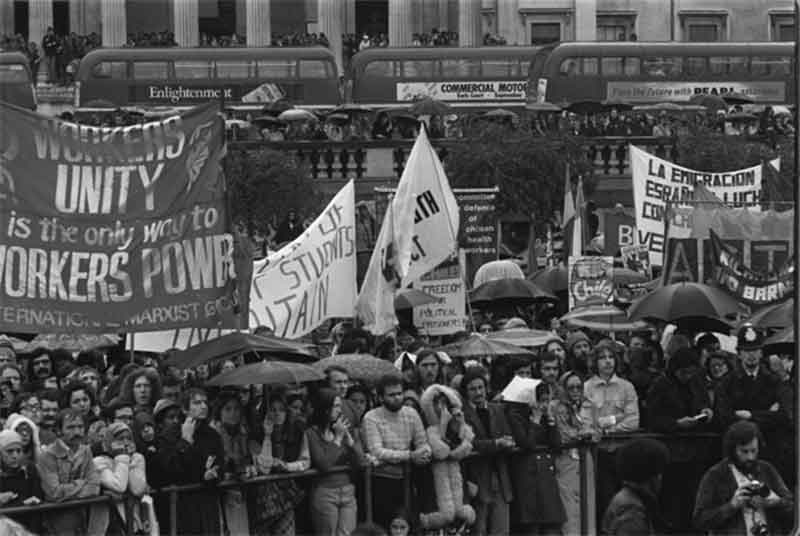
Photo caption. A rally organized by the Chile Solidarity Campaign, addressed by the widow of Salvador Allende, in Trafalgar Square, London, September 1974. Credit: PA Images via Getty Images, accessed at jacobin.com
The persistence of working-class support for right-wing, authoritarian, and openly fascist regimes constitutes one of the most vexing questions of modern politics. Why do workers, whose material interests are objectively opposed to capital, support regimes that ultimately serve capital? Why did German workers vote for Hitler even as their unions were being destroyed and their wages suppressed? Why do Indian informal workers chant religious slogans even as their wages stagnate and their children go hungry? These questions are not merely academic; they are urgent political problems that demand a rigorous theoretical response.
The conventional explanations for this phenomenon are inadequate. The liberal-secular response, associated with scholars such as Martha Nussbaum and Rajeev Bhargava, treats working-class support for authoritarianism as false consciousness, a failure of education, a return of pre-modern obscurantism, or a temporary lapse of reason (Nussbaum 2007; Bhargava 2010). This explanation, while morally comforting, cannot account for the rationality of subaltern support for authoritarian regimes. It assumes that workers are simply deceived, rather than making calculated choices within constrained circumstances. The orthodox Marxist response, found in certain quarters of the Left, reduces the phenomenon to economic determinism: workers vote for the right because they are bought off or terrified into submission (Patnaik 2017). This explanation, while materialist in orientation, cannot account for the active, enthusiastic, and often self-sacrificing nature of working-class participation in right-wing movements. It reduces workers to passive objects of manipulation rather than active subjects of history.
This essay builds upon these explanations rather than simply replacing them. Nussbaum and Bhargava are correct that ideology matters; Patnaik is correct that material conditions constrain. What is missing is an account of how these dimensions interact, how regimes actively produce new kinds of working-class subjects, and how consent and resistance coexist as simultaneous and contradictory phenomena. Such a framework must be materialist without being economically determinist, must recognise the importance of ideology without treating it as mere manipulation, and must account for both consent and resistance.
This essay explores two primary questions. First, why do working-class sections support right-wing regimes despite the fact that these regimes are pro-capitalist? Second, how is the working class related to these regimes, what are the mechanisms of integration, and what forms does resistance take? Drawing on the comparative historical analysis of five cases, Nazi Germany, Fascist Italy, Francoist Spain, Imperial Japan, and Pinochet’s Chile, and applying this framework to contemporary India, the essay develops a theoretical account of working-class incorporation under right-wing authoritarianism.
This essay does not claim that contemporary India replicates historical fascism in its entirety. Rather, it traces a family resemblance in the mechanisms through which right-wing authoritarian regimes incorporate fragmented working classes: atomisation through informalisation, the dual substitution of psychological and selective material wages, and the manufacture of a permanent Other. The comparison is thus analytical, not historical; it seeks structural homology, not replication.
I use “fascism” here not as a rhetorical charge but as an analytical framework defined by the five propositions developed below. Contemporary India does not replicate every feature of historical fascism; elections continue, opposition parties function, and the Constitution remains formally intact. But the mechanisms of working-class incorporation, atomisation, selective material wages, the manufacture of a permanent Other, and the repression of independent organisation, display a family resemblance that demands comparative analysis. Whether the regime evolves into a fully fascist form is less important than understanding how it currently operates.
Theoretical Foundations: Six Propositions on Fascism and the Working Class
Before proceeding with the empirical analysis, we must establish the theoretical groundwork. The following six propositions, developed through our engagement with the Bologna framework and the comparative cases, provide the analytical backbone of this essay.
The first proposition is that fascism is a historically recent and quite modern phenomenon. It is not found in ancient or medieval contexts. Fascism is unthinkable without mass industrial capitalism, the nation-state as the primary political unit, modern propaganda technologies, and the emergence of a mobilized but politically disoriented petty bourgeoisie. Pre-modern tyrannies were personal or dynastic; they did not claim to be the total fusion of state, nation, and people. Fascism is a mass phenomenon requiring mass participation, mass media, and mass psychological manipulation. It is capitalism’s modern answer to socialism’s modern challenge (Bologna 1993; Gramsci 1971).
The second proposition is that fascism is a pro-bourgeois and pro-capitalist movement. However, it is not simply pro-bourgeois in the liberal sense of free markets, free trade, and parliamentary rule. Fascism is pro-big capital while rhetorically attacking plutocracy and finance capital. In practice, it destroys small bourgeois competition through cartelization, protects monopoly capital, and guarantees profit by crushing labour. In ideology, it disciplines the bourgeoisie too, demanding that they subordinate their short-term profit to the national project of war, autarky, and expansion. Fascism is thus pro-capitalist as a system but anti-liberal as a method. It saves capitalism from the bourgeoisie’s own internal squabbles and from the proletariat’s revolt (Bologna 1993; Poulantzas 1974; Jaffrelot 2021).
The third proposition is that on the surface fascism may appear anti-any religion, ethnicity, language, or region, but at its core it is always anti-working class. Fascism weaponizes identities such as religion, ethnicity, region, and language to fragment the working class horizontally. The enemy is never the capitalist; it is the Jew, the Muslim, the migrant, the communist, the outsider. The core project is to destroy all independent working-class organization, including unions, cooperatives, mutual aid, and strike committees. Even when fascism uses workerist rhetoric such as national syndicalism and labour dignity, it evacuates those terms of any class content. The Nazi regime called itself Socialist and had Labour Fronts, but abolished the right to strike on Day One. The anti-working-class core is not a secondary effect; it is the primary function (Bologna 1993; Mason 1993; Teltumbde 2018).
The fourth proposition is that fascist regimes emerge to save capitalism in crisis, but they ultimately end up widening capitalism’s inherent contradictions. This is not merely a hypothesis; it is historically demonstrable. Nazi Germany temporarily stabilized capital via rearmament, state contracts, and plunder. But it overheated the economy, required permanent expansion, and collapsed in total war, leaving Germany physically and economically destroyed. Fascist Italy followed a similar trajectory of imperial overreach in Ethiopia, Albania, and the Second World War, ending in military defeat and economic ruin. Pinochet’s Chile saved capital via neoliberal shock therapy, but created extreme inequality, deindustrialization, and a debt crisis that haunt Chile to this day. The dialectical mechanism is that fascism cannot resolve capitalism’s internal crisis because it refuses to touch private property relations. It can only export the crisis through war, plunder, or austerity, or intensify it through rearmament. Eventually, the contradiction between national autarky and global capital, or between militarism and productive investment, bursts through (Bologna 1993; Mason 1993; Moulian 1997; Patnaik 2017).
The fifth proposition is that fascism as an ideology is not organic, either in the Gramscian sense of spontaneous, lived, and sedimented common sense arising from material conditions, or in the biological sense of emergent, self-sustaining, and affective bonds of care and loyalty that hold a collective together. Instead, it is superimposed, instrumental, and driven by parasitic interests, lacking the rooted, generative cohesion of working-class consciousness or even pre-human social bonds (Gramsci 1971; Teltumbde 2018). Working-class consciousness is grown in the workplace, in the mohalla, in the strike, in the shared experience of exploitation. It has depth, texture, and self-reproducing character, even when incomplete or contradictory. Fascism, by contrast, is written from above by intellectuals, generals, industrialists, and propagandists; it is broadcast, not incubated; it requires constant artificial reinforcement through rallies, slogans, parades, and surveillance; and it collapses rapidly when the coercive apparatus weakens, as seen in 1945 Germany and 1943 Italy. Organic ideology is calm in its certainty; fascist ideology is hysterical in its insecurity.
However, we must add a critical refinement to this fifth proposition. While fascism is initially superimposed, if it holds power long enough, approximately a generation or fifteen to twenty years, it can sediment into the common sense of a population, especially if alternative institutions such as unions, clubs, and churches are destroyed; if education and media are fully captured; and if the working class is atomized and materially pacified. Under such conditions, fascist ideology can feel organic to the masses, not because it is, but because all other reference points have been erased. It becomes a second nature, a false organicity. Franco’s Spain, after forty years, saw many Spaniards internalize national-Catholic ideology as just the way things are. Contemporary India, after a decade of relentless majoritarian messaging, sees many young workers genuinely believe that Hindu identity precedes class identity. That belief is felt as organic, even though it was manufactured (Gramsci 1971; Teltumbde 2018; Jaffrelot 2021). In Gramsci’s terms, the chimera does not achieve hegemony, the spontaneous consent of the governed, but rather a statolatry that must be constantly reinforced because it lacks the contradictory plurality of genuine common sense (Gramsci 1971: 276).
To these five propositions, we add a sixth, which emerges specifically from the Indian case: caste operates as a distinctive mechanism of fragmentation that differs qualitatively from the class and political fragmentations analysed by Bologna in the German context. Where the German working class was divided horizontally by skill, sector, and party affiliation, the Indian working class is divided vertically by a graded hierarchy of caste that structures not only occupation and income but also social dignity, marriage, and access to public space. This vertical fragmentation is more rigid and more durable than horizontal class divisions, and it provides the chimera with a uniquely stable foundation (Ambedkar 1936 [2014]; Teltumbde 2018; Guru 2009).
The Bologna Framework: Nazi Germany as the Paradigm
Sergio Bologna’s 1993 lecture, “Nazism and the Working Class,” delivered at the Milan Camera del Lavoro, represents a decisive intervention in the historiography of working-class behaviour under fascism (Bologna 1993). Bologna broke sharply with two dominant narratives: the liberal or social democratic view that the German working class was simply deceived or bought off by Hitler, and the orthodox Marxist view that the working class was entirely crushed, passive, and reduced to a mere object of history after 1933. Bologna’s central argument, drawing on Timothy Mason’s foundational research, was that Nazism was a response to the high level of working-class organisation and militancy in Germany, not merely a substitute for it (Mason 1993). The Nazis did not simply destroy the working class; they re-organised it. The German Labour Front was not just a tool of repression; it was a modernising apparatus that brought workers into a relationship of negotiated dependence with the state. The KdF, or Strength Through Joy, offered holidays, sports, and cheap consumer goods. This was the selective material wage.
Mason’s work, which Bologna championed, showed that from 1936-37 onwards, there was passive resistance, which often became active, among the German working class. There were strikes, to which the regime was forced to respond with repressive measures (Mason 1993). Bologna thus completely overturned the dominant view which claimed that there was no resistance to the Nazi regime from within the working class except during the first few months of its rise. His intervention was not merely historiographical; it was political. By demonstrating that the working class was never fully pacified, Bologna opened the question of why that resistance did not become more widespread and more effective.
To understand why the Nazi regime’s strategy of integration succeeded, we must first understand the class composition of the German working class in the final years of the Weimar Republic. Bologna’s analysis of the statistics is devastating: by the end of the Weimar Republic, the number of workers employed in factories with fewer than ten employees stood at approximately seven million out of a total of fourteen and a half million, thus around 50 per cent of the workforce (Bologna 1993: 8). This is not a picture of a monolithic, factory-based proletariat. It is a picture of an atomised, fragmented, and precarious workforce. The Weimar Republic was an extraordinary laboratory of modernity, not in the sense of the big Fordist factory, but in the sense of a decentralisation of production that permitted better political and trade-union control of the workforce.
Bologna highlights a figure that resonates profoundly with our analysis of the Indian informal worker: the Lohnarbeiter wechselnder Art, the mobile waged worker who moved from one sector to another without fixed employment in any particular sector. These were not necessarily unskilled workers; they could be skilled workers selling their labour here and there, at higher rates than they could have obtained by remaining in one particular workplace. Nine hundred thousand of these mobile workers were unemployed in 1931; by 1933 the figure was 1,296,000. In Berlin, at the height of the Depression, they represented 45 per cent of the unemployed, and in districts such as Kreuzberg, 48 per cent (Bologna 1993: 9). The political implications of this fragmentation are profound. The Social Democratic unions had concentrated on the component of the working class employed in big factories, where trade union agreements were more or less respected. But this vast territory of the micro-factory, of micro-work, was a territory governed by unwritten rules and family-type relations of control.
The Communist Party, meanwhile, was a party with a membership made up of 80 per cent unemployed workers by 1931. At the party’s organising conference in Berlin-Brandenburg, one of the Communist Party’s strongholds, 878 of the 940 delegates present were unemployed (Bologna 1993: 12). The result was a profound political fragmentation. The SPD and KPD were not two wings of a single labour movement; they were two hostile cultures, two different mentalities. As Bologna puts it, it was not simply a question of two separate political lines, of different strategies of leaderships that were at loggerheads with each other; it was a question of two cultures, two different and hostile mentalities, so that unity at the grassroots level was just as difficult, if not more difficult, to create, as unity at the top (Bologna 1993: 14).
Bologna’s most original contribution is his analysis of the Weimar welfare system. He shows that the system was not a benevolent safety net but a sophisticated apparatus of control, surveillance, and atomisation. The system was organised around three forms of intervention: the Arbeitslosenunterstützung, which was unemployment benefit available only to those who had contributed for a certain period, those who had been continuously employed over a period of years; the Krisenunterstützung, which was benefit available for exceptional crisis situations in individual industrial districts or factories, available to precarious workers who had not accumulated sufficient contributions for ALU; and the Wohlfahrtsunterstützung, which was poor relief paid by individual municipal councils, discretional, humiliating, and expected to be repaid (Bologna 1993: 15-17). As the Depression deepened, the system increasingly pushed workers from the first two tiers into the third. By March 1933, when Hitler was already in power, ALU recipients had become a minority. The vast majority ended up in the third pool, subjected to a highly discretional system, monitored, and saddled with lifelong debts to their respective municipal authorities.
The result of driving the unemployed onto the system of municipal welfare was to create an army of people obliged to go asking for charity from a bureaucrat, who very often judged their needs solely on the basis of subjective impressions. The unemployed could receive social security only if they succeeded in convincing the benefits officer in a face-to-face interview. This led to the creation of a mass of millions of people who were open to blackmail (Bologna 1993: 18). The system thus progressively lost almost all its character as a social service, and became increasingly a supplementary policing system over the weaker parts of society. It divided and selected, creating further systems of degradation, but above all institutionalising social differences. Bologna’s analysis of the welfare system is crucial for our comparative framework because it reveals the function of welfare under authoritarian regimes: not to alleviate poverty, but to manage it, to atomise the poor, to surveil them, to create dependency, and to prevent collective action.
The Nazi regime inherited this fragmented and atomised working class and perfected the system of control. But it also added something new: the indirect wage. Bologna critiques the revisionist historians, such as Rainer Zitelmann, who argued that Hitler was a true working-class leader who set in motion highly advanced social policies (Zitelmann 1990). He dismisses this as a reading based on Hitler’s speeches rather than on material reality. But he does acknowledge that the Nazi regime offered material concessions: the KdF programme, which provided cheap holidays, sports, and consumer goods; the promise of the KdF-wagen, the Volkswagen; and the expansion of social insurance (Bologna 1993: 20-21). These concessions were not distributed evenly. They were targeted at the labour aristocracy, skilled workers in core industries such as automobile, chemicals, and armaments, who were offered proletarian privilege in exchange for political quiescence. The regime’s strategy was to integrate this section of the working class through material concessions while repressing the rest.
The integration was real, but it was limited. It depended on the continued delivery of material goods, which in turn depended on the regime’s military conquests and the exploitation of forced labour (Herbert 1979; Roth 1987). When the war turned against Germany, when material shortages bit, the workers resisted through slowdowns, absenteeism, and the famous 1943 strikes in the Ruhr and Berlin (Mason 1993: 345-350). Bologna poses the crucial question: why was it that the passive resistance to Nazism did not then translate into active resistance, into an open demonstration of antagonism, and why was there not a sacrifice of struggle against Nazism by the working class and the German proletariat, such as could be presented to the judgement of history as an element of its memory? His answer is implicit in his analysis: because the conditions for active resistance, collective organisation, shared identity, a clear enemy, and a transformative vision, were absent or suppressed (Bologna 1993: 22-23). The working class was atomised by the structure of production, fragmented by the welfare system, divided by political culture, and integrated through selective material concessions. But the integration was never total. The 1943 strikes, the passive resistance that Mason documented, and the survival of working-class memory and culture all suggest that the chimera of integration was fragile, contingent, and ultimately unsustainable.
Comparative Cases: Italy, Spain, Japan, Chile
Having established the Bologna framework, we now turn to four comparative cases. Each case illuminates a different mechanism of working-class integration, and each reveals the fragility of that integration. The Italian case is the earliest of our comparative cases, and it provides the theoretical foundation for much of our analysis through the work of Antonio Gramsci, who wrote his Prison Notebooks from Mussolini’s prisons (Gramsci 1971). The Italian fascist regime operated through corporatism, the absorption of unions into the state. Workers and employers were forced into state-controlled syndicates that mediated wages and working conditions, but outlawed strikes. The regime also offered the Dopolavoro, the fascist after-work organisation that provided cheap holidays, sports, and cultural events (Passerini 1987: 45-67). This was the selective material wage, a palliative that mimicked welfare. The regime also expanded social insurance, including pensions, health insurance, and accident compensation, but as a gift from the state, not as a right earned through struggle. The 1929 Lateran Pact brought the Church into the fascist state, enabling the use of Catholic social doctrine to discipline workers through parish networks and familial ideology (Spriano 1964: 89-112). The regime’s social base was the petty bourgeoisie, agrarian elites, and some industrial workers, the labour aristocracy of the Italian industrial triangle of Turin, Milan, and Genoa.
The resistance emerged when the regime’s coercive capacity weakened. In 1943-44, in the wake of Mussolini’s fall and the German occupation, Italian workers in Turin, Milan, and Genoa spontaneously re-established factory councils, similar to the 1919-20 Soviets (Spriano 1964: 234-256). The partisan resistance of 1943-45 demonstrated that fascism had not achieved hegemony; it had achieved domination, which collapsed when the war turned. The key insight from the Italian case is that corporatism, the absorption of unions into the state, is the primary mechanism of working-class integration. The Dopolavoro is the selective material wage. But the cracks, the factory councils of 1943-44, appear when the state’s coercive capacity is weakened.
The Spanish case is the most repressive of our comparative cases. The regime offered minimal material concessions, relying instead on repression and ideological control (González Calleja 2012; Martín Ramos 2010). The Francoist regime operated through vertical syndicates, where workers and employers were organised into the same vertical syndicates by industry, outlawing class-based trade unionism. The regime’s policy of autarky, economic self-sufficiency from 1939 to 1959, meant chronic scarcity of consumer goods, and working-class consumption was severely depressed. This was not a palliative regime; it was repressive with minimal concessions. The regime also relied on Catholic paternalism, with the Church integrated into the regime, propagating the ideology of the familia española: work as duty, poverty as virtue, and strikes as sin (Martín Ramos 2010: 78-95). The social wage was minimal, and housing, health, and education remained profoundly inadequate. The regime’s social base was the agrarian oligarchy, the Church, the military, and a fragmented working class that was too atomised to organise effectively.
The resistance emerged in the 1960s, with clandestine strikes in the Asturian coal mines in 1962, the Basque industrial zone, and Madrid. The Comisiones Obreras emerged as a clandestine trade union movement that operated within the Vertical Syndicates, a brilliant example of counter-hegemonic practice (González Calleja 2012: 234-256). In the final years of the regime, strikes became massive and politicised, demonstrating that the working class had never accepted the regime’s legitimacy. The key insight from the Spanish case is that Francoist Spain represents minimal integration. The regime was overwhelmingly repressive, offering very few selective material benefits. The working class was atomised and disciplined through poverty and fear, but when the regime weakened after Franco’s death in 1975, massive working-class mobilisation erupted. This suggests that palpable material concessions, as seen in the Nazi and Italian models, may be more effective in integrating workers than pure repression. Repression creates latent opposition; concessions create loyalty, but only while they are delivered.
The Japanese case is distinctive because it was not a mass party movement like Germany or Italy but a state-led mobilisation by the zaibatsu, industrial conglomerates, the military, and the bureaucracy (Itoh 1997; Sugimoto 1979). The Japanese regime operated through enterprise unionism, where unions were organised within individual companies, not across industries. This atomised workers and prevented class-wide solidarity. The regime also offered lifetime employment for the minority of workers in large corporations, which created a labour aristocracy that identified with the company, not with the class. The regime also used seniority wages, where wages increased with age, creating a generational hierarchy within the workforce that disciplined younger workers (Sugimoto 1979: 112-134). The Pan-Asianist ideology, experienced by colonised populations as imperialist domination, told Japanese workers that their sacrifices, which included low wages, long hours, and military service, were necessary for the liberation of Asia from Western imperialism. This was the psychological wage: the worker was not an exploited subject but a participant in a great civilisational project. The regime’s social base was the state-bureaucratic elite, the zaibatsu, and the rural petty bourgeoisie. The labour aristocracy in large corporations was the primary base of support within the working class.
The resistance emerged in the coal mines of Hokkaido and Kyushu in the 1930s, often led by women and young workers (Sugimoto 1979: 145-167). Wartime slowdowns and absenteeism were common as the war turned against Japan after 1942. The 1945-46 labour offensive, a wave of strikes, factory occupations, and unionisation, demonstrated that the integration achieved by the wartime regime was shallow and collapsed with the state’s coercive apparatus (Itoh 1997: 89-112). The key insight from the Japanese case is that Imperial Japan demonstrates the enterprise-union model of atomising workers through company loyalty rather than class solidarity. The selective material wage, lifetime employment, was limited to a minority of workers; the majority in small firms, agriculture, and colonial territories were super-exploited. The psychological wage, Pan-Asianism, was the primary integrative mechanism. When the war failed to deliver its promises, both the material and psychological wages collapsed.
The Chilean case is the most recent and the most neoliberal of our comparative cases. The regime did not offer a welfare or corporatist integration; it offered atomisation through marketisation (Moulian 1997; Winn 1986; Barrera 1979). The Pinochet regime operated through neoliberal shock therapy, deregulating labour markets, privatising state enterprises, and slashing social spending. The working class was atomised, and workers could no longer organise because jobs were precarious and casualised. The Labour Plan of 1979 was the regime’s counter-revolutionary legal framework: it outlawed industry-wide unions, restricted collective bargaining to the individual enterprise, and made strikes illegal for essential services (Barrera 1979: 67-89). The regime deliberately expanded the informal sector, including street vending, casual labour, and domestic work, isolating workers from each other and preventing the spatial and social proximity that makes union organising possible. Unlike Nazi Germany or Italy, Chile dismantled welfare, and health, education, and pensions were privatised. The worker was left to fend for herself in the market. The psychological wage was negative: the regime used the fear of the Unidad Popular, Allende’s socialist government, to maintain support among the middle classes: “You may be poor, but at least you are not a communist” (Moulian 1997: 45-67). The regime’s social base was big capital, both domestic and international, the military, and the middle classes.
The resistance emerged in the 1983-87 National Protests, led by the pobladores, shantytown dwellers, students, and workers (Winn 1986: 234-256). The regime responded with massive repression, with over one thousand killed and thousands tortured. The copper mine strikes were a site of resistance; the miners, despite the regime’s repression, organised clandestine strikes and slowdowns (Winn 1986: 267-289). The poblador movement, which organised around the shantytowns, suggests that spatial organisation can substitute for workplace organisation when the latter is destroyed. The key insight from the Chilean case is that Pinochet’s Chile represents neoliberal integration, destroying the working class’s capacity to organise through atomisation and informalisation. Unlike Nazi Germany or Italy, there is no selective material wage; there is only fear and survival. This is the most fragile form of integration, producing constant resistance, but resistance that is sporadic and easily repressed.
Theoretical Synthesis: The Logic of Integration and the Chimera of the Working Class
From the comparative analysis, we can extract the core theoretical insight. Right-wing authoritarian regimes do not merely suppress the working class; they reorganize it. They operate through a dual substitution. The first is the psychological wage: national pride, civilisational restoration, racial or civilizational superiority, and the promise of belonging to a great nation. The second is the selective material wage: targeted welfare, consumer goods, and palliatives that manage poverty without abolishing it. This substitution is the chimera of integration. The worker receives something real, pride, belonging, a gas cylinder, a house, but in exchange, she surrenders the possibility of structural transformation. The chimera offers the appearance of empowerment while foreclosing the reality.
I use “chimera” to denote an incorporative regime that offers the appearance of empowerment, psychological belonging and selective material benefits, while foreclosing structural transformation. Unlike “hegemony,” which implies consent to a total worldview, the chimera is knowingly partial: workers recognise its limits but accept its terms within a constrained field of alternatives. The chimera is not a false consciousness in the classical sense; it is a rational response to a structure that forecloses more transformative possibilities. The worker who accepts the gas cylinder and the Ram Mandir is not deluded; she is making the best of limited options in a political economy that has made land reform, universal social security, and robust labour rights unavailable.
This theoretical synthesis directly addresses our two primary questions. Why do working-class sections support right-wing regimes despite the fact that these regimes are pro-capitalist? Because the regimes offer a dual compensation for the absence of structural transformation: a psychological wage that provides a sense of belonging and dignity, and a selective material wage that provides immediate, tangible benefits. The worker is not fooled; she is making a rational choice within a structure that limits alternatives.
The question of how the working class is related to these regimes is answered through the mechanisms of integration. The working class is atomised through the fragmentation of production and the welfare system. A labour aristocracy is created that benefits from selective material wages. A permanent Other is manufactured that unifies the fragmented working class against a common enemy. And independent working-class organisation is repressed.
I use the term “labour aristocracy” advisedly, not in the classical Leninist sense of a stratum bought off by imperial super-profits, but to describe a relatively privileged segment within India’s informalised workforce, government employees, small traders, and skilled workers, whose material stability depends on regime patronage rather than class organisation. This stratum is not a “labour aristocracy” in the classical sense; it is a “beneficiary stratum” whose relative privilege is contingent on the regime’s continued delivery of selective material wages.
The chimera of integration is fragile. It depends on three conditions. The first is the continued delivery of the selective material wage. When inflation rises, when the subsidy is cut, when the house is built without water or electricity, the worker experiences the failure of the chimera. The second is the continued manufacture of a permanent Other. When the Other is over-produced, it can trigger backlash. When the Other is humanised through daily contact or through shared struggle, the chimera cracks. The third is the continued fragmentation of the working class. When workers organise across caste, religious, and regional lines, the chimera’s logic is broken.
Right-wing regimes both exploit existing fragmentations and actively produce new ones. The German working class was already divided by SPD/KPD hostility; the Nazi regime intensified this division while introducing new racial cleavages. Similarly, caste and religious divisions pre-existed Hindutva, but the regime has manufactured novel anxieties, “love jihad” and “land jihad,” that did not exist in their current form prior to 2014. The regime’s strategy is to intensify these fragmentations through the manufacture of a permanent Other, such as the Jew, the Muslim, or the foreigner; through the targeting of welfare to create a labour aristocracy that identifies with the regime; and through the repression of collective organisation, including unions, strikes, and protests.
The comparative cases reveal that resistance is always present, but it takes different forms. Everyday resistance includes slowdowns, absenteeism, and sabotage, as seen in Nazi Germany, Imperial Japan, and contemporary India. Organised resistance includes strikes, protests, and uprisings, as seen in Nazi Germany in 1943, Fascist Italy in 1943-44, and Pinochet’s Chile in 1983-87. Organisational resistance includes clandestine unions, factory councils, and poblador movements, as seen in Francoist Spain with the CCOO, Fascist Italy with the factory councils, and Chile with the pobladores. Cultural resistance includes music, poetry, and street theatre, as seen in contemporary India with the Kabir Kala Manch and the Jana Natya Manch. The shift from everyday resistance to organised resistance depends on the weakening of the regime’s coercive capacity, such as war or economic crisis; the development of alternative organisational forms, such as factory councils, clandestine unions, or neighbourhood committees; and the emergence of a transformative vision, such as socialism, anti-caste politics, or cross-religious solidarity.
The Indian Case: The Chimera of Hindutva
We now apply this theoretical framework to contemporary India. The first step is to understand the transformation of class composition under neoliberalism and the post-2014 political order. Ninety-two per cent of the Indian workforce is now informal. This is not a residual category; it is the dominant form of labour (National Statistical Office 2024). The informal worker is the construction worker, who is migrant, male or female, living in a jhuggi, paid daily, with no contract and no security; the domestic worker, who is female, often Dalit or Muslim, working in multiple homes, invisible to labour law; the platform gig worker for companies such as Zomato, Swiggy, Uber, and Ola, who is an entrepreneur on paper but a precarious worker in reality; the waste-picker, who is Dalit and often women, engaged in the most stigmatised labour yet essential to urban ecology; and the street vendor, who sells vegetables, chai, or garments without a license and is constantly threatened by eviction (Agarwala 2013; Breman 2013). The formal-sector worker, who is unionised, protected, and relatively secure, is a shrinking minority. The new labour aristocracy is the caste-labour aristocracy: the relatively privileged among SCs, STs, and OBCs, including government employees, small traders, and skilled workers, who benefit from the chimera’s selective wages (Jaffrelot 2021). The Indian informal worker is the direct descendant of the Lohnarbeiter wechselnder Art, the mobile, precarious worker who moved from sector to sector without fixed employment. The chimera exploits this atomisation.
The Hindutva regime operates through the same logic of substitution we have identified in the comparative cases. The psychological wage is Hindu pride. The RSS’s shakha in the mohalla offers physical training, community, and a narrative of civilisational restoration (Hansen 2001; Anderson and Damle 2019). The Ram Mandir is the symbol of this restoration, a visible, monumental, and emotionally resonant achievement (Jaffrelot 2021). The CSDS-Lokniti 2024 data shows that 22.4 per cent of respondents named the Construction of Ram Mandir as the most liked work of the central government, above any economic achievement (CSDS-Lokniti 2024: Q11a). The psychological wage is the promise of dignity without redistribution. The lower-caste Hindu is offered a sense of belonging in the Hindu nation, even as she remains at the bottom of the caste hierarchy.
The RSS shakha operates through what Hansen calls “spectacular politics”: daily drill, uniformed discipline, and masculine camaraderie produce a somatic sense of belonging that precedes ideological commitment (Hansen 2001: 178-195). The Ram Mandir offers a monumental, visible achievement that confers dignity without redistribution. The shakha is not merely an ideological apparatus; it is an affective community that meets the worker’s need for belonging, discipline, and purpose in a world of precariousness and atomisation.
The selective material wage is palliative welfarism. The BJP-led government has implemented an extensive array of welfare schemes. The Ujjwala scheme provides free gas cylinders, which addresses cooking fuel but not energy poverty. The PMAY scheme provides subsidised housing, which is moderate in transformative potential as housing is an asset, but quality is often poor. The Ayushman Bharat scheme provides health insurance, which is low in transformative potential as insurance does not equal accessible healthcare and the private sector captures much of the benefit. The PM-KISAN scheme provides cash transfer of six thousand rupees per year, which is insufficient to lift small farmers out of poverty and does not address land reform. The DBT scheme provides cash transfer for various subsidies, which has low transformative potential as it provides efficiency gains but no change in the subsidy structure (Drèze and Khera 2022). None of these schemes challenges the underlying structure of inequality. They are palliatives that manage poverty without abolishing it. They bind the worker to the state through a relation of patronage rather than right (Chatterjee 2004).
The CSDS-Lokniti 2024 data on credit attribution is revealing: among those who benefitted from Ujjwala, 68.3 per cent credited the central government; among those who benefitted from housing schemes, 63.9 per cent credited the central government (CSDS-Lokniti 2024: Q19b). The state government, which often implements these schemes on the ground, receives far less credit. This is not accidental; it is the result of a deliberate communication strategy that brands schemes as Modi’s guarantees and ties benefits directly to the Prime Minister’s image. The credit attribution data suggest that the selective material wage operates not only through material self-interest but through what Honneth calls “recognition”: the worker experiences the gas cylinder or the house not merely as a commodity but as proof that the state sees her (Honneth 1995: 25-45). This affective dimension makes the chimera harder to dismantle through counter-information alone.
The manufactured Other is the Muslim as enemy. The Muslim is constructed as a demographic threat, a job-stealer, a seducer of Hindu women through love jihad, and an encroacher on Hindu land through land jihad (Jaffrelot 2021; Ahmad 2022). The CSDS-Lokniti 2024 data shows the depth of majoritarian political culture: 50.2 per cent agreed that the will of the majority community should prevail; 69.7 per cent agreed that minorities should adopt the customs of the majority (CSDS-Lokniti 2024: Q12, Q30). These are not merely incidental attitudes; they constitute the ideological substrate upon which the chimera is built. As Hansen has argued, the RSS’s genius lies in its ability to transform the majority into a minority, numerically dominant but culturally, politically, and existentially threatened (Hansen 2001: 171). In this narrative, the claim to power is never a claim to domination; it is always a claim to restoration. The Hindu is not becoming dominant; he is reclaiming what was always his.
The Indian chimera is distinctive because the psychological wage is structured by caste. The RSS’s strategy is to subsume caste identities within a Hindu frame, offering lower-caste Hindus a sense of belonging in the Hindu nation while maintaining the caste hierarchy (Jaffrelot 2005; Teltumbde 2018). Ambedkar’s insight, developed in Annihilation of Caste, is crucial here: caste is not merely a division of labour but a division of labourers, a graded hierarchy that prevents the emergence of class solidarity by setting the oppressed against each other (Ambedkar 1936 [2014]: 87-92). The Indian chimera exploits this graded hierarchy, offering lower-caste Hindus a psychological wage that compensates for their material subordination without challenging the structure that produces it.
The evidence is clear. The BJP’s leadership remains overwhelmingly savarna, and over seventy per cent of the RSS’s highest decision-making body, the Akhil Bharatiya Pratinidhi Sabha, are from upper castes (Suryawanshi 2019: 45-48). The material benefits of the Hindutva project accrue disproportionately to upper castes, and the top ten per cent holds over sixty per cent of national wealth (World Inequality Database 2024). Caste violence persists, and crimes against SCs have increased 41 per cent from 2014 to 2022 (National Crime Records Bureau 2023). The chimera of Hindu unity is the promise of collective power and civilisational restoration in exchange for political loyalty, leaving the structures of caste and class exploitation intact.
The National Election Study 2024 provides empirical weight to our analysis. The BJP’s vote share in 2024 was 52 per cent among General or savarna castes, which was a decline of three per cent from 2019; 41 per cent among OBCs, which was a decline of four per cent; 24 per cent among SCs, which was a decline of seven per cent; and 35 per cent among STs, which was a decline of five per cent (CSDS-Lokniti 2024: Table 8). The BJP’s support is highest among General castes, lower among OBCs, and significantly lower among SCs and STs. The decline in support from 2019 to 2024 was sharpest among SCs and STs. The chimera is cracking, and lower-caste Hindus, particularly Dalits, are moving away from the BJP.
The NCRB data shows a consistent increase in crimes against SCs and STs from 2014 to 2022. NCRB data indicate that crimes against SCs rose by 41 per cent between 2014 and 2022, from 40,801 to 57,582 (National Crime Records Bureau 2015-2023). The NCRB revised its recording methodology in 2018, which may partially account for the apparent increase. However, the trend remains robust even controlling for this change. The rhetoric of Hindu unity has not reduced atrocities; it has emboldened perpetrators, who feel that the state will not act against them.
The BJP’s decline from 303 to 240 seats in the 2024 Lok Sabha elections is a political expression of fragmentation. The sharpest declines were among SC and ST voters, and in states where economic distress is highest. The opposition’s counter-narrative, “save the Constitution,” “protect reservation,” and “caste census now,” gained traction because it spoke to material anxieties that the chimera could no longer manage (Election Commission of India 2024). While this essay emphasises class-caste defection, the 2024 results also reflected regional party resurgence, such as SP-Congress in Uttar Pradesh and TMC in Bengal, the Agnipath agitation affecting upper-caste youth, southern states’ continued resistance, and local anti-incumbency. These factors are not mutually exclusive with the argument presented here.
The chimera is showing stress fractures. The material contradiction of inflation, unemployment, and rising inequality is eroding the selective material wage. The CSDS data shows that 23.8 per cent named price rise or inflation as the most disliked government work, and 23.1 per cent named growing unemployment (CSDS-Lokniti 2024: Q11b). The caste contradiction is that caste violence persists despite the rhetoric of Hindu unity. The demand for a caste census, which the BJP resists, reveals the persistence of caste as a material structure (Jaffrelot 2021). The religious contradiction is that the Muslim as the manufactured Other is contested. The 2024 election saw increased Muslim turnout, and the opposition’s counter-narrative challenged the BJP’s communal frame (CSDS-Lokniti 2024). The gender contradiction is that the woman who works in domestic labour, construction, or beedi rolling and struggles for food, water, and safety experiences a contradiction: she is praised but not liberated (Agarwala 2013; Breman 2013).
The regime manages the tension between upper-caste dominance and lower-caste inclusion through what Jaffrelot calls “ethnic democracy”: lower-caste inclusion is symbolic rather than structural (Jaffrelot 2021: 23-35). The OBC Vice-Presidency, the SC President, and the ST iconography of welfare schemes offer representational inclusion while economic power remains concentrated in savarna hands. The chimera offers lower-caste Hindus a psychological wage of Hindu pride and belonging to a great civilisation; a selective material wage of the gas cylinder, the house, and the bank account; and a promise of social mobility, the possibility of moving up the caste hierarchy without abolishing it. In exchange, lower-caste Hindus are asked to accept the persistence of caste hierarchy, as they remain at the bottom of the caste order; the subordination of caste to Hindu identity, where caste is secondary and Hindu unity is primary; and the manufacture of the Muslim Other, where the enemy is the Muslim, not the savarna capitalist. This is the double chimera of the Indian case: dignity without redistribution for lower-caste Hindus; security without structural change for upper-caste Hindus.
Resistance in India takes multiple forms. Gig workers for Zomato, Swiggy, and other platforms have engaged in strikes and protests over pay cuts and working conditions in 2020-2024, demonstrating that even the most atomised workers can find ways to organise (PTI 2021). The Bhim Army has intervened in Dalit labour struggles in Maharashtra and Uttar Pradesh, linking caste assertion to material demands. Everyday resistance in informal workplaces, including slowdowns, absenteeism, and tool sabotage, is widespread, echoing the passive resistance that Mason documented in Nazi Germany. The Shaheen Bagh movement of 2019-2020, led by Muslim women, was a spatial occupation that transformed a neighbourhood into a site of sustained resistance, reminiscent of the poblador movements in Chile (Kaur 2020). The farmers’ movement of 2020-2021, which cut across caste, religion, and region, demonstrated that cross-identity solidarity remains possible even under the chimera’s rule. The movement was primarily an alliance of the agrarian petty bourgeoisie, though it included agricultural workers and drew support from diverse caste and religious communities. Its organisational form, the mandi committees and the sustained encampments at Delhi’s borders, offered a template for spatial resistance that the labour movement might adapt.
The four labour codes passed in 2019-20 represent a further mechanism of atomisation. By making hiring and firing easier, restricting the right to strike, and weakening collective bargaining, the codes institutionalise the informalisation that the chimera exploits (EPW 2020). They are the legal architecture of the chimera’s labour regime.
Comparison with Bologna: The Distinctiveness of the Indian Chimera
The Indian chimera shares the Nazi logic of atomisation, welfare-as-control, and the manufactured Other. But it differs in five respects that determine its specific fragility. First, caste. The German case had race, which was anti-Semitism, but not caste as a graded hierarchy. The Indian chimera operates through a caste structure that fragments the working class vertically (Teltumbde 2018; Ambedkar 1936 [2014]). Second, informalisation. The Indian informal sector is far larger than Weimar’s, at 92 per cent versus 50 per cent. The Indian worker is more atomised, more precarious, and more difficult to organise (Agarwala 2013; Breman 2013). Third, neoliberalism. The Nazi regime was statist and autarkic. The Indian chimera operates within a neoliberal framework, including privatisation, deregulation, and fiscal conservatism, that intensifies the contradictions it promises to manage (Patnaik 2017; Vanaik 2024). Fourth, democracy. The Nazi regime abolished democracy. The Indian regime operates within a formal democratic framework, including elections, rights on paper, and civil society, that both constrains and legitimises its project (Jaffrelot 2021). Fifth, the labour aristocracy. The Nazi labour aristocracy was skill-based; the Indian labour aristocracy is caste-based. This makes the Indian chimera more stable because caste is a more rigid and hierarchical structure than skill (Teltumbde 2018; Guru 2009).
Conclusion: Beyond the Chimera
This essay has explored two primary questions. First, why do working-class sections support right-wing regimes despite the fact that these regimes are pro-capitalist? The answer lies in the dual substitution that these regimes offer: a psychological wage that provides a sense of belonging and dignity, and a selective material wage that provides immediate, tangible benefits. The worker is not fooled; they are making a rational choice within a structure that limits alternatives. The second question, how is the working class related to these regimes, has been answered through the mechanisms of integration: the atomisation of the working class through the fragmentation of production and the welfare system, the creation of a labour aristocracy that benefits from selective material wages, the manufacture of a permanent Other that unifies the fragmented working class against a common enemy, and the repression of independent working-class organisation.
The six propositions with which we began have been integrated throughout the analysis. Fascism is a historically recent and modern phenomenon. It is a pro-capitalist movement that saves capitalism from its own contradictions but ultimately widens those contradictions. Its core is always anti-working class. It is not organic but superimposed, though it can become a false second nature over time. And in the Indian case, caste operates as a distinctive mechanism of vertical fragmentation.
The Indian chimera is fragile. It depends on the continued delivery of the selective material wage, the continued manufacture of a permanent Other, and the continued fragmentation of the working class. When these conditions fail, the chimera cracks. The 2024 election result is evidence of this. The farmers’ movement is evidence of this. The persistence of caste violence, the demand for a caste census, and the Muslim political assertion are all evidence of the chimera’s limits.
The chimera operates within a neoliberal framework that intensifies the very contradictions it promises to manage. Inflation erodes the value of the selective material wage. Unemployment makes the psychological wage insufficient. Caste violence exposes the lie of Hindu unity. Economic crisis creates material grievances that the chimera cannot resolve (Patnaik 2017; Drèze and Khera 2022; Vanaik 2024). The regime’s response is to intensify repression through UAPA, police violence, and criminalisation of dissent. But repression creates its own contradictions: it alienates even the regime’s own base, and it creates martyrs and symbols that galvanise opposition.
The task is not to educate the worker out of false consciousness, but to build the organisational forms that can collectivise the atomised worker. These forms must operate through the mohalla, the basti, and the neighbourhood. They must replace the selective material wage with universal rights such as land, labour rights, and social security. They must replace the psychological wage with material solidarity that is cross-caste and cross-religious. They must replace the manufactured Other with class consciousness, where the enemy is capital, not the Muslim. Existing experiments, the farmers’ movement’s mandi committees, the Shaheen Bagh model of spatial occupation, and Dalit labour organising in Maharashtra, offer partial templates for such forms (Kaur 2020; EPW 2021). The 2020 labour codes, which dismantle collective bargaining, must be contested not merely as bad policy but as the legal architecture of the chimera itself.
The chimera is a political project, not a structural necessity. Its fragility, evident in the 2024 electoral shift, the farmers’ movement, and the persistence of caste violence, suggests that the conditions of its reproduction are historically contingent rather than mechanically determined. Bologna’s final question was: why was it that the passive resistance to Nazism did not then translate into active resistance? The answer is that the organisational conditions for active resistance were absent or suppressed. The task for India is to create those conditions, through the patient, painstaking work of building the organisational forms that can translate passive resistance into active resistance, sporadic protest into sustained struggle, and fragmented consciousness into class consciousness. The work continues.