
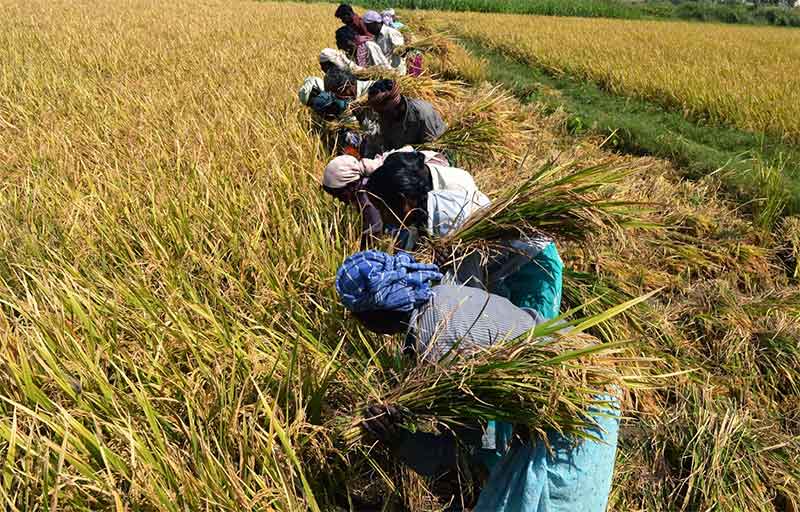
If there’s one country that captures the global battle over who controls the basic building blocks of life, it’s India.
With more than half of its 1.4 billion people dependent on agriculture for a living, the stakes transcend national borders. What is taking place in India is a high‑stakes laboratory for a global script: the methodical dismantling of indigenous food systems to be rebuilt in the image of transnational capital.
The Bretton Woods Blueprint
Since the collapse of Bretton Woods, financial liberalisation has given global capital a licence to roam and left governments begging for ‘market confidence’. Instead of planning for food security, states are told to impress bond markets and credit‑rating agencies. India’s long history of World Bank loans and ‘reform’ has reshaped policy, turning the countryside into a testing ground for a food system run to satisfy investors before citizens.
Agrarian dispossession and debt are built into this model. When governments cut support to small farmers and pull back from public procurement and storage, it is sold as ‘fiscal discipline’. In reality, it clears the way for private capital to step into the space abdicated by the state. What appears in villages as suicide, migration and loss appears in boardrooms as ‘consolidation’ and ‘efficiency’.
Once food and farming are wired into global markets, shocks far from India—an interest‑rate hike in Washington, a sell‑off in emerging markets—can help push up food prices or crash farm incomes. While for farmers and consumers this means insecurity, for traders and speculators it means another chance to profit from volatility. The same policies that make life precarious in the countryside help to protect corporate profits in bad times and boost them in good times.
India has borrowed more from the World Bank than any other nation in that institution’s history. In the 1990s, the bank promoted reforms explicitly designed to push hundreds of millions off the land and out of subsistence farming. Public investment in agriculture has been steadily reduced, with an ultimate aim of opening the land for private equity and the agri‑cartel.
We are seeing smallholders bankrupted, soils depleted and communities shattered. By 2030, Delhi’s population is projected to hit 37 million—a megacity ringed by concrete deserts where fertile fields once stood. This is the urbanisation the technocrats demand: sprawling cities that rely entirely on industrial‑scale agriculture and supermarket chains, effectively crowding out local, sovereign food systems.
Regulatory Capture: The ILSI
Food policy itself has been quietly hijacked. The International Life Sciences Institute (ILSI)—financed by Coca‑Cola, PepsiCo, Monsanto and hundreds of other corporations—has infiltrated government bodies worldwide. A 2019 New York Times investigation exposed how ILSI shapes high‑level food policy to legitimise ultra‑processed foods laden with fat, sugar and salt.
This is regulatory capture in plain sight. In 2016, a UN committee led by two ILSI officials ruled that glyphosate was “probably not carcinogenic”, directly contradicting the WHO’s own cancer agency. In India, ILSI’s influence has expanded precisely as rates of obesity, cardiovascular disease and diabetes skyrocket. The West has already endured this transformation: de-nutrified food, monolithic diets and a cartel of corporations controlling the supply chain. Now the same model is being forced onto the Global South.
The 2020 Uprising and the Backdoor Laws
In 2020-21, Indian farmers mobilised in one of the largest protests in human history to defeat three farm laws that would have sounded a neo‑liberal death knell for the independent grower. While the laws were repealed, the agri‑cartel has pivoted to a backdoor strategy.
Through various memoranda of understanding signed by the central government with the likes of Bayer, Syngenta and Amazon and proposed new legislation, there is now a concerted push to:
- Privatise seeds: turning a natural resource into a licensed commodity.
- Expand contract farming: locking farmers into lopsided agreements with conglomerates.
- Drive consolidation: handing over land, procurement and storage to private monopolies.
- Dismantle India’s public sector food security framework centred on the Food Corporation of India, the Public Distribution System and state-administered wholesale yards (mandis).
This approach seeks to achieve what the farm laws failed to. And farmers’ organisations are wise to it—see India’s Farmers Against the Global Agri-Cartel. In 2026, although the international media seems no longer interested, India’s farmers are still engaged in an existential struggle to protect livelihoods, farming and communities from the class of multibillionaire predators and speculators.
Neoliberal modernity is a tale of dispossession dressed up as progress. Whether in Punjab, Mexico or Iowa, the question remains the same: will food and land be treated as a public good or as a corporate asset? What happens in the coming years will decide which path humanity takes. Our nourishment, our land and our freedom depend on the outcome of our resistance—by farmers and by the wider population that stands with them (The Agrarian Imagination: Development and the Art of the Impossible.)