
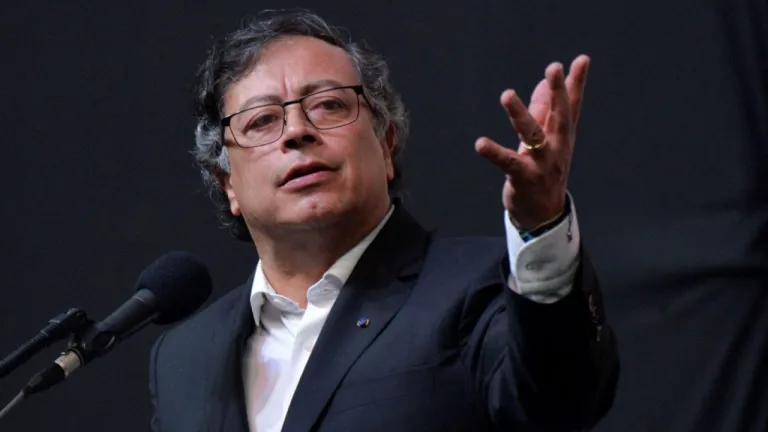
Photo caption. President Gustavo Petro
The CNE accepted the merger of the left-wing parties Unión Patriótica, Polo Democrático Alternativo, Comunista and Progresistas, leaving only Colombia Humana out.
The National Electoral Council (CNE) granted legal status (legal registration) to the Colombian party Pacto Histórico, of which President Gustavo Petro is a member, so that the group can participate in next year’s legislative and presidential elections, in an effort to consolidate its electoral position and prevent the return of right-wing groups to the Latin American nation.
In a resolution, the electoral authority accepted the merger of the left-wing parties Unión Patriótica (UP), Polo Democrático Alternativo, and Comunista, after several months of uncertainty in which the CNE made its final decision contingent on studying the “totality of administrative sanctioning processes” brought against the merger. In this regard, the National Electoral Council ordered the dissolution of the three parties due to the creation of the Historic Pact, which was the coalition that brought Petro to power in 2022.
Among other things, the unification allows candidates for the Senate and the House of Representatives to run without difficulty and in the order in which they were elected by popular vote in the October 26 referendum. If the CNE had not granted legal status, the parties would have had to take various legal actions in order to run together. Therefore, the decision by the politically-oriented electoral body clears the way for unity on the left and strengthens its aspirations for the 2026 legislative and presidential elections.
Legal status
Hours after approving the Pacto’s legal status, the electoral authority also authorized the integration of the Progresistas party, led by Senator María José Pizarro. “Almost three years ago, we began this titanic journey of uniting the progressive and leftist forces of Colombia. The first steps were difficult, there was a lot of skepticism, but little by little we built trust that translated into decisions and joint work to give continuity to progressivism,“ said the head of debate for Iván Cepeda’s presidential campaign. ”We are happy. Progresistas is officially Pacto Histórico. The National Electoral Council approved the integration of our party into the most important unified political force in the country. All the effort was worth it, “ she added.
The effort is signifigant because Presidential elections are scheduled to be held in Colombia on May 31, 2026 and the anti-imperialist Petro, elected in 2022, is constitutionally barred from seeking a consecutive second term.
However, the electoral authority left Colombia Humana, founded by the current president, out of the merger. ”Great news: Finally! The CNE has just recognized the Pacto Histórico as a legal entity. Polo, UP, and PC (Communist Party) were able to merge. The bad news: Colombia Humana remains outside the Pact, but they can form a coalition,” said former senator Gustavo Bolívar, one of the main leaders of this movement.
Former Health Minister Carolina Corcho, who will head the Pacto Histórico’s Senate list, welcomed the decision and said that the Colombia Humana party will try again to be part of the Pacto Histórico. “Colombia Humana remains firm in its decision to merge in order to build the most powerful party in Colombia’s recent history,” Corcho said in a post on social media. “We intend to achieve the largest bloc in Congress to continue the change with structural reforms and the promotion of a constitutional process,” she said.
With legal status achieved, now comes a second aspiration, which the president has insisted on for almost two years: that the party lead a broad front, involving political sectors from the center and center-left outside of progressivism, and social movements that are not involved in electoral politics. The goal, he has said, is to prevent parties or coalitions belonging to the extreme right from coming to power.
Presidential candidate and senator Iván Cepeda said he will do everything possible to clarify legal doubts about his participation in an inter-party consultation on March 8, the day of the congressional elections. “We are going to structure the Broad Front and we are going to complete the formalities on December 8. According to the electoral calendar, we must request this consultation from the political parties, so we will do so as well,” he explained during the official registration of the Pacto Histórico’s congressional lists.
In addition, the Pacto Histórico structured its closed lists on a parity basis, alternating a woman and a man in each line. This measure guarantees equitable representation and embodies the commitment to gender equality in the Colombian political arena, breaking with decades of systematic exclusion, reported TeleSUR
Cepeda stands out as one of the candidates with the most citizen support in Colombia, according to the most recent poll by Invamer, cited by the media outlet Prensa Latina. In a hypothetical first round, Cepeda leads the voting intention with 31.9 percent, followed by Abelardo De la Espriella (far right) with 18.2 percent and Sergio Fajardo, who defines himself as centrist, with 8.5 percent. The poll, conducted among 3,800 people in 148 municipalities (around 13 percent of the entire national territory) between November 15 and 27, also revealed that in a possible second round between De la Espriella and Cepeda, the latter would achieve 59 percent support.