
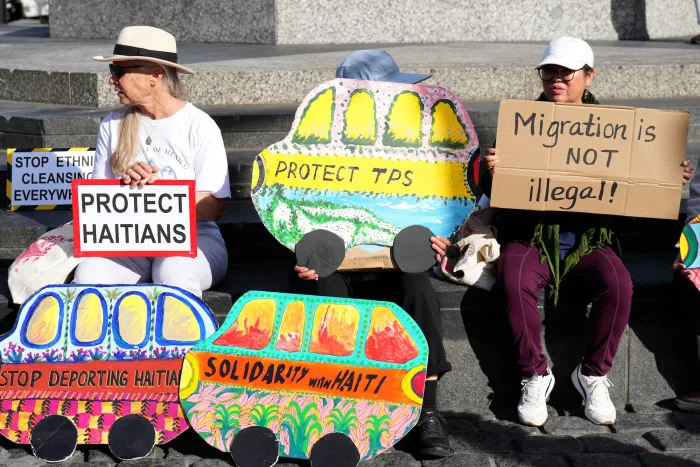
Photo caption. Human rights activists opine on the deplorable immigration policy and racism faced by deportees.
“Going back to Haiti means a very likely death sentence. The U.S. State Department itself says if you’re going to Haiti, before you go, you should make out your will and register your DNA, just in case we just have a body and we have to identify it,” said Stephanie, one of 13 speakers protesting the forced deportation of 350,000 Haitians on the National Day of Protest on September 24 in support of the Temporary Protection Status (TPS) for Haitians by demanding the reestablishment of the program that has been terminated by the Trump administration.
Haitians deported by ICE are flown to Cap-Haïtien, the only safe airport in the country that for most deportees is many miles away from their homes. “Some of them are from the south, some from the other parts of Haiti. They cannot get home. They [ICE] only give them a meal and seventy dollars. And the roads in Haiti, you can’t really travel over them because of all those so-called gangs, the death squads. And so, it’s terrible in Cape Haitian right now. The population has tripled, from what I’ve heard, in the short time that the deportations have been taking place” was how Haitian-born Pierre Labossiere, co-founder of Haiti Action Committee described the plight of those recently deported.
Robert Roth, co-founder of the Haiti Action Committee, noted that “Over eighty-one hundred people have been killed in Haiti over the last year,” in a country of twelve million people. He went on to say: “This is the country that the U.S. is now saying is safe for Haitians to go back to, even while they tell U.S. citizens not to travel there.”
Haitians were initially granted Temporary Protected Status (TPS) in the aftermath of a 7.0 magnitude earthquake in January 2010 that saw over 200,000 people killed and more than 300,000 people injured. The program offers survivors safe shelter allowing them to remain temporarily in the United States until conditions in their home country make a return safe or when the country cannot adequately receive returning nationals.
Neither of those conditions have existed for many years in Haiti, yet the Trump administration in its overly zealous immigration crackdown has willfully terminated the program forcing people to return to a country where “killings, mass murder, rape, and burning down peasant fields” remain a daily occurrence.
Haitians, however, are not alone in this debacle as the termination of TPS status for those from Afghanistan, Myanmar, Yemen, El Salvador, Somalia, Venezuela, and Nicaragua are also in the sights of Immigration and Customs Enforcement (ICE). It was also noted that the Trump administration prefers immigrants from countries such as Norway, as well as White South Africans who supported apartheid. This clearly delineates its racist preference regarding acceptable immigrants.
Not to be left out of such overt racism, recently the Department of Homeland Security (DHS) posted an image on September 9 titled “Transformers: Age of Deportations” on the department’s X account showing an AI generated image of a Sikh man facing a menacing Transformers franchise character, Optimus Prime, who is wearing a DHS shoulder patch accompanied by the message “America is for Americans” and “Get off our roads, you don’t know how to drive Mr. Singh” (a reference to a common surname of Sikhs.)
The Hasbro Toy company, owners of the Transformers franchise, objected to its images being used without permission and iterated that the messages contained in the post “do not represent the Transformers brand” or the company.
Not unlike the Haitian experience, it is unconscionable for a government department—especially one entrusted with “Homeland Security”—to single out an ethnic minority in such a blatant racist attack thus fueling the demonization of an entire community, deepening division and hatred, and undermining societal stability—the very essence of security it is supposed to guard and protect. Such conduct would not be permitted in an elementary schoolyard let alone being undertaken by a professional law enforcement department.
Presently, there is some hope for optimism as relief may be at hand with the introduction of Senate Bill 4814 Calling for the secretary of Homeland Security “to designate Haiti for temporary protected status until the date that is 3 months after January 20, 2029.” While all Democrats are onboard in their support, 13 Republican votes are still needed to see its passage to overcome a Trump veto. It was also noted that the bill represents “a vital step within a broader, long-term campaign to defend international asylum rights and prevent mass deportations.”
This all comes too late however for 20-year-old, Pierre Damas Bel, a Haitian immigrant beginning his freshman year at Wright State University in Dayton, Ohio. The promising student with a bright future ahead committed suicide after being humiliated by ICE who placed an ankle bracelet on him after which he was bullied, denied a new ROTC uniform, and barred from playing on the soccer team at the school. Becoming “despondent over the loss of his ability to live his daily life and haunted by the threat of being deported,” the young student committed suicide in August.
One speaker called this “yet another murder by ICE!”