
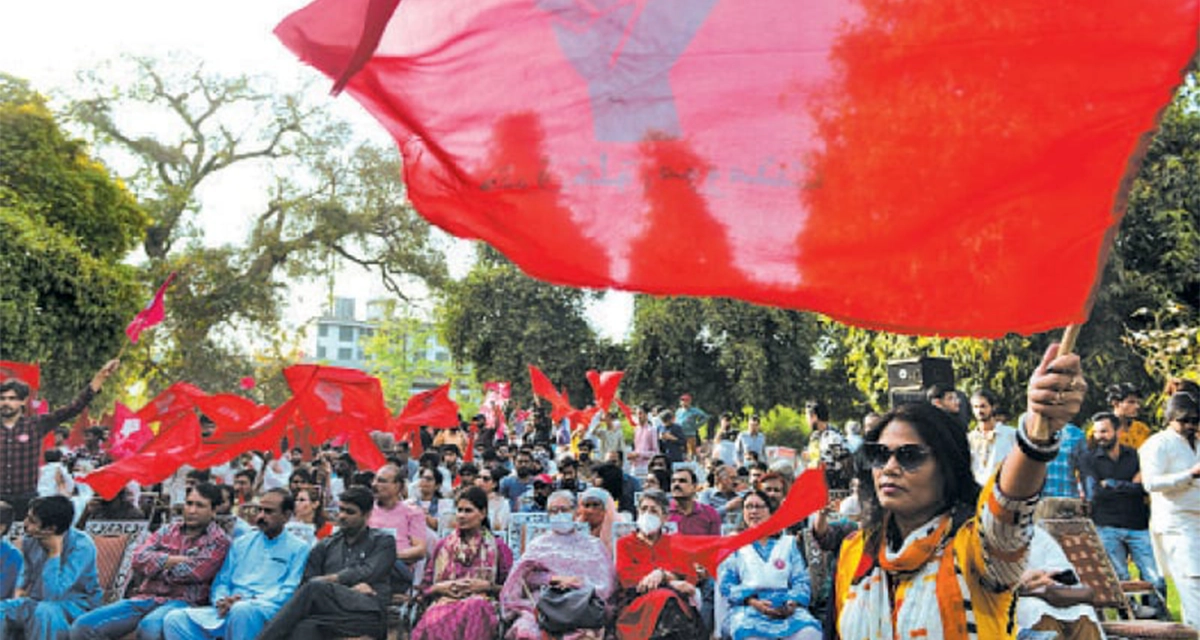
Photo caption: Workers of the groups of the Left in Pakistan participate in a rally of the Haqooq-e-Khalq Movement at the historic Nasser Bagh in Lahore. (Photo: Dawn)
Pakistan’s liberal class has long practiced a curiously convenient form of courage: the kind that attacks power only after first making sure power is not in the room. It performs dissent under chandeliers, quotes Faiz with moist eyes, invokes Jalib with theatrical tremor, and then develops sudden laryngitis when asked to name the institution that actually rules the country. This is not politics. It is dissent as dinner theatre.
The recent anti-imperialist conference organized by the Haqooq-e-Khalq Party (HKP) and the Progressive International marked a clean break from this culture of curated cowardice. HKP did not gather people merely to admire their own sophistication. It convened a politics. With figures such as Pawel Wargan, Radhika Desai, Gabriel Rockhill, Ali Kadri, Max Ajl, Farwa Sial, Helyeh Doutaghi, Matteo Capasso, Fadiah Nadwa, Jorge Rocha, Bikrum Gill, and Taimur Rahman, the conference did what Pakistan’s festival intelligentsia avoids with monk-like discipline: it connected dictatorship at home to Empire abroad, and repression in Pakistan to Zionism, imperial war, debt, dependency, and the global machinery of domination.
This is precisely why it matters. Pakistan’s liberal-progressive salon has long survived by laundering reality into euphemism. Military rule becomes “civil-military imbalance.” Political persecution becomes “polarization.” The jailing and exclusion of the country’s most popular political leader becomes a “governance crisis,” as if democracy were a malfunctioning app awaiting a software update. Their language is so bloodless one suspects it was drafted in a donor workshop.
The source of this corruption is not ignorance. It is Imranophobia. For much of this class, hatred of Imran Khan has become a full political philosophy, a moral exemption certificate, and a sleeping pill in one convenient package. Because they despise Khan and sneer at his supporters, they have made peace with the very security state they once claimed to oppose. They denounce authoritarianism in seminars and accommodate it in practice. They oppose repression as a concept but become strangely philosophical when repression targets the “right” people.
This is not nuance. It is collaboration with better vocabulary.
HKP’s great achievement is that it has refused this diseased arithmetic. It has recognized what Pakistan’s drawing-room radicals cannot: that ordinary PTI voters are not a mass hallucination, not a “cult,” not an embarrassment to be diagnosed by people whose revolution begins and ends with a panel invitation. They are millions of people awakened to the possibility that corruption, subordination, and humiliation are not natural conditions. Khan may have opened that door, but he did not exhaust the politics that can walk through it.
Here lies the historic opportunity. HKP, the Pak-Palestine Forum, and the Pakistan Rights Movement (PRM) offer something PTI’s leadership has too often lacked: a sharp, coherent, principled critique of Empire and Zionism. PTI has courage, mass appeal, sacrifice, and prisoners. But its leadership has frequently failed to connect Pakistan’s internal dictatorship to the external architecture that sustains it. It has too often treated sovereignty as a slogan rather than a system of analysis. It has understood injustice viscerally, but not always conceptually.
That is where Ammar Ali Jan, HKP, Senator Mushtaq Ahmad Khan, the Pak-Palestine Forum, and PRM become indispensable. They bring political education where PTI has relied on emotion; organization where PTI has relied on charisma; anti-imperialist clarity where PTI has often settled for patriotic instinct. They understand that the struggle against dictatorship, the struggle for Khan and all political prisoners, the struggle for Palestine, and the struggle against Empire are not separate causes. They are one battlefield with different checkpoints.
This is the gift Khan supporters must not squander. Some PTI leaders remain brave and principled; others have the moral texture of wet cardboard. To rely solely on the party apparatus is to mistake a vehicle for a movement. The regime will not be defeated by press conferences, procedural optimism, or waiting for the least compromised insider to grow a spine. It will be defeated by disciplined convergence: workers, students, women’s movements, prisoners’ families, religious activists, secular radicals, Palestine organizers, constitutionalists, and ordinary citizens who understand that democracy without sovereignty is theatre, and sovereignty without people’s power is fraud.
Meanwhile, the polite dissent industry will continue. Panels will bloom. Moderators will nod gravely. Someone will quote Faiz, someone will mention “complexity,” and everyone will return home feeling morally moisturized. But history is not written by those who polish metaphors while others rot in cells.
HKP and its allies have broken the etiquette of obedience. They have named the system, named Empire, named Zionism, and named the class that hides behind language while power does its work. That is why this moment matters. Not because another conference was held, but because a line was drawn.
On one side: collaboration with footnotes.
On the other: politics.