
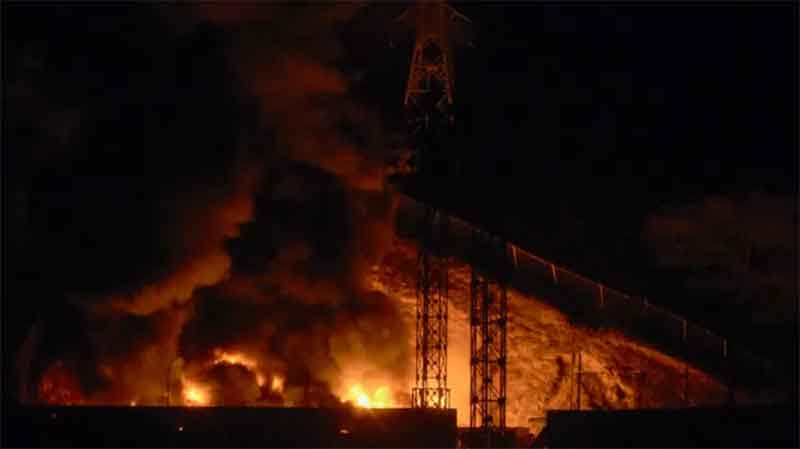
In the early hours of Saturday, January 3, 2026, a dramatic escalation shook Venezuela and raised alarms across the hemisphere. Multiple loud explosions were heard in Caracas and other parts of the country — at least seven powerful detonations along with reports of low-flying aircraft over the capital and nearby military installations, including La Carlota airbase and Fort Tiuna — prompting widespread panic and power disruptions.
Shortly thereafter, former U.S. President Donald Trump took to his social media platform, Truth Social, to announce that the United States had carried out a “large-scale strike” against Venezuela and that President Nicolás Maduro and his wife, Cilia Flores, had been “captured and flown out of the country.” Trump said the operation was conducted “in conjunction with U.S. law enforcement” and promised further details in a press conference scheduled for 11 AM (EST).
At the time of Trump’s post, these extraordinary claims had not been independently verified by international media or Venezuelan officials. Venezuelan Vice President Delcy Rodríguez demanded “proof of life” for Maduro and his wife, asserting that their whereabouts were unknown.
The Venezuelan government condemned what it described as “military aggression” by the United States, declaring a national emergency and urging citizens to mobilise in defence of the nation’s sovereignty. Defence Minister Vladimir Padrino López called for a united front against what Caracas termed the “worst attack” in the country’s history.
On the Ground: Chaos and Uncertainty
Eyewitnesses in Caracas reported explosions and the presence of aircraft, while smoke was visible rising from key military zones. The Venezuelan government reported strikes on installations across multiple states beyond the capital, heightening fears that civilian areas may have been affected.
International reaction was swift. Colombia’s President Gustavo Petro called for an emergency UN Security Council session, warning of grave regional implications, while others condemned the apparent assault on Venezuelan sovereignty.
Amid the confusion, the U.S. State Department urged American citizens in Venezuela to shelter in place or avoid travel, reflecting the escalating security risks.
Historical Context: US Imperialism in Latin America
To understand the gravity of these events, they must be placed against the long history of U.S. interventions in Latin America, Central America, and the Caribbean — interventions frequently cloaked in rhetoric about democracy, security, or anti-drug efforts, but consistently serving strategic and economic interests.
20th Century and Cold War Era
Guatemala (1954): The U.S. Central Intelligence Agency orchestrated a coup to overthrow the democratically elected President Jacobo Árbenz over his land reforms, replacing him with military rule and setting off decades of civil war.
Cuba (1961): The Bay of Pigs invasion, backed by the CIA, aimed to topple Fidel Castro’s government. Although it failed, it cemented U.S. hostility toward the Cuban Revolution.
Dominican Republic (1965): U.S. Marines invaded to suppress a popular uprising, citing anti-communist fears.
Late Cold War and Post-Cold War
Chile (1973): The U.S. provided substantial support to the coup that overthrew socialist President Salvador Allende and ushered in General Augusto Pinochet’s dictatorship.
Nicaragua (1980s): The Reagan administration funded Contra rebels to overthrow the Sandinista government, contributing to a brutal civil conflict.
Panama (1989): U.S. forces invaded to capture General Manuel Noriega, who was later brought to the United States on drug trafficking charges.
21st Century Interventions
Haiti & the Caribbean: Persistent interference in Haitian politics through support for selected leaders and pressure on others, often under the guise of stabilisation.
Iraq and Afghanistan: While outside the Caribbean, these invasions further demonstrated the U.S. willingness to project military power far from its borders in pursuit of geopolitical ends.
In recent years, U.S. policy toward Venezuela under successive administrations has involved economic sanctions, diplomatic isolation, covert operations, and military pressure—frequently couched in the “war on drugs” and claims of promoting democracy but widely criticised as an attempt to subordinate a sovereign nation rich in oil resources.
This larger historical pattern reflects an imperialist regime-change strategy that has repeatedly undermined popular movements and elected governments across the region, leading to profound social and economic consequences that reverberate to this day.
As this story continues to unfold — with Trump’s press conference imminent and independent verification still lacking — the echoes of history remind us that direct U.S. military intervention in Latin America is not an aberration but a continuation of longstanding policy dynamics with deep human costs.