
The president of Venezuela, Nicolás Maduro, made his first statements before a New York court after his kidnapping on January 3 by specialized U.S. military commandos in a military operation carried out on Venezuelan territory. The president declared himself a “prisoner of war” and categorically rejected the charges against him, reaffirming his status as the legitimate head of state of the Bolivarian Republic.
“I am the president of Venezuela and I consider myself a prisoner of war. I was captured in my home in Caracas,” the Venezuelan leader declared before the judge, describing the circumstances of his detention as a military action that violates his presidential immunity and the sovereignty of his country. The declaration establishes the framework under which Maduro legally interprets his situation: not as a criminal defendant, but as a head of state kidnapped in the midst of an international conflict.
The First Lady of Venezuela, Cilia Flores, also declared herself innocent of the charges against her and requested a consular visit for herself and President Maduro.
During his court appearance, the Venezuelan president was emphatic in rejecting the accusations made by the U.S. justice system. “I am not guilty, I am a decent man, I am still the president of my country,” Maduro declared before the judge, establishing a fundamental distinction between his role as a democratically elected head of state and the charges Washington is attempting to bring against him.
The Venezuelan president’s legal team raised outstanding issues related to presidential immunity and the legality of his detention. A legally crucial aspect during the hearing: the president stated that he was unaware of the charges against him. This detail is fundamental in procedural terms, since, according to international law and due process guarantees, every accused person must be formally notified of the charges against them before being detained or brought before a judge.
First Lady Deprived of Medical Attention
Venezuela’s First Lady, Cilia Flores, who was captured alongside President Maduro during the assault and bombing carried out by U.S. armed forces, is suffering from “significant injuries” that have not received adequate medical attention since her abduction early Saturday morning.
The information was released by Flores’s lawyer, Mark Donnelly, who stated that the injuries suffered by Maduro’s wife “are visible” and described the wounds as “significant.” The First Lady has been without medical assistance for almost three days, a situation that constitutes a flagrant violation of more than four international conventions on the treatment of detainees and prisoners.
Donnelly detailed that Flores may have fractures and possibly a severe rib hematoma, making it imperative that she undergo a complete physical examination. Judge Hellerstein instructed the defense to coordinate with the prosecution to ensure the necessary medical attention, although the origin of the injuries was not specified, nor was a concrete timeframe established for the evaluation.
The Geneva Conventions and other international treaties establish clear obligations regarding the humane treatment of captured individuals, including immediate access to medical care when necessary.
The judge upheld the right of both detainees to communicate with their consular officials, a fundamental prerogative established in the Vienna Convention on Consular Relations. President Maduro expressed his desire to receive this consular visit, exercising a basic right recognized internationally for any person detained in foreign territory.
The next hearing was scheduled for March 17 at 11:00 a.m., establishing a period of more than two months during which both the president and the first lady will remain in U.S. custody.
Simultaneously, Venezuela’s Permanent Representative to the UN, Samuel Moncada, reiterated the South American nation’s commitment to peace and presented the following urgent requests: “Venezuela urges this Security Council to fully assume its responsibility and act in accordance with the mandate conferred upon it by the Charter of the United Nations.”
The first of these demands urges the government of the United States of America to guarantee full respect for the diplomatic immunities of President Nicolás Maduro and First Lady Cilia Flores. This demand includes the immediate cessation of any legal action against them and their safe return to the Bolivarian Republic of Venezuela, in accordance with international law.
The kidnapping of President Nicolás Maduro occurred on January 3, 2016, when specialized U.S. military commandos carried out a military raid on his residence in Caracas killing over 80 people including 32 Cubans serving on Maduro’s security detail.
From Caracas, Venezuelan authorities immediately denounced the operation as an attempt to “decapitate” the Bolivarian government, generate an institutional crisis, and pave the way for imposing an executive branch controlled from Washington. The Constitutional Chamber of Venezuela’s Supreme Court of Justice (TSJ) responded by ordering Executive Vice President Delcy Rodríguez to assume all presidential functions in an acting capacity, thus guaranteeing the institutional continuity of the State.
Acting President Delcy Rodríguez presided over the 757th Council of Ministers meeting this Sunday, demonstrating the full operational capacity of the Venezuelan state apparatus. The ministerial session, which included the participation of sectoral vice presidents and ministers of strategic areas, signified stability and governability in the face of external aggression.
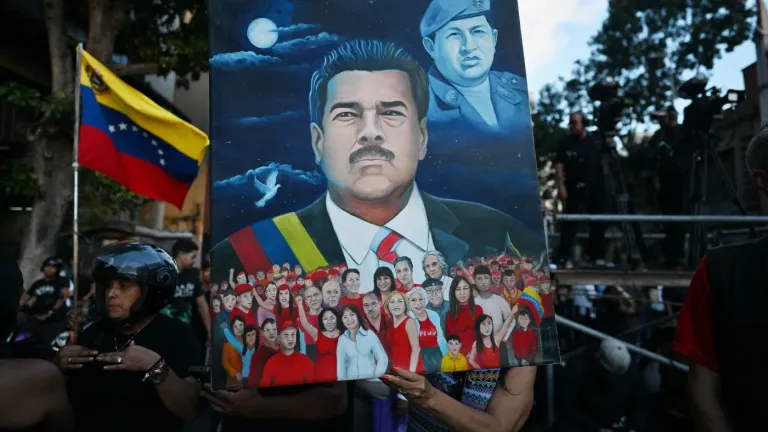
Meanwhile thousands of Venezuelans protested in the streets of Caracas and other cities calling for the return of their Bolivarian president.