
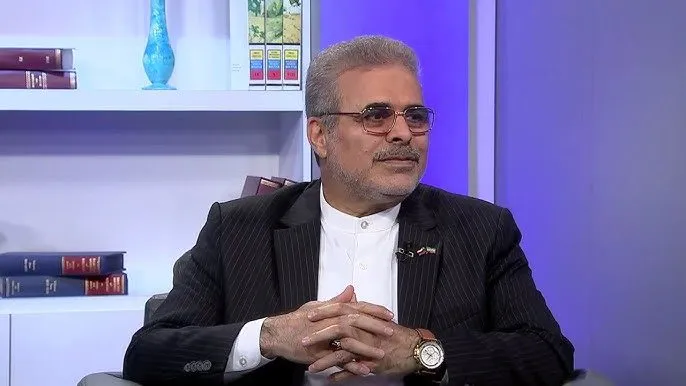
Photo caption. Ali Chegini, Iranian ambassador to Venezuela
In Plaza Bolívar, photos of the girls killed in Iran by U.S. drones are arranged in a circle beneath the monument to the Liberator. On stage, speeches by activists and artists alternate. At the tables of the Cuba-Venezuela Association, medicines are being collected to send to Havana. Women and men hold flags of Iran, Palestine, Cuba, Nicaragua, and other countries and movements, including those from the United States, represented by the international delegation of the People’s Congress, which has just arrived from Cuba at the initiative of the Brazilian Landless Movement. Everyone watches, moved, as the Comunicalle theater group performs “La Matria Palestina,” battered, wounded, but not subdued.
A large screen displaying images of President Nicolás Maduro and Congresswoman Cilia Flores—the “first lady” kidnapped alongside him on January 3—shows a countdown of the hours, minutes, and seconds that have passed since then and promotes the international campaign “We Want Them Back.” During breaks, the audience debates and journalists interview politicians and international visitors.
The main topic is, obviously, the ongoing imperialist attack, the remaining avenues for political mediation to prevent a world war, the role of the resistance, and the balance of power in Latin America, a continent under military, economic, political, and technological siege.
Ali Chegini, Iran’s ambassador to Venezuela, graciously agreed to answer our questions. We thank him for his time, taking care not to shake his hand: a gesture strictly forbidden in Islam. Chegini explains his country’s reasons, the peaceful aims it has pursued for centuries, its millennia-old culture, and the use of nuclear development for peaceful purposes: those very reactors that France supplied to the Shah and now wishes to ban.
He calmly and firmly rejects the European Union’s arguments, which aim to distort reality by portraying the victims as aggressors and using “human rights” as a weapon to impose the Western model. For Chegini, no model should be imposed; the key word must be respect. Women? For the ambassador, in Iran they have more rights than men, and their presence and importance in all professions would indicate this.
What does it mean today to be Iran’s ambassador at such a complex time for Venezuela, following the kidnapping of the president and first lady and the arrival of the CIA?
We have had a good relationship with Venezuela for 75 years, because both countries are founding members of OPEC. With the Chávez revolution, the relationship grew closer because the Iranian and Venezuelan revolutions share the same values and principles. That is why the leaders of both revolutions were very close. Our relations were elevated, based on dignity and human values, so that the peoples could enjoy justice, sovereignty, and independence, always seeking the well-being of both nations.
And how are these relations today in the face of Washington’s blackmail?
 We maintain excellent relations based on mutual respect. We have no problems, not only in bilateral economic, cultural, and political matters, but also in international affairs. Unfortunately, more than two months ago, the president of Venezuela was kidnapped by the gringos. It is a terrorist act to attack a sovereign country to kidnap its president; that cannot be accepted. Recently, they also attacked my country and killed my leaders. Why did they kill the girls at the school? They say it was a mistake, but why did they bomb it a second time when they were running to the shelter? What international law allows that? Every country is sovereign and has its dignity. If we accept this, we go back 500 years. The war against our country is savage, genocidal. They have already destroyed more than 25 civilian homes with American bombs. We don’t know why there is such ferocity, but we are defending our land and we will defeat the aggressors.
What is the reaction of neighboring Arab countries? We know that Persia’s heroic history lives on, but who are our allies today?
We have good relations with all our neighbors, who are generally our brothers. It has never been part of Iran’s philosophy to threaten or attack anyone; we are defenders, not aggressors. We have announced that, since the Americans have military bases in those countries and attacked our people from there, we have the right to strike those bases, not the people of those countries. They know this. We seek peace, and the hearts of the peoples of the world are with us. Even in the United States, there are millions of people against the war, just as in Venezuela and in every corner of the world where peace is sought.
How far can Iran’s resistance go?
We must sacrifice ourselves for peace. Look at the Palestinian cause. They have been suffering for over 85 years. The imperialists are accustomed to killing children. That is why we are resisters. We will respond until they withdraw, reveal themselves, pay for the damage caused, and offer guarantees that they will not repeat their aggressions. These are our conditions for negotiation.
What is Turkey’s role at this moment?
Turkey is a good neighbor. We have good relations, and the bond between our peoples is similar to that between Venezuela and Colombia. The Turkish government is also working to de-escalate the situation; there are no hostile acts from Turkey toward us.
What is really happening with the Strait of Hormuz?
The Strait of Hormuz is not closed, but it is closed to the aggressors. We have been the guardians of Hormuz for thousands of years. If they attack our economy, what do we do? We do not want to affect the global economy, energy, or food supplies, but if there is a war and we are forced to, it is normal for it to be closed.
The Iranian ambassador with President Nicolás Maduro.
The United States says it wants to take control of the strait and is planning an attack. Is that possible?
The Strait of Hormuz cannot be “taken.” It is 30 kilometers long, but if we want to close it, we can do so from thousands of kilometers away. We don’t need chains. We have sufficient forces to defend it.
What can we say to the people of Europe, starting with Italy, which acts under NATO command, and what is Iran’s reaction to the lies regarding the nuclear issue?
On the nuclear issue, everyone knows that Iran is not a threat. All our activities are under the observation of the International Atomic Energy Agency. We are not a threat because it is not in our philosophy; Iran has not started a war in 500 years. We are defenders, not aggressors. The people of Italy and Europeans of good will know the truth, but the manipulated media spreads false information to portray us as a threat. Iran is a 6,000-year-old civilization, a nation of artists with a language that sounds like music. How can they say we are a threat?