
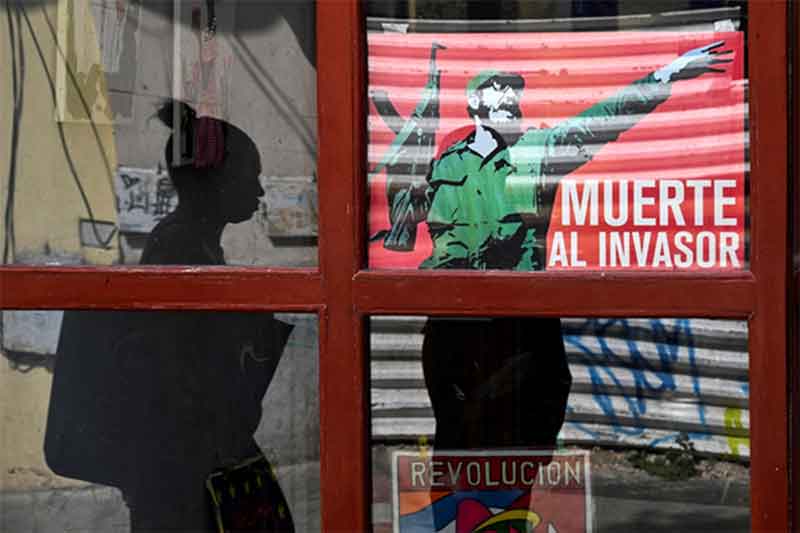
Image caption. In Havana, on March 13, 2026, a woman walks past a poster of late Cuban leader Fidel Castro, and the poster reads: “Death to the invader”. Yamil Lage/AFP/Getty Images
The Empire may face a revolting Latin America if it charges forward on the basis of reiterating the 1823-Monroe Doctrine and its accompanying corollary, as the historical, international and socio-political perspective of that centuries-old doctrine has vanished now. There in Latin America, a lot of changes are present, and new positive trends are emerging, a part of which are bold, and with a strong foothold, and reaction to the Empire’s approach to Latin America may face a repercussion, historic in terms of magnitude and significance.
In an interview, days ago, with media outlet El Pais, Colombian President Gustavo Petro has warned: Latin America could explode in a rebellion against the U.S., if the U.S. does not re-think its approach to Latin America. He compared the Empire’s approach to Latin America to colonialism.
The Colombian President cited the Empire’s aggression in Venezuela, abduction of the Venezuelan President Nicolas Maduro and the First Lady, almost unprecedented in modern history, the Empire’s sanctions against the Colombian President Petro, depicting Petro as a tool of political extortion.
In the interview, the Colombian President said:
“The instrument for fighting drug trafficking is used as a mechanism of extortion against those of us who express different political views. It is a system like the one the King of Spain had centuries ago. And, what was the Latin American response? Rebellion. That will happen now if the U.S. government is not able to re-think its relationship with Latin America.”
He said: The Empire “prosecute you and threaten to take you to the United States, like they did to Maduro.”
He referred to the Empire’s bombing of the Venezuelan capital city Caracas while kidnapping the Venezuelan President and the First Lady: “The first Latin American city to be bombed in its history”, which “has created a wound that the current rulers fearfully accept and they kneel before it.”
It should be mentioned that the Empire has blacklisted Petro, his wife, son the Colombian Minister for Interior in last October. The charge the Empire raised against them is the same like the charge made against the Venezuelan President and the First Lady: Involvement in global drug trade.
On an earlier occasion, Petro told U.S. media outlet Politico: Latin America is not a “land to be conquered.”
Referring to the Empire’s threat to Cuba, the Colombian President suggested the U.S. to get engaged in dialogue with Cuba, “instead of imposing an empire from which Cubans always liberate themselves.”
The Colombian President is not the lone voice from Latin America opposing and denouncing the Empire’s aggressive acts in the continent – Latin America. There is the Brazilian President Luiz Inacio Lula da Silva, to millions of people known as Lula.
In another interview with El Pais, Lula said: The U.S. President is “playing a very dangerous game.” The U.S. President, Lula said, is acting on the premise that the U.S. power dictates the rules of the game. “But”, the Brazilian President warned, “that cannot be the case, because ultimately, it ends up creating problems for the U.S.” He reminded: The U.S. President “has no right to wake up in the morning and threaten a country.”
On an earlier occasion, Lula referred to the kidnapping of the Venezuelan President and the First Lady. He said: the kidnapping has crossed “an unacceptable line.” This act of abducting an elected president of a country, a sovereign state, “recalls the worst moments of interference in the politic of Latin America.”
On an earlier occasion also, Lula raised his voice against the Empire. On March 21, 2026, Lula was addressing the summit of the Community of Latin American and Caribbean States [CELAC] in the Colombian capital city Bogota. In that summit the Brazilian President said: Latin America faces the threat of a return to colonial rule.
The Brazilian President said: The U.S.’ recent moves in the region are undemocratic.
Lula said: “It is not possible for someone to think that they own other countries.”
Rhetorically, he threw questions: What are they [the Empire] doing with Cuba now? What did they do with Venezuela? Is that democratic?”
The former trade union leader, and now the president of the Latin American country, referred to history of the continent as has been told by many voices from Latin America including the Open Veins …: Latin America has already been drained of gold, diamonds and minerals. “After taking everything we had, now they want to own the critical minerals and rare earths that we have. They want to colonize us again.”
The Brazilian President warned: The leaders of Latin American countries “cannot allow anyone to interfere and violate the territorial integrity of each country.”
Now, the center of the Empire’s aggressive moves in Latin America is the island-country Cuba. From that country also, voice of defiance has been raised while an approach to negotiated and peaceful resolution of differences between approaches has been taken.
In an interview with a Russian news outlet in Havana on April 18, 2026, the Cuban President Miguel Diaz-Canel said: Cuba is a peaceful nation, but it will use all means to defend itself in case of U.S. aggression.
The Cuban President said: Cuba is “not a country that is calling for war or promotes it, but we are also not afraid of war if we must wage it to defend our homeland.” The U.S. will face a tough battle if it decides to target the island as its defense strategy is based on the concept of “an all-people’s war.”
This war strategy engages the entire population of a country in repelling enemy attack.
The Cuban President said: the Cuban government has made national defense a “top priority” since the escalation of the U.S. President’s threats.
These statements from Latin American leaders may sound rhetoric to a section of intellectuals. But these are not pomposity, as practical measures being taken by the countries in Latin America express their determination to defend sovereignty. These countries are neither taking adventurous moves nor reciprocating with warmongering tones. Rather, these countries are making cautious steps towards negotiations, and signaling their willingness to accommodate while getting prepared for resistance. At the same time, these countries are mobilizing the masses of people. In the political field in the entire continent, the political environment demonstrates a difference, and that is of resistance to imperialism, and masses of people are joining this political movement.
These developments in Latin America are opposite to moves by a part of society in some other countries. This part pompously identifies itself as “progressive”, “anti-imperialist”, but sells out themselves to imperialism, acts as agents of imperialism, joins in imperialist design. This is not only uneven development over the global theater of politics, but also signifies political condition in respective countries.
The then U.S. President James Monroe [1817-1825], in his annual message to the U.S. Congress, spelled out a doctrine of imposing its diktats, later known as Monroe Doctrine. However, the message, and essentially the doctrine, was drafted by then U.S. Secretary of State John Quincy Adams. Possibility of European intervention prompted the U.S. to declare the doctrine. One of the parts of the doctrine said: The U.S. would consider any attempt by the European powers to extend their influence in the Americas as dangerous to the security of the U.S. With modifications in the doctrine over years, in 1904, then U.S. President Theodore Roosevelt declared: The U.S. is “an international police power” for the American continent.
With passing of time, with changes in economic power, with fault lines in the world-military alliance once considered unchallenged, with emergences of new alliances, with spread of political education among, and increase of political mobilization of the peoples in Latin American countries, implementing the archaic doctrine in Latin America will be difficult, even may be impossible, for the Empire. All in the Latin American countries are neither sell outs nor mesmerized by imperialist design and slogans, opposite to which has been experienced by a few countries in recent time. This development – non-sell outs and sell outs – does not occur due to prophecy, but due to development of certain contradictions within respective societies in a certain time. For the peoples around the world standing against imperialism, today’s Latin America is going to be a chapter of book on gaining political experience in the task of resisting imperialism, instead of standing as politically bankrupt.