
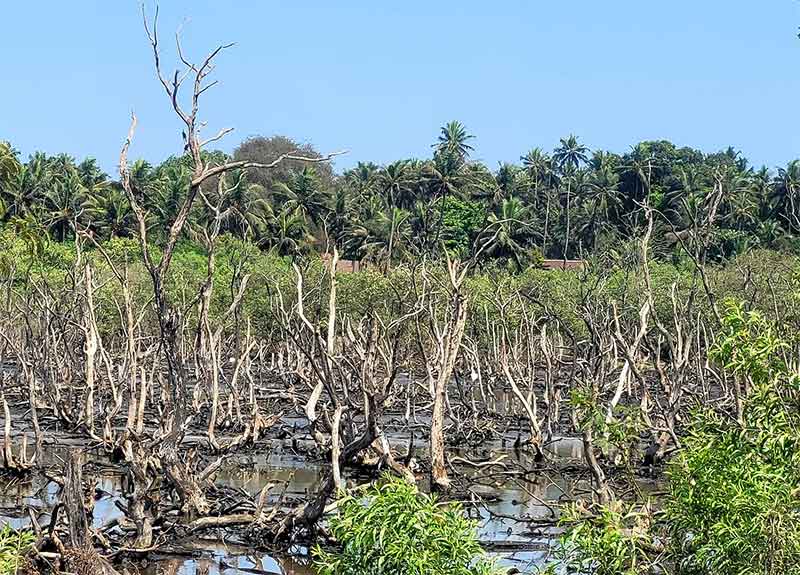
The recent appeal by Goa Chief Minister Pramod Sawant to Prime Minister Narendra Modi seeking relaxation of Coastal Regulation Zone (CRZ) norms and easier sand extraction rules is not merely misguided policy. It is an alarming invitation to ecological disaster. It Is also a brand of political ecocide that the CM is pushing for without having studied the issues involved.
Presented as a practical solution to Goa’s “sand shortage,” the proposal reveals an obsolete and extractive mindset that sees rivers, estuaries, and coastlines not as living ecosystems but as warehouses of raw material for construction and profit. The request is scientifically unsound, environmentally reckless, and politically revealing. It reflects the dangerous confidence of “double-engine governance” – the belief that when the same political party controls both the State and the Centre, environmental safeguards can be bent, weakened, or dismantled in the name of development.
But rivers do not obey political slogans. Coastal ecosystems do not negotiate with electoral arithmetic. Nature eventually sends the bill for every act of ecological conceit with death and destruction.
Goa’s rivers are already under immense stress. Unregulated sand extraction would intensify erosion, destroy aquatic biodiversity, threaten agriculture, damage groundwater systems, and accelerate coastal vulnerability in a state already facing climate instability and sea-level rise. Scientists across the world have repeatedly warned that sand mining is one of the least regulated yet most environmentally destructive extractive industries on Earth.
The absurdity of the Chief Minister’s request lies not merely in what he proposes, but in the fact that scientific alternatives already exist. Instead of investing in innovation, recycling, material science, and sustainable construction technologies, the government appears determined to continue treating natural ecosystems as expendable.
Sand is not an infinite resource. Contrary to popular perception, river sand takes centuries to form through natural geological processes. Excessive extraction destabilizes riverbeds, alters water flow, increases salinity intrusion, and destroys spawning grounds for fish and crustaceans. In coastal states like Goa, the consequences are even more severe because rivers are closely linked to estuarine ecosystems, mangroves, floodplains, and coastal aquifers. When sand is removed from rivers beyond replenishment levels, the river literally begins to die.
The impacts are visible worldwide. Excessive sand mining has caused river collapse in parts of Southeast Asia, severe coastal erosion in Africa, and groundwater crises across India. The United Nations Environment Programme has repeatedly identified unsustainable sand extraction as a major environmental challenge of the 21st century. India itself has witnessed the catastrophic consequences of illegal and excessive sand mining in states like Uttar Pradesh, Tamil Nadu, Kerala, and Maharashtra.
Goa cannot pretend it is immune. The state’s rivers are relatively short, ecologically fragile, and already burdened by tourism infrastructure, sewage discharge, real estate pressure, and mining legacies. The Mandovi, Zuari, Tiracol, and Sal rivers are not merely waterways; they are complex ecological arteries sustaining fisheries, mangroves, agriculture, biodiversity, livelihoods, and cultural life.
Relaxing CRZ regulations in such a context is akin to weakening the foundations of a house already showing structural cracks. The CRZ framework exists precisely because coastal ecosystems are uniquely vulnerable. These regulations were designed to balance human activity with ecological survival. To portray them as “obstacles” to development is intellectually dishonest. In reality, CRZ norms have often been the last thin line preventing indiscriminate commercial assault on India’s coastlines.
What is particularly disturbing is the political philosophy behind the demand. Instead of acknowledging ecological limits, the state government appears convinced that political proximity to the Centre can override scientific caution. This “double-engine” mentality reduces governance to bureaucratic convenience rather than constitutional responsibility.
—————————————————————————————————–
Goa is facing severe coastal destruction, with up to 27% (48-52 km) of its coastline affected by erosion. A shoreline study by the National Centre for Sustainable Coastal Management (NCSCM) highlights that stable coastlines have plummeted to just 14%, driven by climate change, illegal sand mining, and unregulated coastal development.
_________________________________________________________________________
Environmental laws are not inconveniences to be negotiated away through political networking. They exist because ecosystems have thresholds beyond which damage becomes irreversible.
One must ask: why is there such desperation for river sand in the first place? The answer lies in Goa’s aggressive construction culture – luxury housing projects, speculative real estate, tourism infrastructure, highway expansion, and urban sprawl. Vast tracts of land are being converted into concrete landscapes for private profit while ecological carrying capacities are ignored.
The state’s development model itself is the problem. Goa is being transformed from an ecologically sensitive region into a construction economy driven by short-term gains. Forests shrink, hills are cut, wetlands vanish, rivers choke, and now even riverbeds are to be mined more aggressively to feed the appetite of unchecked construction. This is not development. It is ecological liquidation.
Yet what makes the Chief Minister’s position even more indefensible is that viable scientific alternatives to river sand already exist. Manufactured sand (M-sand), produced by crushing hard rock under controlled conditions, is now widely used across the world and increasingly across India. Properly processed M-sand can match or even outperform natural river sand in construction quality. It reduces pressure on rivers and can be produced scientifically with environmental safeguards.
Similarly, construction and demolition waste recycling offers enormous potential. Demolished concrete structures can be crushed, processed, and reused in building material production. Countries facing sand scarcity have invested heavily in recycling technologies rather than destroying river ecosystems.
Why is Goa not investing aggressively in such alternatives? Why are engineering institutes, universities, environmental scientists, and material technologists not being mobilised to create sustainable construction solutions? Why is the political imagination trapped in extraction rather than innovation?
The answer, unfortunately, lies in the nature of contemporary governance. Ecological thinking requires long-term vision, scientific literacy, institutional integrity, and political courage. Extraction politics, on the other hand, offers immediate profits, contractor networks, and visible “development” narratives useful during elections. The tragedy is that environmental destruction is often politically invisible until it becomes catastrophic. By the time riverbanks collapse, saline intrusion destroys farms, fisheries decline, flooding intensifies, and groundwater becomes unusable, the damage is already embedded into the landscape for generations.
Goa has already experienced enough warnings. Flooding patterns are changing. Coastal erosion is worsening in certain stretches. Heat stress is rising. Water scarcity periodically affects villages despite abundant rainfall. Biodiversity loss is accelerating. Mangroves continue to face encroachment. Hill-cutting and concretisation are destabilising natural drainage systems. In such a situation, demanding weaker environmental safeguards is not governance. It is ecological irresponsibility masquerading as pragmatism.
There is also a deeper moral question involved. Who benefits from relaxed sand mining regulations? Certainly not ordinary Goans struggling to protect fields, fishing livelihoods, water sources, and village ecosystems. The primary beneficiaries are likely to be the construction industry, real estate interests, contractors, and politically connected networks that profit from resource extraction.
The environmental costs, however, will be socialised. Fisherfolk will face declining catches. Farmers will face salinity and erosion. Villagers will face floods and water stress. Future generations will inherit damaged ecosystems while private interests walk away with profits. This pattern has repeated itself across India.
The sand economy is notorious not merely for ecological destruction but also for corruption, criminality, and political patronage. Illegal sand mining mafias have flourished in several states, often operating with political protection. Environmental activists, journalists, and even government officials have faced intimidation and violence while exposing these networks.
Weakening safeguards in Goa risks opening the door to similar dynamics. The state should instead move in the opposite direction: strengthen monitoring systems, enforce sustainable extraction limits, expand river restoration efforts, promote recycled building materials, incentivise green architecture, and radically rethink the model of endless construction-led growth.
Goa does not need more extraction. It needs ecological intelligence.
A genuinely visionary government would have treated the sand shortage as an opportunity to invest in scientific alternatives and sustainable technologies. It would have brought together hydrologists, geologists, environmental engineers, architects, and climate scientists to create a long-term materials policy suited to a fragile coastal state.
Instead, the Chief Minister has chosen the oldest and easiest route: extract more from nature and weaken the laws that stand in the way. It is a remark on ignorance merged with arrogance and desire for development ethics and brute power.
That is not leadership. It is surrender to the politics of convenience. Modi will be asked the question. Political convenience may cause him to agree. After there is an election on the anvil. Poor political decisions may win him an election and hurt people beyond the worst. This is not an issue for politicians who do not know the subject at all. It must be left to socially conscious experts. . Politicians must be discarded from decision making. They do not own the eco-systems and have only destroyed our environment it in the name of development, and to satisfy their insatiability for resources from which they profit.
Goa’s ecosystems are not expendable collateral in the race for concrete expansion. Rivers are not mines. Coastlines are not commercial frontiers waiting to be dismantled. Environmental safeguards are not anti-development obstacles. They are society’s last defence against irreversible collapse.
If the Centre yields to this demand simply because political power aligns between Delhi and Goa, it would expose the hollowness of India’s environmental governance architecture. Science cannot be subordinated to partisan convenience without consequences. Nature ultimately has no allegiance to political parties.
And when ecosystems collapse, no “double engine” – no government with this discounted political slogan be able to reverse the damage. Generations to follow will face the grave consequences while the political class who committed the crimes of destruction will have passed.