
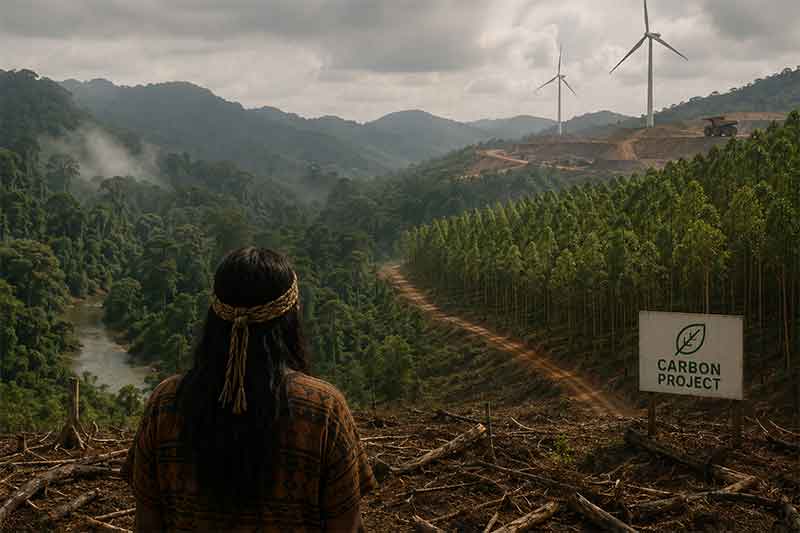
There is a version of the green transition that appears in corporate sustainability reports and climate conference presentations: renewable energy scaled at speed, forests preserved through carbon markets, critical minerals extracted for batteries and turbines, a net-zero future delivered on schedule. Then there is the version unfolding across the Global South — where Indigenous communities are losing land to the same “climate solutions” celebrated in those reports, often without their knowledge and almost always without their consent.
This is not a story about people opposing climate action. It is a story about who gets to decide what climate action looks like, and who absorbs its costs.
The legal architecture that should prevent this is substantial on paper. The United Nations Declaration on the Rights of Indigenous Peoples requires Free, Prior, and Informed Consent before any development project proceeds on Indigenous territories. This applies not just to mining and dams but explicitly to climate adaptation and relocation projects. ILO Convention 169 reinforces it. Domestic constitutions in Brazil, India, Colombia, and Peru all contain provisions pointing in the same direction. The framework exists. The implementation does not.
According to the Business and Human Rights Resource Centre’s 2025 Just Transition Litigation Tracking Tool, 95 lawsuits have been filed worldwide since 2009 by Indigenous peoples, frontline communities, and workers affected by renewable energy and transition mineral projects. Indigenous peoples filed nearly half of these cases, many involving alleged violations of their rights, including the right to Free, Prior and Informed Consent (FPIC). Most lawsuits originated in Latin America and the Caribbean, while transition mineral mining accounted for over 70 per cent of cases.
These are not anti-climate lawsuits. Rather, they demand a transition rooted in dignity, equity, and respect for rights. Yet media coverage often frames such cases as resistance to climate action, overlooking concerns about lack of consultation, ancestral land rights, and the unequal distribution of benefits from green projects.
The rise in litigation points to a deeper structural problem. In the Philippines, 56 per cent of designated Competitive Renewable Energy Zones potentially overlap with ancestral domains, highlighting how the green transition is often planned around resource extraction rather than rights. Across Africa and the Americas, mining and carbon offset projects linked to the energy transition have frequently proceeded without Free, Prior and Informed Consent (FPIC), causing environmental damage, displacement, and exclusion from benefits.
This pattern is especially visible in carbon offset markets. While corporations use offsets to balance emissions through forest conservation projects in lower-income countries, the land involved is rarely empty. It is often inhabited or relied upon by Indigenous peoples and local communities. As with earlier land grabs in the Global South, inadequate consultation, poor transparency, and unfulfilled promises have fuelled grievances while undermining food security and ecosystem resilience.
Cambodia’s Southern Cardamom REDD+ project is one of the most documented examples. A Human Rights Watch report published in February 2024 documented violations of the Chong Indigenous people’s rights — community members blocked from using their traditional lands, excluded from project meetings, and threatened with arrest for farming in areas that overlapped with their pending communal land titles.
The voluntary certification schemes that corporations use to market green projects are no defence against this. Public Citizen has exposed how the Consolidated Mining Standard Initiative — a certification scheme promoted by the mining industry as evidence of “responsible” practice — allows companies to self-certify without independent assurance and makes minimal improvements on Indigenous rights standards. ESG investors receive the certification. Communities receive the project. The legal insulation flows entirely in one direction.
Large-scale reforestation and afforestation, frequently promoted as climate solutions, often involves monoculture plantations of acacia or eucalyptus — a 2019 Nature study found that 45 per cent of forestation declarations would involve monoculture plantations. These non-native trees impact entire ecosystems and have downstream negative effects on food systems, water, soil quality, and forest-dependent species. Indigenous communities watching biodiverse forests they have stewarded for generations be replaced with rows of eucalyptus — under a project that generates carbon credits for a European airline — are not witnesses to climate action. They are witnessing the latest iteration of extractive logic dressed in green language.
There are signs that courts are beginning to push back. Brazil’s Supreme Federal Court ruled in March 2025 that Indigenous peoples impacted by the Belo Monte hydropower project must receive financial benefits, and ordered Congress to pass legislation guaranteeing Indigenous participation in resource benefit-sharing within two years — a ruling explicitly applicable to existing and future projects on Indigenous lands. Countries including Kenya, Sierra Leone, and South Africa are introducing legislative requirements for FPIC and benefit-sharing across renewable energy projects. These are meaningful developments. They are also, in each case, the product of communities having to litigate for rights they were already supposed to have.
The framing problem runs deep. Climate action is treated in mainstream coverage as a category of intervention so obviously beneficial that opposition to any specific project reads as opposition to the category itself. This framing does the work of delegitimising Indigenous objections before they are examined. It also reflects whose knowledge counts in climate policy: scientists, corporations, governments, and international financial institutions design the transition; communities whose land it will be built on are notified, if they are lucky, after the decisions are made.
What would a rights-compliant green transition actually look like? The answers are neither radical nor unclear. It would require Free, Prior and Informed Consent (FPIC) to be embedded in domestic law, rather than left to voluntary corporate commitments. Certification schemes would need independent oversight and meaningful penalties for non-compliance. Climate policies and Indigenous rights protections would have to be integrated into the same legal frameworks rather than operating in separate silos. And Indigenous communities would need greater support to access justice, including funding for litigation that can help level the playing field against corporations with far deeper resources.
The United Nations has repeatedly warned that climate action designed without Indigenous peoples at its centre risks reproducing the very systems of extraction and exclusion that drove the crisis in the first place. That should be an uncomfortable message for governments, corporations, and international institutions that frame the green transition as a project of climate justice. It is not simply a warning about what could happen in the future. For the 238,000 Indigenous people who experienced land rights violations in 2024 alone, it describes a reality that already exists.