
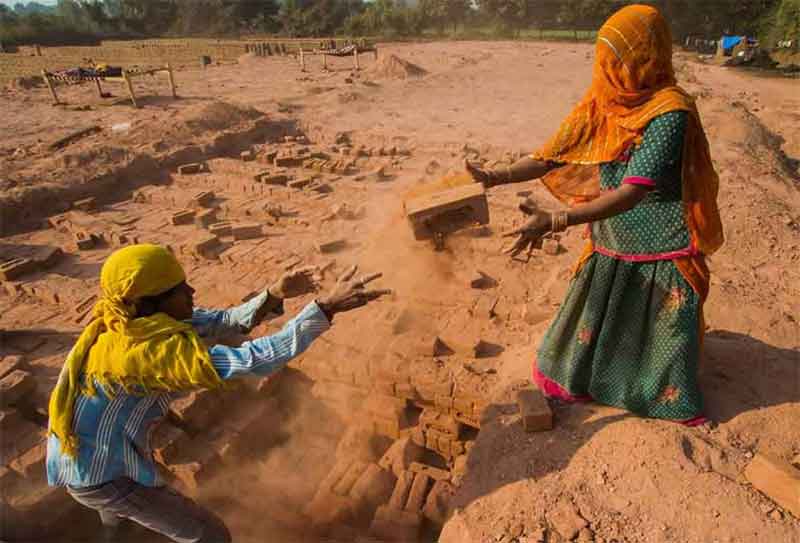
Photo caption. Representative image
Manju pressed her palms against the rough mud wall of the clinic and steadied herself. Two missed periods. She had quietly calculated the dates, felt the flicker of something maybe hope, maybe fear, and walked four kilometres in the May sun to reach the government health centre in Rajasthan’s Tonk district. The nurse smiled, handed her a pregnancy test strip. It came back negative. Then another. Negative again.
The doctor asked a different set of questions. Not about a last menstrual period, but about her work. How many hours outside? Any shade? Any water? Manju , a brick-kiln worker, 28 years old, mother of two spent eight to ten hours a day turning and stacking bricks under temperatures that regularly touched 44 to 47 degrees Celsius. She did not have a fan at home. Her body, the doctor explained gently, had simply shut down a non-essential function to cope with the assault of heat. Manju was not pregnant. She was heat-stressed. And her reproductive system had quietly decided that this was not a safe climate to bring another life into.
Climate change discourse has historically centred on aggregate risk, obscuring the “differentiated vulnerabilities” produced by gender, class, and caste. Rising temperatures do not operate on a neutral body. The female reproductive system is acutely sensitive to thermal stress: persistent elevation of core body temperature disrupts the hypothalamic-pituitary-ovarian (HPO) axis, suppressing ovulation and inducing functional hypothalamic amenorrhea. Heat triggers elevated cortisol, which signals the body to treat reproduction as dispensable under conditions of environmental duress — a physiological enactment of what development scholars might recognise as ‘forced adaptive trade-offs’ among populations with zero resilience buffer.
The epidemiological evidence substantiates what community health workers have long observed anecdotally. A 2021 study in ‘Nature Climate Change’ documented that heat exposure in late pregnancy significantly raises the risk of preterm birth, stillbirth, and low birth weight across South Asian contexts. PHFI researchers found that women in agricultural belts of Bihar, Odisha, UP, and Rajasthan exposed to temperatures above 35°C in the third trimester face up to a 16% higher risk of stillbirth. Stanford University’s 2020 findings further establish that each one-degree Celsius rise in average monthly temperature correlates with approximately a 1% increase in miscarriage rates — losses that in India’s under-documented informal economy remain largely invisible within official reproductive health data.
A 2023 MAKAAM survey of over 400 brick-kiln women workers in Rajasthan and UP found 61% reporting menstrual irregularity during peak summer months; 40% sought no medical care, normalising disruption as seasonal. In coastal Odisha, women paddy farmers working in flooded fields where wet-bulb temperatures compound thermal stress showed higher rates of heat-induced reproductive morbidity than male counterparts doing equivalent work, reflecting both biological vulnerability and the “gendered distribution of outdoor labour burdens”. In Delhi’s 2024 heat emergency, a Jagori health camp documented two early pregnancy losses among informal settlement women within two weeks of peak heat events.
What this field evidence makes structurally legible is the operation of a “triple burden”: women in marginalised communities bear disproportionate ‘productive labour’ in thermally hazardous conditions, carry the full weight of ‘reproductive labour’ with bodies compromised by heat, and are simultaneously excluded from the ‘social protection architecture’ , formal employment contracts, maternity benefits, cooling infrastructure, that mediates risk for women higher in the socioeconomic hierarchy. India’s 1.4 million annual stillbirths — the highest national count globally — almost certainly conceal a significant heat-attributable fraction, yet occupational heat exposure is nowhere recorded on death certificates or ANC cards. The absence of data is itself a governance failure with gendered consequences.
At the level of labour law, the Occupational Safety, Health and Working Conditions Code (2020) mandates adequate ventilation and rest facilities but sets no temperature threshold — rendering it climatically illiterate. The Code requires amendment to incorporate ILO-aligned heat safety standards: defined wet-bulb temperature limits for heavy outdoor work, mandatory rest cycles on heat-advisory days, and explicit protections for pregnant workers in the second and third trimester. Equally critical is the extension of the Maternity Benefit Act to informal workers. As it stands, the Act’s 26-week paid leave provision covers only the formal sector, rendering women like Manju and the 90% of India’s female workforce in informal employment legally invisible on the question of reproductive health protection. The e-Shram portal, with over 300 million registered informal workers, provides a ready administrative infrastructure for this extension.
At the level of local governance, both Gram Panchayats (under the 73rd Amendment) and Urban Local Bodies (under the 74th Amendment) hold constitutional mandates over public health and sanitation that can be operationalised for heat response. Panchayats can condition operating licences for kilns and construction sites on the provision of shaded rest infrastructure. Municipalities can require contractors employing informal workers to register pregnancy status and demonstrate access to cooling facilities. The MGNREGA programme already contains a provision for lighter work assignment for pregnant women, a provision that is structurally unimplemented because no temperature-linked trigger or monitoring mechanism exists. A Ministry of Rural Development circular linking this provision to district heat-warning systems would cost nothing and protect thousands of women across the scheme’s 52% female participant base.
Finally, ‘Heat Action Plans’, currently being scaled across 130-plus Indian cities under NDMA guidance, must undergo a ‘gender-responsive mainstreaming’ process. The celebrated Ahmedabad model was designed around mortality thresholds and elderly populations — it does not speak to chronic reproductive harm in working women. Integrating gendered heat vulnerability mapping, deploying ASHAs and anganwadi workers as reproductive heat-health responders, and adding heat-exposure screening to the existing ANC card are low-cost reforms that would, for the first time, make the reproductive cost of climate change legible in public health data.
Manju walked back from the clinic with a small bottle of oral rehydration salts and an instruction to rest and stay cool. There is no shade at a brick kiln. There is no rest when piece-rate wages mean every brick not stacked is a meal not bought. But there are laws waiting to be enforced, panchayats with the power to act, and a health system that could, with one additional question on one additional form, begin to count what is being lost. Her body is doing what it can. The question is whether a warming country — its governments, its local bodies, its labour inspectors — will finally do what it must.