
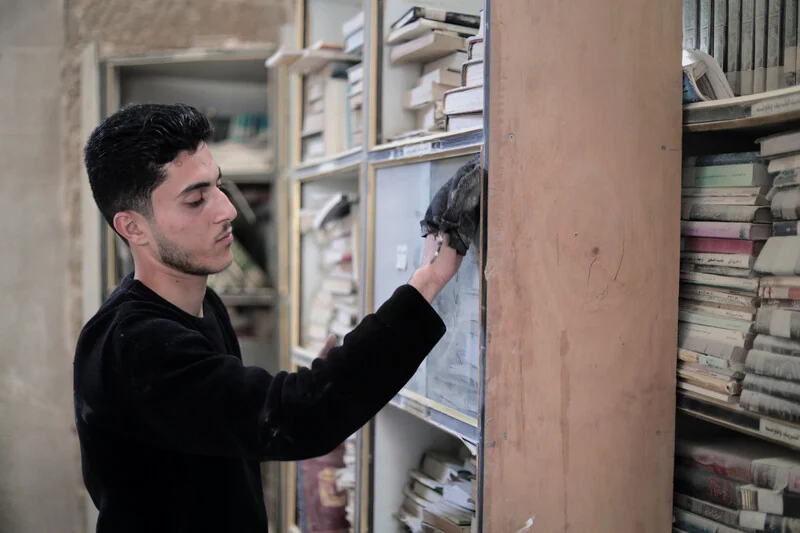
Photo caption. A young volunteer is organizing books at the Omari Library at the Great Omari Mosque, which Israel bombed in December 2023. APA images
It was a hot day in August. The air was thick and full of dust. Around me I saw crumbling shelves and musty manuscripts. It was hard to focus for the mess, and my eyes kept darting from one corner to another.
This was my first visit to the Great Omari Mosque library. Everywhere was in complete bedlam and the place was full of insects. Around me I noticed many heartbreaking details, including a copy of the Holy Quran so badly torn that not a single word remained legible.
I turned to look at the broken windows of the library, when I saw Haneen al-Amsi, 33, the executive manager of Eyes on Heritage Foundation, a Gaza research and documentation institute founded in 2009, picking up remnants from a broken shelf.
She spoke, breaking my train of thought.
“Did you know that I packed what I could save from these manuscripts when the evacuation orders came down before I packed my personal belongings,” she sighed. “I was looking for a safe place for this inherited heritage before my own safety.”
Al-Amsi is originally from the village of al-Sawafir al-Sharqiyya. Her family were made refugees in 1948. She lives in Gaza City and her words reminded me of why I was there.
One night in mid-July, I was scrolling through social media when I saw a friend’s story that Eyes on Heritage Foundation was looking for volunteers to learn how to save and restore Gaza’s written history and heritage. At the time, I had just finished my third year at Al-Azhar University where I am studying English language and literature. I desperately needed something to ground me amid the chaos of life in Gaza.
I am a bookworm. I have always loved books and manuscripts. Here, it seemed to me, was an opportunity to combine my love of books with my conviction that we must do all we can to preserve our Palestinian identity and Gaza’s collective memory.
Two days after registering my interest, al-Amsi called me for an interview. Stepping into her small, temporary office (their main offices were destroyed in Israel’s genocidal aggression) somewhere in the al-Mina neighborhood of Gaza City, I saw several irreplaceable and valuable books and manuscripts just placed on wooden pallets on the ground. There was an old astronomical manuscript that I tried to read, but I couldn’t. It had been exposed to the elements and was too moldy.
Layers of history
The bombing of the Great Omari Mosque on 8 December 2023 was clear proof – if proof was needed – that Israel’s indiscriminate aggression on Gaza was not just about killing people, but about destroying history and heritage. This is a genocide in the truest sense, one that aims not just at our lives and the conditions of life in Gaza but at memory itself.
The site itself has been a site of worship for 4,000 years. It is understood to have been home to a Philistine temple from the second millennium BC, before it was converted into a Roman temple in 50 BC. It became a Byzantine church in the 5th century and was then converted into a mosque after the Muslim conquests of the 7th century under Omar Ibn al-Khattab, one of four “rightly guided” early leaders of Islam after Prophet Muhammad.
It went through another stage as a Christian church after the crusader invasions, until the Mamluk dynasty rebuilt the mosque and raised its octagonal minaret in the 13th century.
These were the layers of history I stepped into on my first day as a volunteer. And I soon realised how the mosque is also not only about worship even though I grew up going there, a 20-minute walk from our home, for eid prayers during the holidays. It has been a sanctuary of knowledge since the Mamluk era.
In a corner at the back of the mosque, a cracked door separates the library from the rest of the building. On that first day, sunlight slipped through a small breach in a damaged wall and fell across the wooden shelves, where I started dusting some of these extremely rare and valuable books and manuscripts.
The library was founded by al-Zahir Baybars al-Bunduqdari, who stocked it with thousands of books and manuscripts. The oldest surviving document dates back to the early 16th century. One of its most notable manuscripts is Sharh al-Ghawamid fi ‘Ilm al-Fara’id (Clarifying the Ambiguities in the Science of Inheritance) by Badr al-Din al-Mardini, a renowned astronomer and mathematician, which is approximately 500 years old.
Other important works include Diwan Ibn Zuqa’ah Al-Ghazzi, a rare collection of poetry by the distinguished Gaza-born poet Ibn Zuqa’ah, which sadly didn’t survive the bombing but for which copies exist elsewhere, and collections of fatwas [Islamic rulings] by the scholar Al-Timirtashi Al-Ghazzi, dated to 1720 and Hasan bin Abd Al-Latif Al-Husseini, dated to 1820.
In 2019, in collaboration with the British Library, some 211 manuscripts from the Omari library were digitized and made available online.
My eyes naturally fell on more modern Palestinian texts, including an archive of the original names of Palestinian villages pre-Nakba and the watermarks from traditional industry companies like the iconic al-Jamal (Camel) Nablus soap brand.
Crucial restoration
Al-Amsi, as I was dusting, spoke to me of the library’s more modern history, of Othman al-Tabaa, who was imam at the mosque in the early 20th century and who helped revive the library, of Jamil al-Rayyes who succeeded al-Tabaa in 1950 and carried on his work.
I looked at the damaged shelves and thought of the scholars whose works were preserved here. Their words and wisdom now lay covered in dust and I found myself determined to save what could still be saved.
Israel destroyed more than 90 percent of the mosque mostly in December 2023 but also in subsequent bombings over the past three years. The library, with its 20,000 books and manuscripts, lay buried under rubble for more than 500 days. Eyes on Heritage estimates that just 4,000 books and 147 manuscripts have survived.
The loss is irreplaceable, Abdul Latif Abu Hashem, 61, the general manager of Eyes on Heritage and currently a visiting scholar at the IREMAM Arab and Islamic research institute in Marseille, told me over the phone.
“There are no paper copies of these manuscripts at any library in the world.”
The process of restoration is a delicate one. If we find that a book or manuscript can be salvaged, we move to the next stage, carefully cleaning dust and mold from the pages.
Our tools are basic. We use a small paint brush to remove dust. We also have a single microscope that the team managed to restore, to investigate whether books are free of insects. During one of these restoration efforts, I was amazed to see a silverfish bug greedily eating its way through a page.
After identifying and cleaning, we create digital metadata of these books, which includes title, author, topic and year of publication. Then we organize them according to topic.
Amid the deprivation and suffering in Gaza, the restoration of old manuscripts and books may seem to some of secondary importance. But this is our heritage and history, and it is passed down from generation to generation on our land.
“Just to find a pail of water is the hardest thing these days,” al-Amsi said. “But I believe that our youth must understand that they are the foundation for passing down this heritage. That is why we chose them [we were 11 youth in total] to revive this library.”
Abu Hashem concurred. “There is no history without these pieces,” he told me, while he was relating how he and his family had been displaced from their home in Rafah during the genocide. Preserving this library, he said, while difficult, is crucial “to get life back” in Gaza.
Reviving Gaza is not only about restoring old walls. Resistance takes many forms. It can begin with a sheet of crumbling paper and a drop of faded ink. It can be done with a small paint brush.