
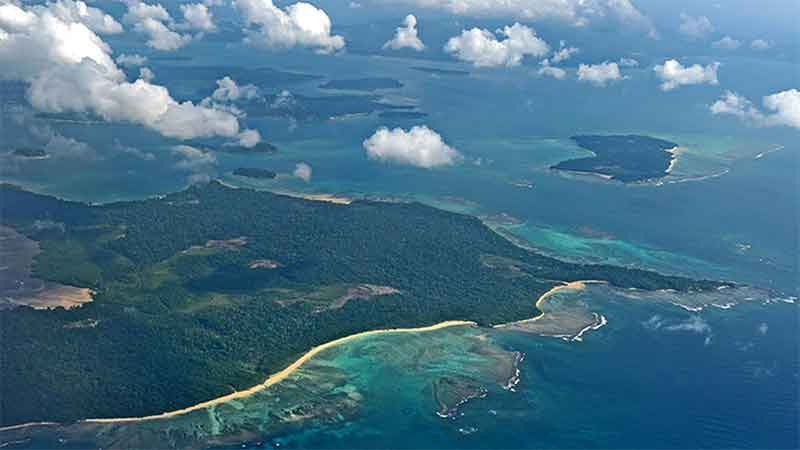
The so-called “mega development project” of Great Nicobar Island is being pushed by the Modi government as a symbol of progress. But from an environmentalist’s standpoint, as from anyone with human rights as an anchor – as our Constitution guarantees, it is something far more troubling. It’s nothing less than a blueprint for a massive ecological erasure in one of the last remaining intact tropical rainforest landscapes in South Asia, and one among several critical remaining ones on Earth. And that erasure will be “forever” in a country’s civilisational time scale.
A Rainforest That Still Breathes whole:
Great Nicobar is not just any “forest land”, as even many scrublands are defined. It is a living, breathing ecological wonderland of extraordinary richness and rarity. Lying within the Indo-Burma Biodiversity Hotspot, the island contains primary (old-growth) rainforests, meaning ecosystems that have evolved over tens of thousands of years without large-scale human disturbance.
These forests are also huge Carbon reservoirs:
Dense tropical rainforests like these store massive amounts of carbon in both above ground biomass and soil, acting as natural buffers against climate change. Their destruction releases this carbon irreversibly, at least in the centuries-scale measurements . They are also very good hydrological stabilizers – the rainforest regulates rainfall patterns, groundwater recharge, and prevents soil erosion — especially crucial on an island vulnerable to cyclones and tsunamis.
A Genetic Diversity Treasure house :
Scientists have repeatedly emphasized that many species here are still undocumented, even unknown to science.. Destroying these pristine forests means wiping out unknown medicinal, ecological, and evolutionary knowledge forever, which might be critically needed for human adaptation in this age of rapid climate collapse.
Among the many species uniquely tied to this ecosystem:
The Nicobar megapode, a ground-dwelling bird that builds remarkable incubation mounds from forest debris, nthe giant leatherback sea turtle which nests at Galathea Bay — one of the most important nesting sites in the Indian Ocean, endemic reptiles, amphibians, and insects found nowhere else on Earth.
Coral reefs and mangrove systems that form an integrated land-sea ecological continuum : This is not replaceable biodiversity. It is irreplaceable.
The Indian government’s plan to do the replacement plantations in the Haryana Aravallis, smells of absurdity and massive corruption. These are two completely different ecosystems, the Aravalli mountains being a sparse dry forest area, not even comparable to the dense tropical rainforest of Great Nicobar. No comparison of biodiversity, of carbon storage and climate control…..
Indigenous Life Interwoven with Nature:
For the Shompen and the Nicobarese, the traditional residents of Great Nicobar, the rainforest is not a “resource” — it is identity, sustenance, culture and history.
The Shompen, particularly, live deep within the forest in small, semi-nomadic groups. Their knowledge of plants, animals, and seasonal cycles represents a form of ecological intelligence that modern science is only beginning to understand. To fragment their habitat is to dismantle an entire worldview.
History has shown that when such communities are exposed to rapid “development”,
Diseases and demographic collapse often follow.
Cultural systems disintegrate. Economic marginalization replaces self-sufficiency.
No compensation package can substitute for the loss of a living culture rooted in land.
The Scale of Destruction
The project proposes:
Diversion of ~130–150 sq km of pristine forest,
felling of nearly 1 million trees,
Construction of a massive transshipment port, airport, power plant, and township.
But numbers alone fail to capture the much deeper damage. This is not selective logging—it is landscape-level transformation:
Roads will carve the forest into fragments, isolating wildlife populations.
Light, noise, and pollution will penetrate deep into previously undisturbed habitats.
Coastal engineering will alter sediment flows, affecting coral reefs and turtle nesting beaches.
And all this in a region that lies in a highly seismic zone, still bearing the memory of the 2004 Indian Ocean tsunami.
A Dubious Economic Argument:
We are told this sacrifice is necessary to build a global transshipment hub, competing with ports like :
Port of Singapore,
Port of Colombo,
But this narrative is shaky at best. Global trade is entering an uncertain phase, shaped by geopolitical tensions, regionalization, and slowing growth. Existing ports are already efficient and deeply integrated into shipping networks. Building a new mega-port in an ecologically fragile, remote island—at enormous financial and environmental cost – raises serious questions of viability.
Environmentalists and economists alike ask:
Is this truly about national interest, or about enabling large-scale private corporate profit under the banner of development?
Ecological Collapse in the Age of Climate Crisis:
At a time when the world is grappling with climate breakdown – heatwaves, floods, massive forest fires, increasing g storms and cyclones, biodiversity collapse, ….. – the destruction of a primary rainforest is not just a local issue. It is another step to a global catastrophe.
Tropical rainforests like Great Nicobar:
Absorb carbon emissions we are failing to reduce,
Buffer extreme weather events,
Sustain biodiversity that stabilizes ecosystems worldwide.
To destroy them is to accelerate the very crises we claim to fight.
The Ethical Question:
This is not merely a technical or economic debate. It is an ethical one. Do we, in the 21st century – armed with full knowledge of ecological limits – still choose to erase ancient forests, displace indigenous peoples, and gamble on uncertain economic returns?
Or do we recognize that some places are too valuable to destroy? In reality, most of the remaining natural places should be inviolate ?
A Different Vision:
An environmentalist’s perspective does not reject development. It demands a different kind of development :
One that respects ecological thresholds.
One that centers indigenous rights and knowledge.
One that values long-term planetary stability over short-term gains.
Great Nicobar offers India an opportunity—not to repeat the mistakes of extractive development—but to lead with a model of conservation-led,g climate-conscious stewardship.
To lose it would not just be a national tragedy.
It would be a global one.