
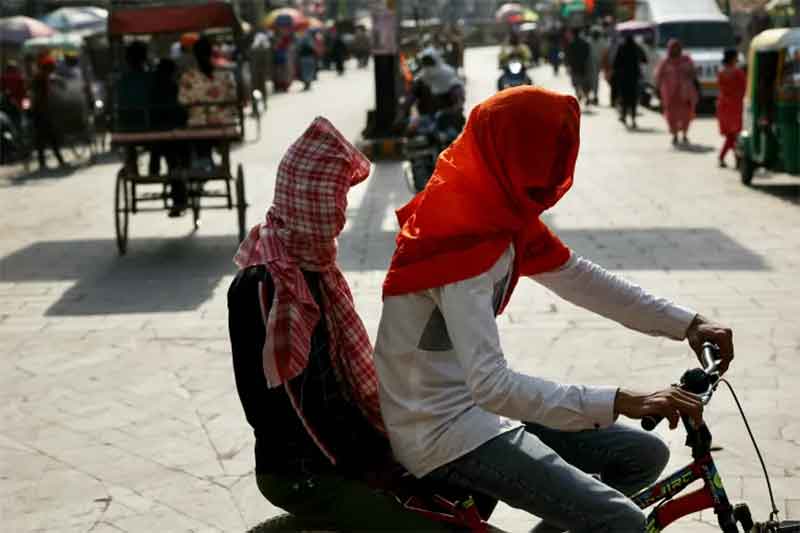
Sixteen years ago in May 2010, the city of Ahmedabad and its surroundings came under an intense heatwave, marked by “record-breaking” maximum temperatures. This heat wave resulted in a mind-boggling 1344 excess deaths in the Ahmedabad area alone. Excess over the background mortality rate of 3118 deaths normally occuring in the same period and same area – a massive increase. This was relative to May 2009 and May 2011, approximately a 43% increase in heat related mortality. The maximum temperature recorded by the meteorological stations was 46.8°C. This human disaster gave the impetus for India’s first Heat Action Plan for Ahmedabad in the year 2013, lead by Dr Dileep Mavlankar of the Public Health Foundation of India, and with active participation of the Ahmedabad Municipal Corporation. There are pointers to show that that city has coped with subsequent heat incidents much better, largely because of an increased public awareness of what to do and what not to do during extreme heat days, and some basic provisions.
Now, there’s another ‘change in the air’. Cities like Delhi, Ahmedabad, Hyderabad etc traditionally faced mostly dry heat conditions in summer months, where the maximum day temperatures shoot up beyond 45°C on peak heat days, but the relative humidity or ‘mugginess’ was low. The human (or animal) body can cool itself ‘naturally’, by perspiration, if you keep yourself hydrated. But Delhi, my current ‘home town’ for over 30 years, increasingly looks like a City that is learning to sweat, as it slowly descends into a Humid Heat environment, from a largely dry and hot summer.
For a tad over three decades, I have lived through Delhi’s summers. I distinctly remember a time when heat here had a certain clarity – harsh, yes, but mostly dry. except the occasional breaks by an ‘aandhi’ or dust storm, which brought the temperatures down, but left it mostly dry. The afternoons scorched, the loo winds burned your skin, and yet early mornings and evenings offered a measurable respite from the high temperatures. Sweat quickly evaporated in the dry air, allowing our bodies to naturally cool down by the loss of heat of evaporation. Nights cooled significantly, at least enough to let the core body temperature go down inducing sleep – because the dry rocky surface quickly re-radiated heat back to space. And that heat had a much clearer escape route, as the atmospheric air had much lower moisture, a powerful heat trapping green house gas .
That memory now feels like it belongs to another city, another climate. Today, Delhi does not just burn – it suffocates, much like my earlier home town of Kolkata. Or the inner parts of on-coast Chennai. Sweat accumulates and drips down the face and arms, and the heat clings to your body. The air feels much heavier, wetter. It is no longer only the simple thermometer reading that tells the story, but the more complex realities of the human body itself. The city has crossed into something new : a hybrid of heat and humidity that was once alien to its semi-arid identity, something called a high heat index environment. But the India Meteorological Department – the apex technical body of the government in matters of weather and climate, still dishes out the headline air temperature most prominently, clinging to an era long gone. Even it’s ‘Heatwave warnings” are based only on the maximum surface air temperature, as if the human body is a metallic or stone object, without its internal processes being powered by liquid flows . even though it gives the “Feels like ” temperature, essentially telling how the human body is perceiving the temperature, the heat index, it’s just a side note, without any operational function !

As we all know, Delhi’s meteorological stations regularly registers over 45°C on a few summer days, and the Mungeshpur station registered over 49°C just two years ago. And please take note : Delhi is the ‘Greenest Mega City’ in India, as per reports by Forest survey of India, with about one-fourth of its land area under “forest and tree cover” ! Is this a paradox ? Not really, it’s a slow but real change that is taking hold . But the reality remains and should hit us all hard and centre — The Greenest Megacity of India is also one of the Hottest (in summer) and most polluted cities – not only in India, but in the entire world. Solid data bears that out.

So a solution to the severe and fast increasing heat stress in Indian cities cannot be tackled just by the over-simplistic slogans or actions like “ped lagao, garmi bhagao” (meaning – plant a tree, eliminate heat). Unfortunately, a large number of so-called experts, media groups, administrators and yes – politicians, seems to believe in that mirage.
This is not to say that having higher tree covers in cities do not affect the temperature under their shades and immediate vicinities – they definitely do. By blocking a large part of the solar insolation (incoming solar energy per square meter), and even more – by evapotranspiration . As trees draw in water from the ground and release them as moisture just above the canopy, part of this water evaporates and absorbs large amount of sensible heat from the air that carries the water molecules. The sensible heat becomes less, though the total heat energy is not gone. It’s present there in the water vapour, and when and where it condenses as water droplets , it releases that same amount of heat back. That’s simple physics, and no amount of “Trees Cool down the Earth” belief can eliminate that. And higher heat retention by heavy-built concrete structures combined with higher water vapour concentration in the air above our cities, aided by evapotranspiration, along with a myriad uses of warmer water within the cities – from kitchens to industrial processes to internal combustion engine vehicles – are preventing night time radiative heat escape to the sky /space — making our nights uncomfortably more warm that they used to be. Heat Island plus moisture dome is a double hit.
And it’s Not Only Delhi. Cities with traditionally dry summer heat, like Hyderabad, Pune etc are undergoing similar transformations.
This transformation is neither accidental nor singular. It is the cumulative outcome of a host of factors – global warming and climate change layered onto intensely local, urban processes.
Climate Change and Rising Heat / Temperature : the Base layer
At the broadest scale, Delhi’s changing summers are anchored in global warming, like in all other cities.. Heatwaves across India are becoming more frequent, longer, and more intense, with temperatures regularly exceeding historical norms. Scientific projections suggest that in cities like Delhi, the combination of rising temperatures and persistent hot nights will dominate future climate patterns. The proportion of “combined hot days and tropical nights” could rise dramatically, approaching near-continuous heat stress conditions for the worst months, in the later part of this century.
The night temperature is crucial : the city is not cooling enough at night anymore. The human body is denied recovery after a long hot day (and we have not yet started noticing the impacts on other animals that live in our cities).
The Urban Heat Island : A City That Stores the Sun
But climate change alone does not explain Delhi’s (or similarly impacted other south-Asian cities ) particular brutality. The city itself has become a Heat Engine.
Urbanisation replaces moist soil, trees, and water with concrete, asphalt, and glass—materials that absorb and retain heat – both Solar and internally generated – during the day and release it slowly at night. This is the urban heat island (UHI) effect. In Delhi, studies show that decades of urban expansion have increased temperatures by around 1°C and intensified heat island effects by as much as 5–6°C in some areas.
The mechanism is simple but devastating:
Built surfaces of concrete etc trap solar radiation. Heat is then released slowly after sunset, disrupting Night-time cooling . Warmer nights are the result. And for millions of poorer urban residents forced to live in cramped houses or shanties made of heat retaining materials, that failure to cool in the night, brings longer term diseases and drastic loss of productive capacity. So it’s not only a loss to the poor workers, but also to the “economy”.
Even within the city, “warm pockets” emerge depending on land use – dense built-up areas absorbs and radiate far more heat than parks or open spaces.
When Heat Meets Moisture : The Rise of “Humidity or Moisture Islands”
Delhi was never meant to feel like Mumbai, or Chennai or Kolkata. Yet increasingly, it does.
Researchers have long noted that alongside heat islands, cities can develop “humidity / moisture islands”, where moisture accumulates depending on surface conditions and atmospheric dynamics.
What has changed in recent years is the frequency and persistence of this combination :
Higher baseline temperatures plus More moisture retention in the air, combined with
Reduced ventilation due to dense urban form.
Humidity transforms heat into something far more dangerous. It prevents sweat from evaporating – the body’s primary cooling mechanism. The result is a higher heat index, where temperatures feel far worse than they are.
There is another, global scale moisture pump at work – record breaking sea Surface Temperatures over the past 3-4 years. As the Sea Surface waters heat up, there’s much more evaporation and the global-warming heated air holds more moisture too. As this moist air is carried inland, this is creating higher relative humidity in many geographies.

This is the “new Delhi summer” I have come to dread : not just hot, but oppressively humid too.
Vehicles, Waste, and the Everyday Production of Heat within the city :
The city is also producing enormous quantities of heat in real time. Millions of vehicles (well over 1.1 crores, including 2 and 3-wheelers in Delhi, and about 3 crores in Delhi NCR) moving through Delhi’s roads generate not just serious levels of air pollution, but direct thermal energy as waste heat through their tail pipes. Traffic congestion worsens this effect, with idling engines continuously releasing heat into already overheated streets. And this heat builds up, on top of the “climatic heat”.
On top of this,
Waste burning releases both heat and heat-trapping pollutants in large quantities. The problem is compounded by the so-called Waste to Energy (WtE) plants, each of which burn thousands of tons of solid municipal waste every day, adding massive extra loads of heat and heat trapping gases (mostly CO2) /particulates, directly into the city’s air.
Industrial and construction activities adds substantial localized thermal loads too.
Air conditioners, increasingly ubiquitous, expel heat back into the urban environment.
Urban heat is not just absorbed – It is actively manufactured within the city, and there’s hardly any noise about this when we talk about making our cities resilient to climate change.
Studies note that such anthropogenic activities contribute significantly to near-surface temperature increases and amplify the UHI effect.
The Paradox of a “Green” hot City :
Delhi presents a striking contradiction.
According to the latest assessments by the Forest Survey of India, roughly 25% of Delhi’s area is under forest and tree cover, making it one of India’s greenest megacities. And yet, this has not protected it from rising heat stress.
Because :
* The Green cover is unevenly distributed,
* Dense built-up zones overwhelm cooling benefits
* Loss of water bodies and wetlands reduces evaporative cooling
* Fragmented green spaces cannot offset large expanses of concrete
* Even cities with significant greenery can become “heat traps” if urban design is unbalanced and ecological systems are degraded
* Even areas with higher tree cover don’t have relief from high humidity , when that happens.
* Delhi’s dense and haphazard built-spaces don’t allow strong wind to flow in many congested areas.
In other words, it is not just how much green exists – but where and how connected it is, along with a host of other factors.
Losing Urban Water Bodies
The same mechanism that helps tree covered areas cool down, is also very effective in urban “sensible heat” reduction – presence of urban water bodies. Large exposed water surfaces help large scale evaporative cooling in their surroundings. With the continuing loss of water bodies, mostly to ‘real estate development’, cities lose this cooling mechanism. Same applies for large open grassy areas. one needs to note that this also has the disadvantage – beyond a certain point – of humidity buildup in the neighbourhood. And in a world increasingly becoming more humid along with being warmer, this quickly triggers uncomfortable heat indexes and health impacts .
The Human Cost : Heat on the Street
For those of us who can retreat indoors, into an air-conditioned environment, Delhi’s heat is uncomfortable, but bearable. For millions of the city’s poor and working class people, it is punishing, often killing.
Over the years, I have watched construction workers labour under direct sun on flyovers and metro lines – barely shielded, often without adequate hydration. I have seen (and worked to educate) street vendors, rickshaw pullers, sanitation workers – people whose livelihoods tether them to the brutally hot and humid open air – endure conditions that are steadily becoming unlivable.
The signs are visible :
* Slower movement by afternoon,
* Frequent pauses in shade,
* Faces drawn with exhaustion,
Research increasingly confirms what is obvious on the streets : heat stress reduces productivity, increases health risks, and disproportionately affects outdoor workers.
This is not just a Climate issue – it is a Labour and Justice issue at its core.
A City Rewritten by Heat :
What has happened to Delhi (and many other similar cities) is not a sudden disaster but a slow rewriting of its climate. A dry heat has become a humid and more dangerous one, without too many people realising the change. Hot days have increased, but it has turned to hotter nights too.
A city that once cooled itself now stores and generates heat.
The causes are layered :
Global warming sets the stage.
Urban heat islands intensify temperatures.
Humidity retention amplifies discomfort and health risks.
Vehicles, waste (including WtEs), and energy use add lots of direct heat.
Fragmented ecology weakens natural cooling.
The result is a new urban climate – one that feels less like a seasonal hardship and more like a structural condition.
A failure of Urban Governance :
While all these changes – local and global – are happening, our city governance seems to be stuck in the early 20th Century framework. The city still plans for more and more heat trapping “developmental infrastructure” and destroys open green spaces, the technical body – India Meteorology Department or IMD, still determined risk with outdated “maximum air temperature” determinant,…. Simultaneously, our cities are now bursting with millions of migrant workers to fulfill these construction and maintenance demands, poorly paid and uncared for workers living in highly vulnerable flimsy housing offering little protection from the elements. It looks like our governance is asleep on decades long cycle, like a Rip van Winkle.
The Question Ahead :
Delhi’s experience is not unique. Across India, cities are becoming “heat traps,” where urban form and climate change reinforce each other.
The real question is not whether cities will get hotter – they will. There’s a popular saying in the climate science fraternity — “if this summer feels unbearably hot, remember, in 20 years this will be what the coolest summer feels like”. The real question is whether they can be redesigned to remain livable.
For those of us who have lived here long enough, the change is undeniable. Delhi has (almost) learned to sweat. The worry is that, increasingly, it may not be able to cool down.