
There is an urgent need to update publics and policymakers on our climate situation in 2026 and what effective mitigation policies must mean now. We’ve passed the 1.5C temperature rise guardrail, extreme weather is effecting life on every continent and in warming oceans, and we are stumbling through a minefield of dangerous and probably irreversible feedbacks. A selection of up to date climate science papers is offered as well as another box of mostly social science critical of our present ineffectual, energy transition, mitigation path.
The new climate science includes papers updating our understanding of climate dangers after the gobsmackingly bananas rise in GMST over the past few years and preliminary assessment of the reasons for this unpredicted rise. Some might consider my update choices cherry picking but these papers are by the best scientists in their fields. They are also focused more on the climate dangers over the horizon – our brains have evolved to prioritize the local and temporal and this is reinforced by our short term and self-interested economic and political timelines; this bias distorts our picture of the whole suite of climate dangers and the importance of mitigation.
Having blown past the guardrail of a 1.5C rise in temperature, our emissions today (after at least three decades of failed mitigation) could trigger feedbacks that would boost temperatures over 4C and more, crashing our global civilization and potentially making most of Earth uninhabitable for future generations for millennia:
Climate Science
The 2024 state of the climate report: Perilous times on planet Earth – Ripple et al
“We are on the brink of an irreversible climate disaster. This is a global emergency beyond any doubt. Much of the very fabric of life on Earth is imperiled. We are stepping into a critical and unpredictable new phase of the climate crisis.”
Global Warming Has Accelerated – Hansen et al
“We also show that IPCC’s emphasis on global climate models led to a marriage of aerosol forcing and climate sensitivity, such that underestimate of aerosol forcing led to underestimate of climate sensitivity. The result is a double whammy that helps explain global warming acceleration and alters projections of future climate, magnifying the danger of intergenerational injustice.”
Global Tipping Points Report 2025 – Lenton et al
In depth report on climate tipping points
Many risky feedback loops amplify the need for climate action – Ripple et al
“Many feedback loops significantly increase warming due to greenhouse gas emissions. However, not all of these feedbacks are fully accounted for in climate models. Thus, associated mitigation pathways could fail to sufficiently limit temperatures. A targeted expansion of research and an accelerated reduction of emissions are needed to minimize risks.”
A minefield of dangerous feedbacks Gwynne Dyer
This newspaper column (not a science paper) is an insightful look at our present climate predicament.
Feedbacks already set off are presently reducing the carbon budget and time for mitigation. The present breakdown of multilateralism threatens to put us on a path where mitigation to keep us climate safe isn’t possible.
These papers should set off alarm bells about effective mitigation: obviously the Paris and IPCC net zero by 2050 timeline is now outdated; climate is an emergency where emission reduction of a scale urgently needed this decade is no longer possible without emergency government action. The mitigation box below contains important but largely ignored papers that the majority of the public and policymakers haven’t digested yet. (Perhaps because, combined with accelerating warming, they make mitigation inconvenient squared and so denial kicks in.)
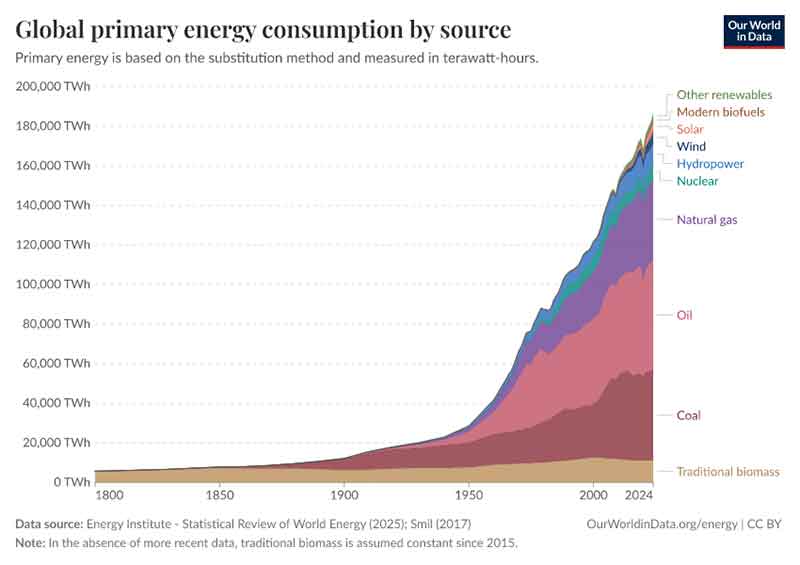
Building renewable capacity is good but will not displace fossil fuels any time soon and has no chance of reducing emissions by the very much needed at least half by 2030 imperative:
Effective Mitigation
Energy transitions or additions? Why a transition from fossil fuels requires more than the growth of renewable energy – Richard York and Shannon Bell
“Evidence from contemporary trends in energy production likewise suggest that as renewable energy sources compose a larger share of overall energy production, they are not replacing fossil fuels but are rather expanding the overall amount of energy that is produced.”
The energy transition is a pipedream – Rachel Donald
Jean-Bapiste Fressoz is a French historian and author of More and More: The all consuming history of energy. This podcast (there is a transcript) is a good introduction to his work.
Amid explosive demand, America is running out of power – Evan Halper
“Vast swaths of the United States are at risk of running short of power as electricity-hungry data centers and clean-technology factories proliferate across the country, leaving utilities and regulators grasping for credible plans to expand the nation’s creaking power grid.”
Cutting with both arms of the scissors: The economic and political case for restrictive supply-side climate policies – Fergus Green and Richard Denniss
“But the comparative literature on climate policy instrument choice has been remarkably silent on instruments that aim to restrict the supply of commodities and products whose downstream consumption produces greenhouse gas emissions (“restrictive supply-side climate policies”), of which measures to restrict fossil fuel energy supply are the most relevant.”
Cap and Adapt: A Failsafe Approach to the Climate Emergency – Larry Edwards and Stan Cox
“Here, we propose a policy framework we call Cap and Adapt, to accomplish the resolution’s proposed managed phase out of fossil fuels, and by design to do so at a speed matching the last-minutes-to-midnight urgency of our climate plight.”
A Fossil Fuel Nonproliferation Treaty
“Addressing only emissions reductions and demand without fossil fuel supply has allowed countries to claim to be climate leaders while continuing to open, approve and fund new fossil fuel projects.”
Bottom line: if we take the climate dangers seriously, mitigation now has to be both arms of the climate policy scissors – we have to wind down fossil fuel production and use as well as build renewables. Biden’s IRA, introduced at the same time as the US was expanding fossil fuel production, was of very limited emission reduction utility (and consuming more energy also worsened our broader Overshoot or Bottleneck predicament).
“‘This is not a transition. It’s a systematic expansion of all energy sources.’ Rather than replacing fossil fuels, the dominant model of green energy merely layers renewables atop fossilized extractive systems.” Madhuresh Kumar
Mitigation now must be emergency government regulation. Staying in implicatory climate denial isn’t an option, climate is getting worse and worse, including the local and temporal climate dangers today as the rate of warming accelerates. An advanced civilization should have foresight and an open, transparent, inclusive and ethically-centered debate about what to do about the building climate dangers. Instead we’re going the other way, refusing to even recognize the science as worsening heatdomes and storms foreshadow vast areas of our countries becoming uninhabitable.
Speaking of foresight, David Suzuki was recently quoted saying it was too late for climate mitigation. We probably won’t know until long after if our emissions and the warming caused has set off feedbacks to our irreversible destruction. This should focus our resolve to do what it takes to try and hurry back to climate safety. But surely it’s way too late for pretend, ineffectual, incremental mitigation within our present political and economic systems.
All fossil fuel production in my country Canada, for example, will have to be wound down within a decade. This will require a binding international treaty and, in Canada, strict regulation imposed by both the federal government and the producing provinces. This will require emergency governments, Green New Deal-style support by governments, and a major evolution of our socio-economy. This is the mitigation we need now to try and stay climate safe; it’s still possible and it’s what we owe every future generation.