
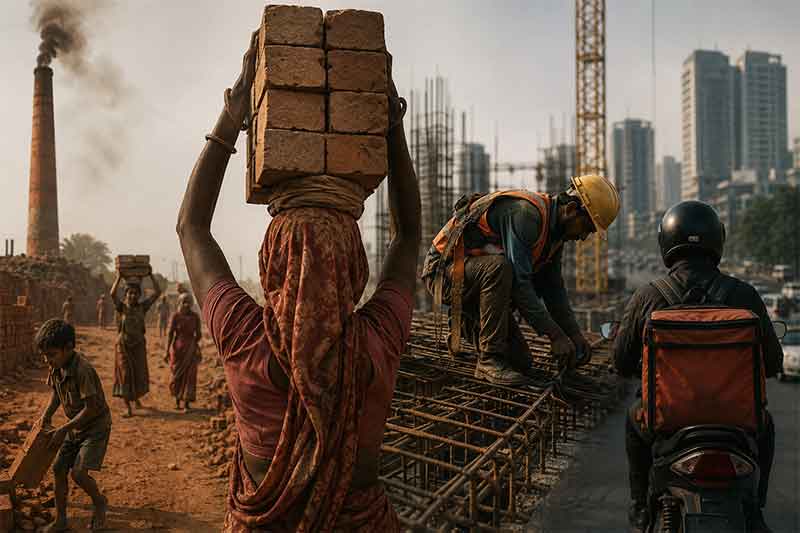
India’s informal economy employs roughly 90% of its workforce, contributes about 45% of GDP, and operates almost entirely outside the reach of effective labour law. The workers who hold this economy together—in brick kilns, construction sites, and gig platforms—share one thing in common: the costs of growth are often settled through their labour, health, and security.
The Brick Kiln System
India has at least 100,000 functioning brick kilns, employing an estimated 23 million workers. The workforce is predominantly Dalit and Adivasi, drawn from some of the country’s poorest districts through a debt-bondage cycle that has changed very little across decades. Contractors advance families between ₹10,000 and ₹20,000 at the start of the season — enough to cover a wedding, a medical emergency, or a debt that spiralled. Once accepted, the advance becomes a trap. Workers are paid by the thousand bricks, not by the hour, which means the family’s only path to earning more is to work longer and involve their children.
Anti-Slavery International’s research across Punjab kilns found that 96% of brick kiln moulders had taken loans, and all had wages withheld for entire seasons lasting eight to ten months. Between 65% and 80% of children under fourteen were found working an average of nine hours a day during the summer months. One-third of all kiln site occupants are children between the ages of five and fourteen, with 80% of those children working directly in brick production alongside their parents. This is not informal employment that happens to involve children — it is a wage structure specifically designed to make child labour economically rational for families who cannot survive without it.
The physical toll of brick kiln work is immense and rarely documented. During the March–June season, temperatures often reach 45–50°C, while workers carry loads of 60–80 kilograms across uneven ground. Women face the same punishing labour as men, often while pregnant. Children inhale clay dust, carry heavy loads, and lose years of schooling. Workers frequently suffer chronic injuries and respiratory illness. Yet nearly 90% of kilns lack running water, and workers have no accident insurance, health coverage, or pension.
Brick kilns are covered by labour laws, but enforcement is weak. Owners often classify their operations as family businesses or seasonal enterprises to avoid scrutiny, while labour inspectors remain overstretched. Bonded labour is illegal in India, yet remains widespread across the sector.
Construction’s Invisible Toll
The brick kilns supply raw material to an industry that is only marginally safer. India’s construction sector is the second most hazardous industry in the country, with an average of 38 fatal accidents every day. Research by the National Institute of Technology, Surat, and IIT Delhi estimates that construction accounts for approximately 24% of all occupational fatalities in India — roughly 11,600 deaths annually out of a national total of 48,000 workplace fatalities, though these are almost certainly undercounts given how systematically the informal sector goes unrecorded.
Daily wages for unorganised construction workers range between ₹150 and ₹300, with no contracts, no job security, and no compensation when an injury permanently takes someone off the site. Only 20% of India’s workforce is covered under any existing health and safety legal framework. The remaining 80%, the vast majority of whom are women, Dalits, Adivasis, or interstate migrants, are invisible to both the law and the data.
Who Bears the Cost—and Who Fights Back
What keeps this system running is not just poverty. It is the failure of institutions that should protect workers. Labour cases drag on for years, media attention fades after disasters, and workers who protest are often treated as a nuisance rather than people with rights. Employers routinely evade responsibility: platform companies call workers “partners”, contractors shift liability through layers of subcontractors, and brick kiln owners present themselves as family enterprises. Accountability is always out of reach.
The idea holding this together is that workers freely chose these jobs and therefore accepted their conditions. But that ignores the debts, caste barriers, migration, and lack of alternatives that shape those choices. It also ignores that children never choose exploitation.
Yet workers continue to resist. In late 2025 and early 2026, gig workers, trade unions, and peasant organisations organised strikes and protests demanding fair wages, social security, and stronger labour protections. Their struggles are connected. The insecurity faced by app-based workers today—uncertain earnings, opaque penalties, and little recourse—is a newer version of what brick kiln workers have endured for generations. A delivery rider managed by an algorithm and a kiln worker tied to an advance may seem worlds apart, but both work within systems that maximise flexibility for employers while limiting accountability.
India’s gig economy already employs around 12 million workers and is expected to double by the end of the decade. Unless policies change, it will not just create more jobs. It will also expand a model that treats workers as disposable and pushes the risks of work onto them—a pattern brick kilns have relied on for generations.
The Political Economy of Bodies
The suffering that runs through India’s informal economy is not an unfortunate side effect of growth. It is part of how the system works. Brick kilns depend on cheap, unregulated labour. Construction booms are built on dangerous work sites where workers routinely risk injury and death. Platform companies promise convenience by shifting the risks of the road, accidents, and lost income onto workers themselves.
The evidence is not hidden. Government surveys, international reports, and workers’ testimonies have documented these realities for years. The real question is why we continue to treat them as problems of informality rather than as the result of an economy that relies on certain people—overwhelmingly Dalit, Adivasi, migrant, and female workers—to bear costs that others profit from.
This suffering is not an unfortunate by-product of growth. It is one of the costs on which growth depends. Every cheap brick, rapidly built tower, and ten-minute delivery relies on labour that remains largely invisible until something goes wrong. When a worker is injured, trapped in debt, or denied compensation, it is often treated as an individual tragedy rather than the predictable result of how work is organised.
India’s growth story is often told through rising skylines, expanding infrastructure, and digital innovation. Less often told is the story of the workers whose bodies bear the costs of that growth. Until those costs are recognised and shared more fairly, the question is not whether exploitation will continue, but how many more people will be asked to carry it.