
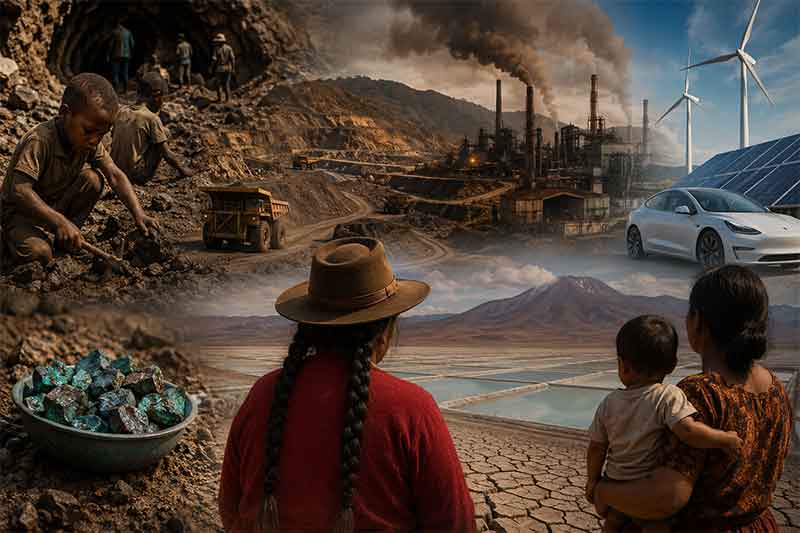
The energy transition runs on a short list of minerals that most people will never see: lithium, cobalt, nickel, copper and a cluster of rare earth elements with names like neodymium and dysprosium. Electric vehicles, wind turbines, solar panels and grid batteries cannot be built without them. Global demand for lithium is projected to rise 353 per cent between 2024 and 2040, according to UNCTAD, while the International Energy Agency projects lithium demand growing fivefold by 2040 under current policy trajectories, with cobalt and rare earth demand rising 50 to 60 per cent over the same period.
This is the mineral economy of decarbonisation, and like the oil economy it is replacing, it has a geography of extraction and a geography of consumption that rarely overlap. The communities paying the environmental and human costs of mining these minerals are, almost without exception, not the communities driving electric cars or installing solar panels.
Who Controls the Supply
The concentration of supply is severe and getting worse in some cases. The Democratic Republic of the Congo accounted for 74 per cent of global cobalt mine production in 2025, Indonesia for 67 per cent of nickel, and China for 69 per cent of rare earth mining, with China additionally dominating the refining stage for all three minerals, where most of the economic value is actually created.
This concentration is precisely what is driving the geopolitical scramble. Lithium-importing countries — the United States, the European Union, Japan, India — are racing to lock in supply through trade agreements, critical minerals partnerships, and direct investment in mines from Brazil to Chile to Zimbabwe. None of these arrangements, so far, is built primarily around protecting the people who live where the minerals are.
Congo: Cobalt and the Children in the Tunnels
Roughly 30 per cent of the DRC’s cobalt production comes from artisanal and small-scale mining — informal operations using hand tools rather than industrial machinery — and it is in this segment that the most documented human rights abuses occur. Amnesty International’s landmark 2016 investigation, conducted with the Congolese organisation Afrewatch, found children as young as seven working in cobalt mines, and traced supply chains from these mines into the products of major global electronics and battery manufacturers. Nearly a decade later, the pattern has not been resolved. A 2025 review of the literature found that children near mining areas show elevated cobalt levels in blood and DNA damage, alongside significantly reduced years of schooling compared to children elsewhere in the country.
The human cost extends beyond child labour. Communities have been displaced for copper and cobalt projects, while competition over cobalt-rich territory has fuelled conflict in eastern Congo. The M23 offensive in Goma in 2025, which killed an estimated 900 to 2,000 people, unfolded in a region central to cobalt extraction. None of this is new. It has been documented for years, yet little has changed.
Indonesia: The Nickel Boom’s Forests and Coastlines
Indonesia produces close to 60 per cent of the world’s nickel, and the expansion has been extraordinarily fast and extraordinarily damaging to the landscape it depends on. A 2025 investigation by Climate Rights International, based on interviews with 93 people living near mining and processing operations across Sulawesi and North Maluku, documented severe air and water pollution, the destruction of fishing and farming livelihoods, land grabbing, and forced relocations.
The environmental cost is impossible to ignore. Nickel mining has destroyed nearly 194,000 hectares of forest since 2000, while deforestation around smelters has more than doubled over the past decade. As forests disappear, so do natural protections against floods and landslides. Researchers have linked the spread of nickel mining to rising flooding and mudslides in affected districts, while the processing of battery-grade nickel generates toxic waste that remains poorly contained. The industry’s heavy dependence on captive coal power is also projected to cause 3,800 premature deaths and $2.63 billion in health costs by 2025.
Latin America: Lithium and the Drying of the Atacama
In the high desert plateau spanning Chile, Argentina and Bolivia — the so-called Lithium Triangle, holding an estimated three-quarters of the world’s known lithium reserves — extraction proceeds through evaporation ponds that draw enormous volumes of scarce groundwater. Lithium mining in Chile’s Salar de Atacama consumes up to 65 per cent of the region’s available water, and a 2025 analysis found that mining has driven a 30 per cent reduction in water levels in the salt flat, with documented declines in vegetation and local flamingo populations.
The Indigenous Lickanantay and Colla peoples, who have inhabited this region for over 11,000 years, depend on the same scarce water for agriculture and pastoral life that the mining operations are depleting. In January 2025, representatives of more than 200 Indigenous authorities from communities across Argentina, Bolivia, Chile and Peru gathered in Jujuy province for an Andean summit specifically addressing lithium’s impact on their lands. A coalition tracking automaker accountability, Lead the Charge, found that the average score of leading electric vehicle manufacturers on respecting Indigenous rights stood at just 6 per cent.
Whose Transition Is This?
None of this is an argument against decarbonisation. Climate change itself imposes catastrophic costs, disproportionately on the same communities — the global south, Indigenous populations, the rural poor — who are now being asked to absorb the extraction costs of the technology meant to address it. The pattern is not new; it mirrors, with some precision, the history of oil and gas extraction, where producing regions bore the environmental damage while consuming nations captured most of the economic and political benefit.
What is missing from today’s critical minerals rush is any serious international effort to ensure that the people living on mineral-rich land share in its benefits and are protected from its costs. Agreements being negotiated by the US, EU, Japan and India focus largely on securing supplies and reducing dependence on Chinese processing. Safeguards for workers, local communities and Indigenous groups remain weak, and the Lead the Charge findings suggest that voluntary commitments have done little to change conditions on the ground. A truly just transition would place labour rights, land rights and water protection at the heart of these agreements, rather than treating them as an afterthought.
The green transition has a supply chain, and that supply chain leaves real people bearing the costs. Whether the coming decade repeats the extractive history it promises to replace will depend not on technology, but on the choices governments and companies make today.