
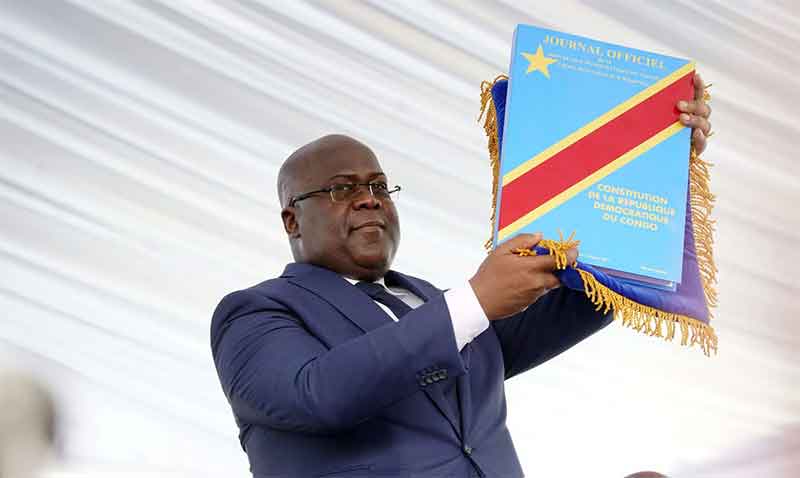
In October 2024, Félix Tshisekedi announced his intention to establish a commission tasked with examining the weaknesses of the current Constitution. He claimed that certain provisions were slowing down the functioning of institutions. However, a revolutionary analysis would question why constitutional change has become a political priority when the country is experiencing a profound security, economic, and social crisis.
Since the establishment of the political order stemming from the 2006 Constitution, the Democratic Republic of Congo has operated within a system that presents itself as democratic but whose institutional mechanisms remain deeply influenced by economic, social, and geopolitical power dynamics. The Congolese people are called to the polls every five years, but this electoral participation does not necessarily translate into real power over the country’s major economic and political directions.
In a revolutionary analysis, it is not enough to view the Constitution as a mere legal text. One must seek to understand the social and economic relations that underlie the institutions. A Constitution may proclaim the sovereignty of the people, equality, and the protection of social rights; but if the economic structure remains dominated by foreign interests and by a ruling class dependent on the imperialist system, legal sovereignty risks remaining largely formal.
The problem isn’t that a constitution can never be amended. Every society evolves and may need new institutional rules. Rather, the problem lies in the relationship between constitutional reform and the interests of those in power. When people suffer from war, unemployment, poverty, and inadequate public services, constitutional reform cannot be considered a priority separate from their material living conditions. Popular mistrust of this proposed change stems primarily from the fact that many see constitutional reform as a possible strategy to allow Félix Tshisekedi to run for a third term.
In June 2026, this controversy took on a new dimension: after its adoption by the National Assembly, the Senate in turn adopted the referendum law on June 15, 2026. The text was then to be submitted to the Constitutional Court for review. On July 28, 2026, the Court declared it constitutional, but subject to several provisions. This step thus paves the way for the continuation of the referendum process and further fuels questions about the true political stakes of this reform. This process is no different from an electoral process; the government is putting in place this mechanism of popular consultation to deceive national and international opinion into thinking that the Congolese people agree to the change in the constitution, yet the people are simply enduring the decisions of a corrupt elite that defends the interests of foreign powers.
Tshisekedi’s rise to power in 2019, thanks to the FCC-CACH coalition he had established with former president Joseph Kabila, sparked considerable hope among the Congolese people. This hope stemmed from the fact that Tshisekedi’s party, the UDPS, which had fought the regimes of Mobutu and Kabila for 32 years, gave the impression that once they controlled the state apparatus, the Congolese people could regain their dignity. However, the gradual breakdown between the FCC of former president Joseph Kabila and the CACH of current president Félix Tshisekedi has revealed a crucial reality: behind the institutions and electoral coalitions lie power struggles for control of the state apparatus by a corrupt elite.
That is why we must move beyond analyses which present these confrontations as mere conflicts between political figures. What we must ask ourselves is : which social classes do these different groups represent? What economic interests do they defend? And above all, what place do the people actually occupy in these power relations?
To answer these crucial questions, one must observe the daily life and household budget of the working class in order to understand that the Congolese political class works for the interests of the bourgeois class and the imperialist powers. In the Kolwezi region, for example, rich in strategic resources for capitalist industries, the population lives in extreme poverty despite the wealth.
The strategy of bourgeois democracy is to hold elections every five years to keep the people in a vicious cycle, thus maintaining control. Elections may change the rulers, but they don’t necessarily change the system itself.
Social life as the true battleground of the crisis
The political crisis cannot be separated from daily life. The young graduate who finishes their studies but cannot find a job, the worker who lacks adequate protection, the farmer who produces without access to a profitable market, the family displaced by war: all experience the concrete consequences of the system’s contradictions. This is why the constitutional question must not be isolated from the social question. Genuine transformation must address the economic structures that perpetuate poverty and dependency. The real Congolese question, therefore, is not simply one of constitutional change. It is one of societal change. The Congolese people cannot be condemned to periodically choose between different factions of the political class while remaining deprived of real control over their wealth.
A true democracy should mean that natural resources effectively belong to the people; that their exploitation primarily finances education, health, agriculture, infrastructure and employment; that communities living in mining areas directly benefit from the wealth produced; that workers have real rights; and that strategic decisions are not made solely in state offices or in negotiations with foreign powers.
The central question, therefore, is that of popular power. As long as the Congo’s wealth is produced by workers but controlled primarily by economic interests that escape popular control, as long as strategic minerals are considered first and foremost as commodities for international competition, as long as democracy is limited to periodic voting, and as long as the people continue to pay the price of wars and political crises, no constitutional amendment alone can resolve the Congolese crisis. Changing the text is not enough. It is necessary to transform the social relations that give the text its true meaning.