
“Despite his brief political career and tragic death – or perhaps because of them – Lumumba entered history through the front door: he became both a flag and a symbol. He lived as a free man, and an independent thinker. Everything he wrote, said and did was the product of someone who knew his vocation to be that of a liberator, and he represents for the Congo what Castro does for Cuba, Nasser for Egypt, Nkrumah for Ghana, Mao for China, and Lenin for Russia …”
These words were written in 1972 by Thomas Kanza, a friend and colleague of Patrice Lumumba, the first Prime Minister of the Democratic Republic of Congo who fell foul of a conspiracy hatched by the Americans and executed by Belgian mercenaries no sooner than he had assumed office. The 65th anniversary of the assassination of this apostle of Congolese self-assertion and pan-Africanism is being observed this year across Africa and other parts of the world. Lumumba was known to look up to India’s national liberation movement against the British, but it is a measure of the times we are passing through that 17th January, the day he was killed along with at least two of his close associates, passed off with no mention of the tragedy in the Indian media.
The high regard in which Lumumba is still held in certain European circles comes across in the writings of the Belgian author, Ludo de Witte, who characterised the elimination of the Congolese statesman as “the most important assassination of the 20th century.” It is a proven fact that the principal reason for Lumumba’s murder was that, on assuming office, he tried to put an end to the West’s loot of his country’s enormous mineral wealth. True to its role of destroyer of any regime unfriendly to the idea of its hegemony, the United States was the chief sponsor of the plot to kill Lumumba, assisted by the Belgians and chosen black accomplices. The Americans, who had used uranium deposits taken out of the Congo to manufacture the atomic bombs dropped on Hiroshima and Nagasaki in 1945, felt even more threatened by Lumumba’s assertion of will than the Belgians who had ruled the African nation with an iron fist for 75 years before being forced to grant independence in 1960.
History forgets, but it also remembers, perhaps not in like measure. But when it chooses to remember, it frequently does so with a startling vengeance, making amends for its bouts of amnesia. Significantly, it was with the eruption of the ‘Black Lives Matter’ movement in 2020 that the extent of brutalities inflicted on the Congolese people began to come to light, forcing the Belgian monarch, King Philippe to tender a public apology for the crimes committed by his country people, including Catholic nuns and priests, over at least three generations. True, the apology, like many similar apologies, may have been no more than an act of tokenism to ward off a temporary irritant, but it did force an ignorant or indifferent world to come face to face with many ugly truths which had till then been hidden from public knowledge. For instance, arguably for the first time, people all over the world came to know of the routine colonial practice to have the hands of black workers chopped off if they failed to produce a required amount of output in the country’s diamond and gold mines. It was the new-found popular anger around the revelation of such atrocities that caused many an inhabitant – black, mixed, and even white – to deface and bring down statues of Leopold II, the villainous Belgian king after whom his white subjects had named the Congolese capital settlement of Leopoldville.
In this context, if the movement for black pride, in its British chapter, failed in its attempt to topple the statues of say, Cecil Rhodes, the rabid racist who made his millions duping naïve and vulnerable Africans when not setting the dogs of colonialism on them, it only went to show how much more adamant the islanders are when it comes to owning up to their misdeeds. For that matter, Queen Elizabeth II, for all her show of decency and decorum, determinedly refused to entertain the question of apologizing for the countless crimes against humanity committed by the British in India, notably the Jallianwalla Bagh massacre. Even after a visiting Archbishop of Canterbury had prostrated himself before the massacre memorial as a gesture of atonement, the empress chose to look the other way.
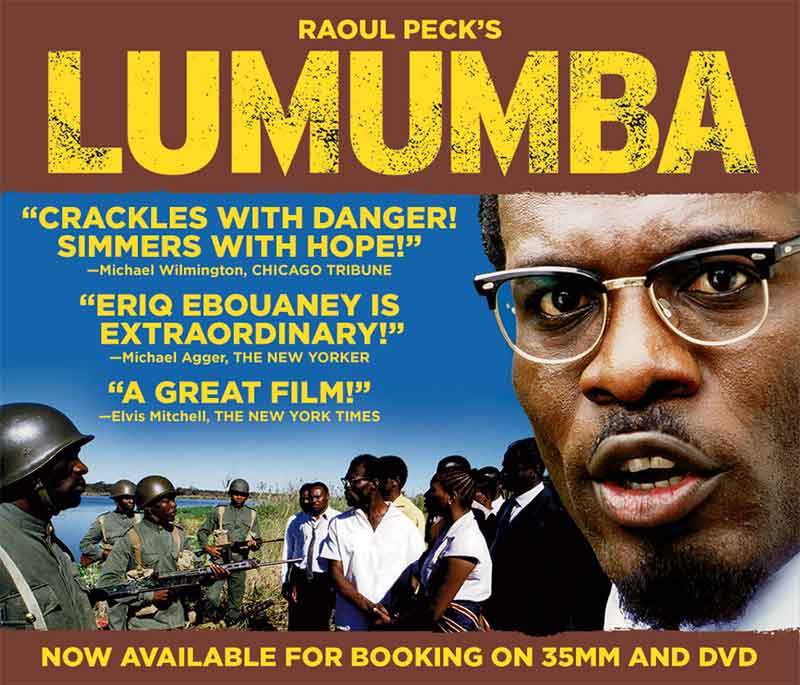
One remembers with a certain deep-seated satisfaction that the Haiti-born Raoul Peck’s restrained, respectful, and revelatory cinematic remembrance of Lumumba – the loving husband, doting parent, conscientious objector, responsible citizen, and principled politician prepared to make the supreme sacrifice, if need be – gained a fresh lease of life across Europe and the USA with the outbreak of the ‘Black Lives Matter’ movement. Screenings of the film produced detailed and fiery discussions around the murderous role of not just white occupiers, but that of the black elite who sided with the Belgians, the French, and the Americans to serve their own narrow interests even if it meant defeating the national cause and perpetuating white hegemony. It was this black bourgeoisie, led by Mobutu Seko Sese, which sealed Lumumba’s fate, leaving the field open for Western corporations to do as they wished with the present and the future of the betrayed Congolese people.
Where others of the Congolese political class, headed by the vacillating president Kasavubu, crossed over to the side of the enemy, Lumumba would not agree to anything that went against the expectations and interests of the masses he was given to addressing as “my black brothers and sisters.” In the film, Lumumba invariably begins and ends his public addresses saluting his people oppressed for centuries and just beginning to savour the joy and pride of a new chapter in their lives. In moving far beyond the sterile homilies of others of his class, Lumumba signed his own death warrant – and passed into tomes of researched findings, but more importantly, into oral history handed down from one grieving generation to the next. If Lumumba is today many legends and more numerous lullabies sung in the wee hours of the night by African grandmothers to put their naughty grandchildren to sleep, the phenomenon only serves to strengthen Virginia Woolf’s contention, it is easy to kill a man, difficult to kill a myth. If, to millions of Africans in Ghana, Guinea or the Congo, in particular, Mobutu or Kasavubu are no better than spittoons, Lumumba is the sun, the moon, or a shining star in the high heavens on a clear, cool night. What more can a man hope for?
Who knew better than Lumumba that if Africa, more than any other part of the world, had to bear the brunt of European greed and violence leading to the irreversible pauperization of the continent, it was the Congo that was made to satisfy the white man’s insatiable lust for profit by any means, the most. Shiploads of diamonds, gold, tin, copper, cobalt and uranium were whisked away to make Belgium a wealthy and prosperous country. Realising that this process of denudation of Congo’s natural wealth would not be tolerated by someone as proud and principled as Lumumba, a consortium of evil decided on his liquidation. What made the task of the killers easier was the widely-believed complicity of the West-driven United Nations in the person of the Swedish secretary-general of the time, Dag Hammarskjold, as also that of the black American envoy to the world body, Ralph Bunche, who, in time, came to be awarded the Nobel peace prize!
Apart from looting the metals and minerals of the Congo, the Belgians despatched thousands of black children to Brussels. These children, known as “the stolen generations”, were made to grow up with “white Christian values”, but ended up as no better than third-class citizens. Emotionally crippled and educationally deprived, they grew up to be nervous wrecks, unsure of themselves at every turn of life; to do the lowliest of jobs that no white Belgian man or woman would deign to touch. It goes without saying that assimilation in white society was never the intention of the colonialists. The Church, on its part, played the role of a silent observer when not an active participant. The psychological brutalization of the black or mixed population abandoned to their own devices in a distant alien land, amounted to no better than a modern-day version of slavery.
Perhaps, the most enduring images in Peck’s film are of Lumumba being forced on to an open truck along with two of his compatriots, Joseph Okito and Maurice Mpolo, and driven to their execution with jeers and blows raining on them. Their mouths are gagged and their hands are tied behind their back. Following their execution, the bodies of the three patriots were dismembered and burned. In a sense, the scenes of the corpses being sawed into many parts and fed to a raging fire drum inside a forest are less heart-rending than those of the repeated humiliations to which Lumumba and his associates were subjected on Mobutu’s orders following their arrest.
On a visit to Kerala in 2012 to deliver the Aravindan Memorial Lecture, Raoul Peck spoke of the unforgivable miscarriage of justice engineered by an international gallery of rogues which claimed the life of Lumumba and brought to an abrupt end his unique brand of socio-political experiments with truth. But Peck also made it clear that the foreign players in the tragedy would have failed to have their way if only their local stooges had not stooped so low. In a wider cinematic context, with Lumumba, which had a very successful screening at Trivandrum coinciding with Peck’s visit, the Haiti-born director joined the great Chilean documentarian, Patricio Guzman in letting the world know of the tragic fate of statesmen of destiny who tried their utmost to prevent the economic brigandage of their respective countries by the West. If Lumumba paid with his life in a desperate bid to save Congo’s gold and diamonds and, most important of all, the newly-independent country’s national sovereignty, the Chilean president, Salvador Allende went to his grave trying to defeat American designs to usurp the Latin American nation’s copper wealth.
In this connection, if Nelson Mandela died in his bed rich in years and international approval, perhaps it can be construed in terms of his seeming disinterest in disturbing the industrial and commercial atmosphere in South Africa, characterised by white ownership of every commodity – big, small and in-between – of economic value. By the time apartheid and white rule came to an end and the African National Congress took over the reins of governance, Mandela was a tired man and apparently not too eager to take on the status quo. This suited the white minority and its “people back home” perfectly, but made a mockery of the decades of struggle by thousands of patriots who had made the change-over possible. These words are not to overlook the long hard years spent in imprisonment on the notorious Robben Island, only to emphasize the safety from Western conspiracies and insurrections that Mandela bought for himself and his inner circle by distancing themselves from any radical decisions which had the potential of upsetting white miners, bankers, businessmen and landowners, not to forget their flunkeys in the Asian community.
Raoul Peck’s account of Patrice Lumumba’s life is a rigorous, almost austere, portrait of extreme political significance which, sensed between the lines, reveals why it is that even today it is possible for Western powers, especially the French, to keep interfering economically and militarily in the affairs of former colonies like Mali, Mauritania, Chad, Niger or Burkina Faso. It was the irrepressible visionary in Lumumba that made him argue till his last breath for not just Congolese independence, won but about to be lost, but African unity and brotherhood; for an unbreakable spirit of Africanism combining memories of past insults and injuries with hopes for a more honourable future when obeisances to the white man and his sidekicks would cease to be the order of the day.