Category: Biodiversity / Biodevastation
-

How Earth-Centered Education Helps Children Learn Through Nature, Play, and Relationship
Children learn best when curiosity, relationships, and direct experience shape education. This article explores Earth-centered ecological education, an approach that encourages learning through nature, free play, observation, and cooperation rather than rigid curricula and standardized outcomes. It examines how time outdoors helps children develop ecological understanding, emotional resilience, communication skills, and a sense of responsibility…
-

Global public health and the uneven distribution of death and disease
Global public health has long been shaped by colonial priorities, argues Geoffrey Jobson, leaving deep inequalities in access to healthcare that persist today. The article examines how technical, aid-driven approaches often ignore the political and economic structures that produce poor health outcomes. Drawing on examples from colonial medicine, the Ebola outbreaks, and the COVID-19 pandemic,…
-

As America turns 250, its attention to continued survival fades and fractures
As the United States marks its 250th year, Richard Heinberg examines a troubling disconnect between escalating climate realities and declining public and political attention to the climate crisis. From the removal of official climate data and the politicization of climate science to record heatwaves, accelerating warming, and mounting risks to global systems, the article argues…
-

Indigenous cultural practices are a climate solution, report finds
Indigenous lands are recognized as crucial for climate mitigation and resilience. New research shows their health is a direct result of the people who inhabit and steward them.
-

The American Paradox: A Blue Economy Leader who Doesn’t Play by the Rules
Dr Sonal Devesh examines the contradictions at the heart of American ocean policy and its implications for the global blue economy. While the United States leads in marine science, fisheries management, and offshore energy, it has often resisted binding international frameworks governing oceans, climate, plastics, and deep-sea mining. The article argues that this selective approach…
-

Big Tobacco promotes e-cigarettes, undermines health protections through U.S. business groups worldwide
Tobacco companies use global American Chambers of Commerce chapters to block taxes, sell new nicotine products, and burnish their public image, researchers say.
-

Catabolic Capitalism: Profiting From Collapse
For much of the past two centuries, profits flowed from building things: factories, transportation networks, electric grids, cities, suburbs, and global communications infrastructure. Capital transformed abundant fossil energy into ever-greater economic velocity and complexity. Today, that process is becoming difficult to sustain. The easiest resources have already been exploited. Infrastructure is aging. Ecological damage is…
-

Unpacking Environmental Justice Amid the Data Centre Boom in India
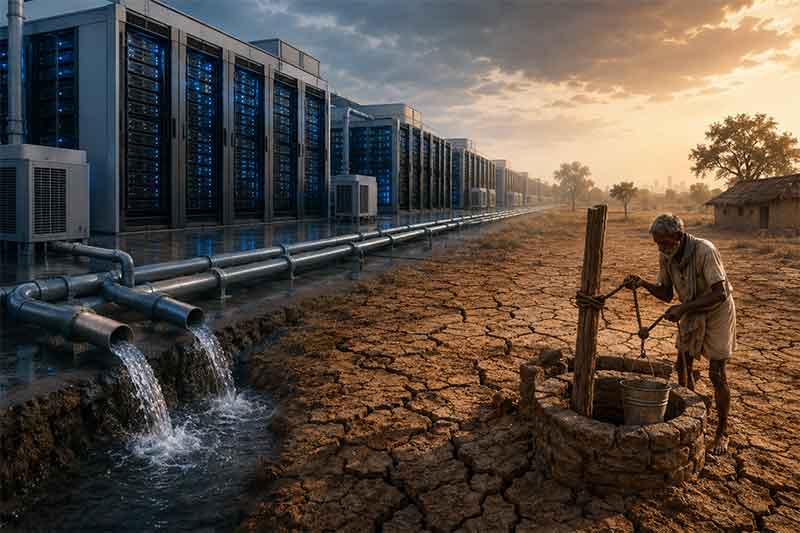
India’s rapid expansion of AI and data centres is raising concerns about environmental justice, resource use, and the impact on vulnerable communities. In this article, Dr Gopabandhu Dash examines the growing ecological footprint of data infrastructure, including its demands on water, electricity, land, and its contribution to carbon emissions. Drawing on studies, public interventions, and…
-
The restoration of farms and farmers: Reflections on the pig reform in Denmark
Denmark’s new agricultural reforms are prompting a broader debate about the future of farming in Europe. In this essay, Gunnar Rundgren examines efforts to curb industrial pig production, strengthen environmental protections and support smaller-scale farming. He argues that decades of consolidation and market-driven agriculture have weakened rural communities, eroded public support for farming and disconnected…
-
Managing energy descent means using less, not just building more: An interview with Richard Heinberg
A hypothetical solar or nuclear future, at current energy usage rates, would require more minerals or uranium than can realistically be extracted. Recycling would help, but there are also limits to recycling. In the end, the main solution to our energy and climate problems must be to find a way to use less,